
Your needs, this model
Does it fit your priorities?
Does a fixed 1,024 Wh station with 1,800 W of 120 V AC cover your ordinary loads?
This standalone option is rated 1,800 W continuous AC at 120 V with 1,024 Wh nameplate storage. Its 2,000 W figure is combined AC/DC output, and Power Lifting does not raise actual output above 1,800 W.
Explore this need in the finder →Do you need up to 1,000 W of compatible solar input and high-power USB-C, while supplying your own panel?
The station’s single solar input is limited to 1,000 W, 12–60 V and 20 A. The standalone package includes a solar charging cable but no panel. USB-C ports are rated 140 W and 100 W.
Explore this need in the finder →Can you lift 25.3 lb, and is a verified expansion battery essential?
The station is listed at 25.3 lb. The standalone sources reviewed do not establish a compatible battery expansion route, so this model should not satisfy an essential expansion requirement.
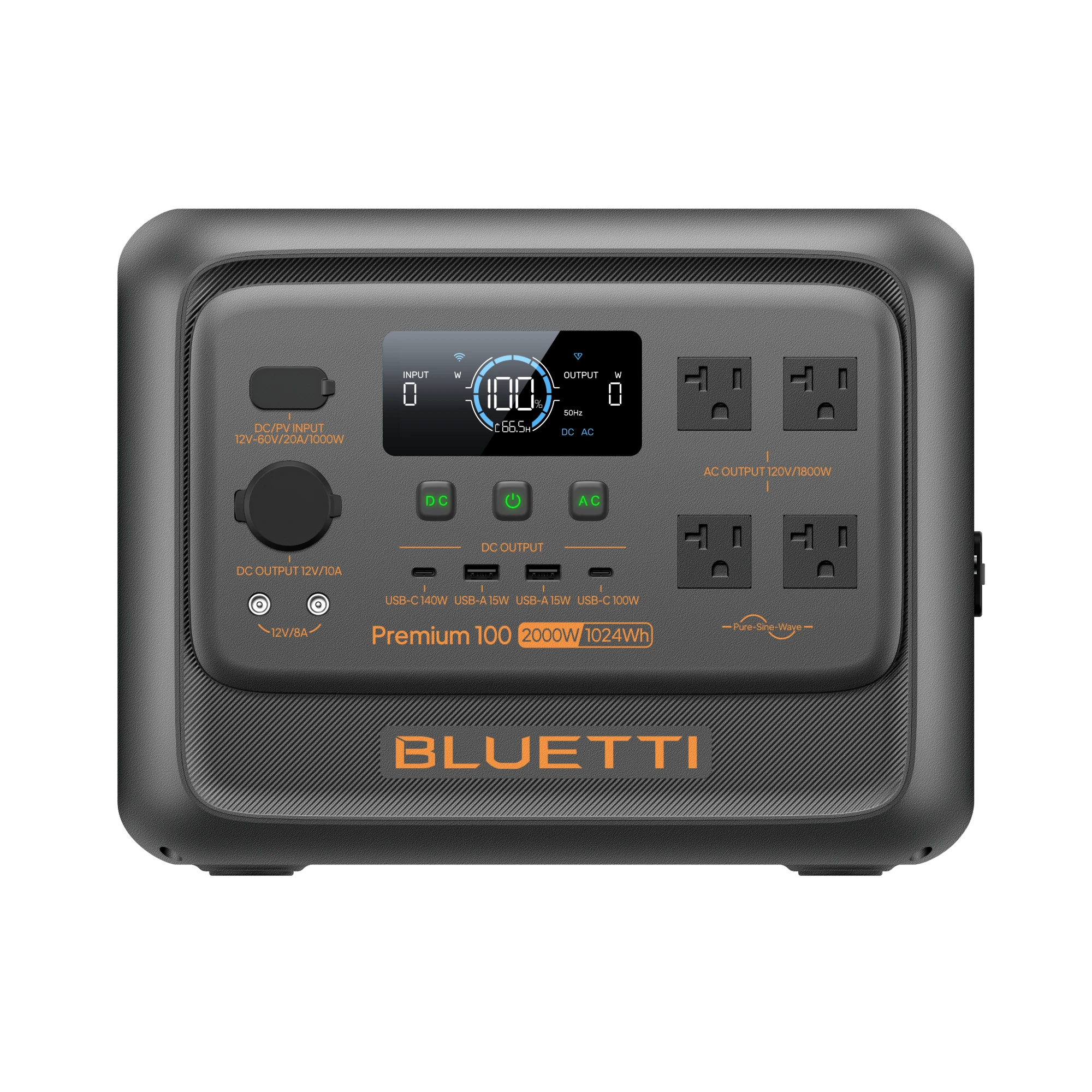
Explore this need in the finder →The BLUETTI Premium 100 V2 standalone (U.S. SKU PR100V2-US-GY-ID-SPFUS-00) stores 1,024 Wh in a LiFePO₄ battery and is rated for 1,800 W of 120 V AC. It weighs about 25.3 lb and accepts up to 1,000 W of solar input within a 12–60 V, 20 A limit. That combination suits a one-kilowatt-hour outage or travel plan where you can handle a 25-pound box and the appliance load stays below the station’s actual AC rating.
Read “2,000 W” as a combined ceiling, not a 2,000 W inverter
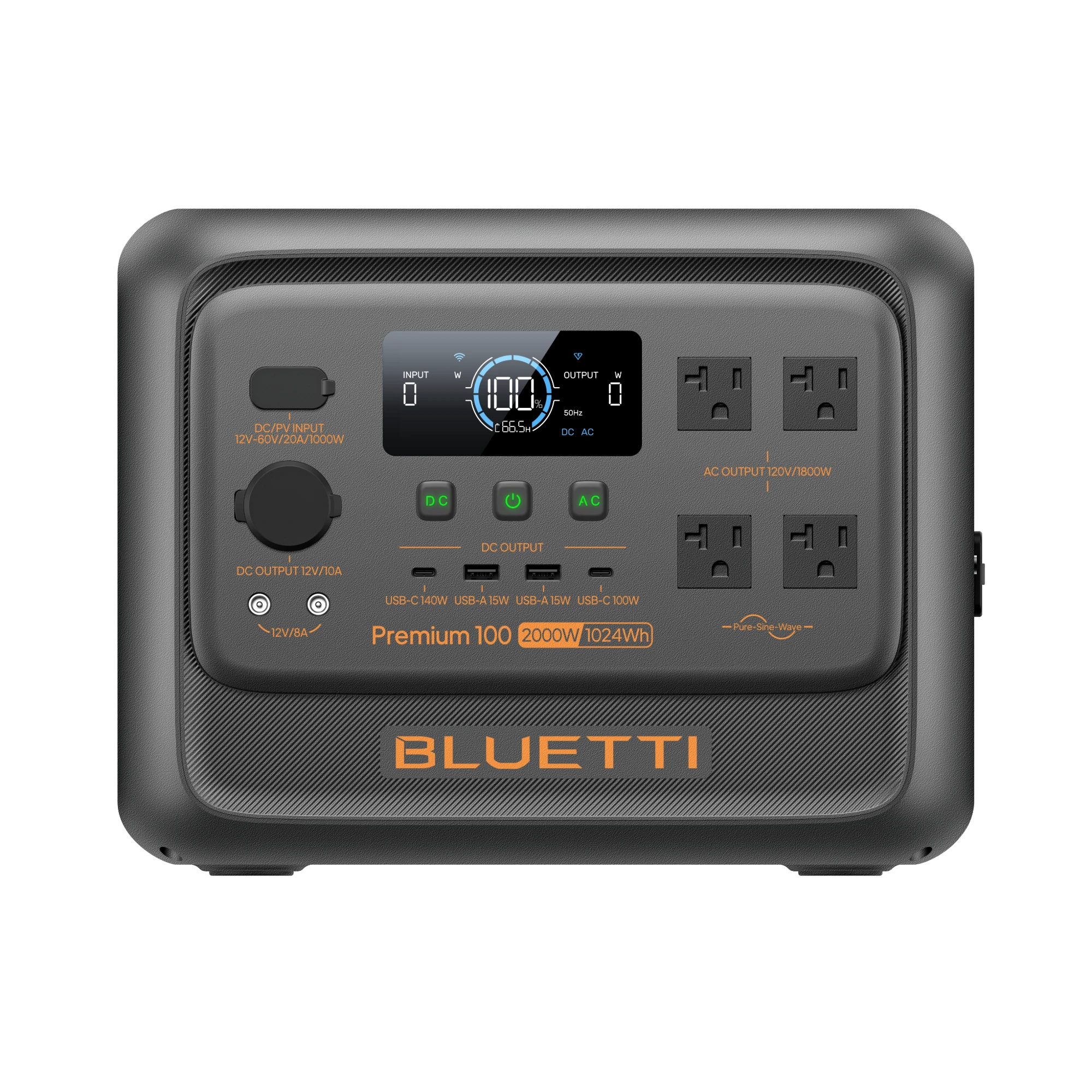
The product option and the front-panel rendering carry a 2,000 W label. The exact English manual separates the ratings: 1,800 W maximum AC output at 120 V, and 2,000 W maximum for AC and DC output combined. Its Power Lifting mode can run certain pure-resistive loads rated from 1,800 W to 2,700 W, but BLUETTI says actual output remains 1,800 W. Add simultaneous appliance loads and startup behavior before choosing a station. A 2,000 W title does not make this a 2,000 W continuous AC unit.
One-kilowatt-hour storage helps, but it is not delivered AC energy
The 1,024 Wh value is battery nameplate capacity, not a promise that an AC appliance receives 1,024 Wh. Estimate from the wattage and duty cycle of the devices you actually intend to run, and leave margin for conversion losses and reserve. If your outage plan needs a second battery, do not count on one: the Premium 100 V2 standalone materials reviewed here do not establish an expansion battery or a maximum expanded capacity.
Useful direct charging, with shared 12 V limits
The manual lists one 12 V/10 A car-style outlet, two DC5521 outputs at up to 5 A each, two USB-A ports at up to 15 W each, and USB-C ports rated at 140 W and 100 W. The DC5521 pair is capped at 8 A total, and the car and barrel outlets are wired in parallel with a 10 A maximum across that group. Those values are not three independent 12 V sources that can be added together. The two USB-C maxima likewise describe individual ports; simultaneous output depends on the station’s overall AC/DC limit and connected devices.
There is a count inconsistency worth checking if plug layout matters: BLUETTI’s specification table says two AC outlets and nine total outlets, while the manual’s U.S. overview drawing shows four receptacle faces. The exact model identity is clear, but I would not choose it for a particular number of wall plugs until the supplied U.S. unit’s front panel is confirmed.
Solar is a capable input, not an included panel
The DC/PV input accepts up to 1,000 W, 12–60 V and 20 A. The manual describes parallel solar connection sets and says the paired sets should use the same panel type and rating; a connected array still has to remain inside the station’s voltage and current window. The standalone offer’s box list includes the station solar charging cable, but not a panel. BLUETTI separately lists two exact U.S. solar-kit options on the same product page: variant 49161674326235 / SKU PR100V2-2-04-SPFUS-00 is titled “Premium 100 V2+200W Solar” and variant 49161674359003 / SKU PR100V2-2-03-SPFUS-00 is titled “Premium 100 V2+350W Solar.” Those titles identify distinct packages and their advertised panel classes, not a different battery or inverter. The station FAQ allows BLUETTI 100 W, 200 W and 350 W panel classes within its 12–60 V total open-circuit voltage, 1,000 W and MC4 limits. However, the selected-option data reuses the station-only image; it does not name either shipped panel’s model, count, electrical specifications or kit-specific box contents. I therefore keep both exact package variants visible in this review but do not turn them into separate panel-system matches. Do not transfer a PV200, PV200D, SP200L or PV350 component’s detailed ratings, weight or cable path to either kit. If an exact panel model, panel count, station-side lead or cold-weather array calculation is essential, confirm the shipped component before relying on it.
For wall charging, the manual lists a 600 W Standard mode and up to 1,200 W Turbo mode, with Silent mode also listed at 600 W. It separately gives 1,800 W for AC input while charging and passing power through, and up to 1,200 W for combined AC-and-solar charging. These figures describe different modes. Its “80% in 45 minutes” estimate is stated for 1,200 W at 25°C; that is a manufacturer estimate, not a charge test here. Vehicle charging is supported through the DC input, but the reviewed manual does not establish a maximum vehicle-input wattage.
UPS claims need the same caution as the wattage labels
The English manual specifies switchover within 10 ms and warns against using the unit with data servers or workstations that need a high-performance UPS. BLUETTI’s product-page promotional paragraph also says 15 ms, despite its headline and technical table saying 10 ms or less. Treat the manual’s figure as a published specification, not an independent transfer test or a medical-device continuity guarantee. Check low-load ECO behavior and the connected equipment maker’s requirements; a brief interruption can still matter to sensitive electronics.
Who should compare the similarly sized Elite 100 V2?
On the evidence available, the Premium 100 V2 and BLUETTI Elite 100 V2 have the same core published plan: 1,024 Wh, 1,800 W at 120 V, 1,000 W maximum solar input, a 25.3 lb listed weight and 140 W/100 W USB-C ports. This Premium model does not show a verified capacity or continuous-output advantage over its closely sized sibling. The retail names and SKUs differ, so compare the exact item, included lead, warranty terms and matching manual rather than assuming those details transfer between versions.
The Premium 200 V2 is a more meaningful size step: its reviewed U.S. standalone plan has 2,073.6 Wh and 2,700 W rated 120 V output, but weighs 53.35 lb. It is a heavier move for a higher load ceiling and roughly doubled nameplate storage. Conversely, if your essential loads are only phones, lights and USB-C devices, a smaller direct-DC station can be easier to carry and avoids using an AC inverter for every device. The Premium 100 V2 is a fit when the 1,024 Wh/1,800 W balance works as-is—not when 2,000 W of continuous AC, 240 V, a guaranteed panel kit or battery growth is essential.
Sources: BLUETTI’s U.S. Premium 100 V2 product option and the English Premium 100 V2 manual listed in the FCC filing. Check the model name on the manual cover before setup; the product-page download link observed for this offer led to a Premium 200 V2 PDF.
Key details at a glance
| Nameplate battery capacity | 1024 Wh |
|---|---|
| Rated AC output | 1800 W |
| Maximum solar input | 1000 W |
| Included panels, combined nameplate | 0 W |
| Maximum USB-C output per port | 140 W |
| Listed weight | 25.3 lb |
| 12 V DC output | 120 W |
| Maximum AC recharge input | 1200 W |
| Manufacturer UPS transfer figure | 10 ms |
| AC outlet output | Yes |
| USB-C ports | 2 |
| USB-A ports | 2 |
| Solar input ports | 1 |
| 12 V car-style output | 120 W |
| Battery chemistry | LiFePO4 |
| Expansion battery in this package | No |
| Separate station units in offer | 1 |
Use the exact model’s instructions for operating limits, supplied equipment and version differences.
Sources for this assessment
- BLUETTI U.S. Premium 100 V2 selected standalone product option
- FCC ID record, User Manua1, document 8631767
- Premium 100 V2 User Manual V1.0, English U.S. text, FCC exhibit Manual1
- Premium 100 V2 Manual V1.0, French companion FCC exhibit Manual2
- BLUETTI exact product-page Premium 100 V2 rendering
- BLUETTI U.S. Premium 100 V2 exact options page (current source snapshot)
A useful match starts with the loads that matter.
Use the finder for hard electrical requirements, then check appliance starting behavior, actual run time and the exact package in the full assessment.