
Your needs, this model
Does it fit your priorities?
Do you need more than 2,600 W of rated 120 V AC from a 2,073.6 Wh station?
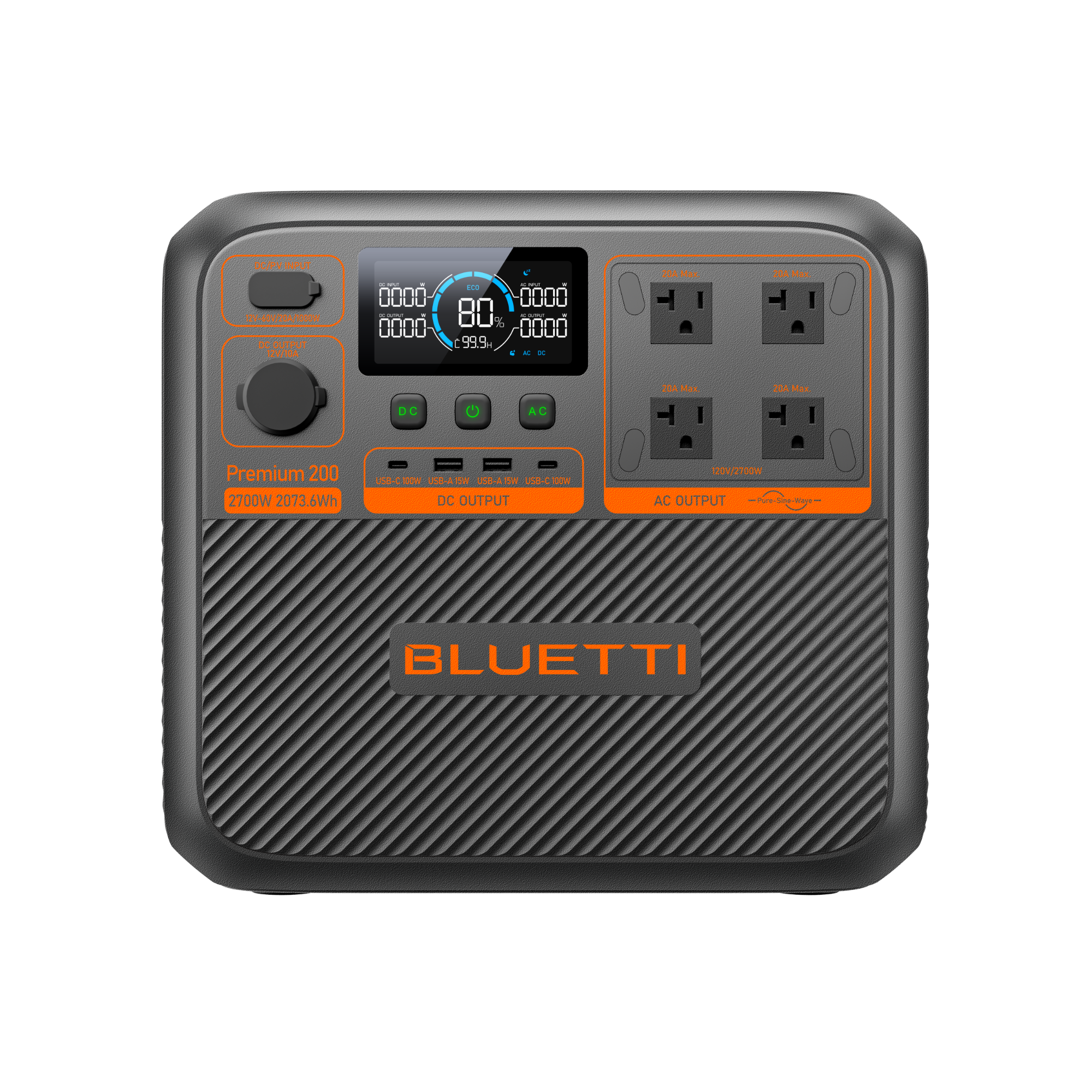
The exact Premium 200 V2 standalone plan is rated for 2,700 W total at 120 V and 2,073.6 Wh nameplate capacity. It is distinct from the same-capacity Elite 200 V2, which BLUETTI lists at 2,600 W. The Premium's Power Lifting feature does not raise its rated continuous output.
Explore this need in the finder →Do you already have a compatible solar panel and lead, but need at least a 1,000 W station input and two 100 W USB-C ports?
The station input is rated 1,000 W maximum at 12–60 V and 20 A, and it has two 100 W USB-C ports. The standalone package includes neither a panel nor the optional MC4-to-XT60 solar charging cable; confirm the array and connection path separately.
Explore this need in the finder →Can you handle a 53.35 lb station that fits beneath a 53.4 lb ceiling, without an expansion requirement?
The exact station weighs 53.35 lb and BLUETTI says the Premium 200 V2 is not expandable. The 53.4 lb finder ceiling accommodates its listed mass; a required expansion battery rules it out.
Explore this need in the finder →The BLUETTI Premium 200 V2 is a distinct U.S. station, not a relabeling of the Elite 200 V2: the two share a 2,073.6 Wh nameplate battery, but BLUETTI rates this Premium version at 2,700 W of 120 V AC rather than the Elite's 2,600 W. That extra 100 W matters only when a real load sits near the lower model's limit. This assessment is for the standalone U.S. SKU PR200V2-US-GY-BL-SPFUS-00; the Premium 200 V2 + 200 W Solar and +350 W Solar selector options are separate packages, not included here.
Read the output as one shared 120 V limit
The product page lists four 120 V/20 A outlets, but states that 2,700 W is the total AC output. Do not treat that as 2,700 W available at each receptacle, and do not plan a 240 V appliance or split-phase home connection around this single station. The useful question is whether the simultaneous load and any startup demand fit within the actual 2,700 W rating. BLUETTI warns that some motors and compressors can draw several times their ordinary running wattage at startup; the nameplate alone will not settle that compatibility question.
The page advertises Power Lifting at 3,900 W; the English U.S. manual says the mode can support pure resistive loads up to 4,050 W, while also stating that actual output remains capped at 2,700 W. Those source claims differ, and neither turns this into a 3,900- or 4,050-W general-purpose inverter. For an essential load above 2,700 W, treat this station as insufficient unless the appliance maker and BLUETTI document a compatible operating plan.
Two kilowatt-hours is useful, but fixed
The manual identifies a 2,073.6 Wh LiFePO4 battery. That figure is the battery's nameplate capacity, not a promise of AC energy delivered to an appliance or a runtime estimate. Conversion losses, reserve settings, temperature and the shape of the load all matter, so plan from your own watt-hours and retain margin instead of converting capacity into a guaranteed number of hours. BLUETTI says the Premium 200 V2 is not expandable and does not support power-bank mode. If a future second battery is part of the requirement, this is the wrong platform, even if its inverter is large enough today.
At 53.35 lb and 13.78 × 9.84 × 12.74 in, it is a substantial case to move repeatedly. It suits a mostly fixed backup location, car-camping setup with careful handling, or a cart-assisted move better than a plan that expects frequent solo lifting. Its single 12 V/10 A car-style output is 120 W; the manual lists car charging at up to 96 W from a 12 V vehicle socket or 192 W from a 24 V socket. Vehicle input is a slower replenishment route, not a substitute for the station's AC or solar path.
Solar-ready does not mean panel-ready in this SKU
The station's one solar/DC input is rated at up to 1,000 W, 12–60 V and 20 A. The standalone product option does not include a solar panel, and the manual lists the MC4-to-XT60 solar charging cable among optional accessories. Confirm the panel's open-circuit voltage, current, connector and the exact lead before connecting anything. The manual's dual-solar instructions require matching panel sets and parallel connection of the two MC4 connector sets; do not improvise a series arrangement from a wattage total alone. The separate solar bundle listings need their own box and cable evidence.
Charging claims also need a careful read. The current U.S. product specification lists 2,300 W maximum AC input, while its headline says 2,400 W AC input. The manual instead lists 1,440 W in Standard mode, up to 1,800 W AC charging in Turbo mode, and 2,400 W maximum for combined AC plus DC input. These are not interchangeable ratings. The exact AC-only maximum is unresolved across the published materials, so do not select this station on the assumption that a particular wall-charge time is guaranteed. Ask BLUETTI to confirm the applicable mode and limit for the unit being sold.
Backup use has limits beyond the 15 ms claim
BLUETTI claims UPS transfer within 15 ms, but the manual explicitly says not to use it for data servers or workstations requiring a high-performance UPS. Transfer time alone does not establish that a specific computer, network device, medical device or other critical load will ride through a changeover. Follow the equipment maker's power requirements and keep a separate, suitable backup for any load where interruption is consequential. The manufacturer also says the unit is not waterproof and should be used and stored in a dry place. Charging is specified from 0 to 40 °C; discharge from −20 to 40 °C.
Who should choose it?
Choose the Premium 200 V2 if you need a single 120 V station with a little more rated AC headroom than the same-capacity Elite 200 V2, two USB-C ports rated up to 100 W each, and you can accept a heavy, non-expandable battery. The Elite 200 V2 remains a relevant comparison if 2,600 W is enough; the energy capacity is the same, so the Premium's higher headline output does not add stored energy. If expansion or higher total energy is essential, compare an independently reviewed expandable platform such as EcoFlow DELTA Pro 3 and check that model's exact battery, connector and system configuration rather than assuming accessories are interchangeable. For 240 V equipment, this 120 V-only plan is not a substitute for a documented 120/240 V system.
These conclusions use the BLUETTI U.S. product page and its linked Premium 200 V2 U.S. manual. No sample was tested and no runtime, performance measurement or price is claimed here.
Key details at a glance
| Nameplate battery capacity | 2073.6 Wh |
|---|---|
| Rated AC output | 2700 W |
| Maximum solar input | 1000 W |
| Included panels, combined nameplate | 0 W |
| Maximum USB-C output per port | 100 W |
| Listed weight | 53.35 lb |
| Compatible extra-battery expansion | No |
| 12 V DC output | 120 W |
| Manufacturer UPS transfer figure | 15 ms |
| AC outlet output | Yes |
| USB-C ports | 2 |
| USB-A ports | 2 |
| Solar input ports | 1 |
| 12 V car-style output | 120 W |
| Vehicle charge input | 192 W |
| Battery chemistry | LiFePO4 |
| Expansion battery in this package | No |
| Separate station units in offer | 1 |
Use the exact model’s instructions for operating limits, supplied equipment and version differences.
Sources for this assessment
A useful match starts with the loads that matter.
Use the finder for hard electrical requirements, then check appliance starting behavior, actual run time and the exact package in the full assessment.