
Your needs, this model
Does it fit your priorities?
Is the exact 1000 option sufficient for your voltage, capacity and continuous output?
The family page identifies EFDELTA1000-AM as the DELTA (1000); its manual row is 1,008 Wh and 1,600 W. The similarly named 1300 is a different capacity/output configuration.
Explore this need in the finder →Do you need a modest solar ceiling and the 12 V vehicle-style output?
The 1000 manual lists a 400 W solar input and a 108.8 W 12 V outlet. The solar cable and panel are sold separately for the new standalone model.
Explore this need in the finder →Is the 30 ms EPS interval acceptable to the backed-up load?
The manual gives approximately 30 ms and specifically warns against devices requiring zero-millisecond transfer. Use the load maker’s tolerance rather than assuming compatibility.
Explore this need in the finder →A smaller rating set than the DELTA (1300)
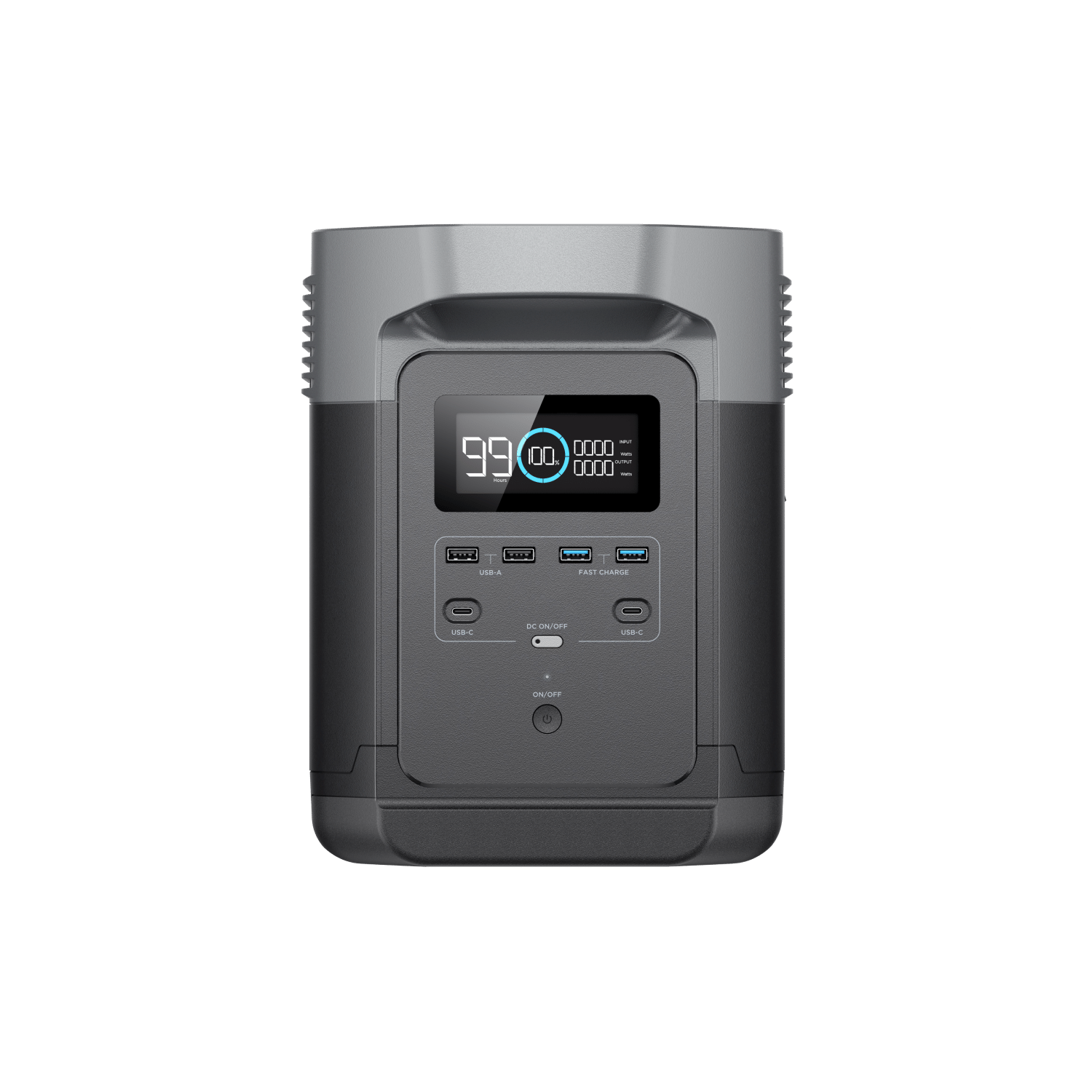
The EcoFlow DELTA family listing presents separate U.S. options named “DELTA (1000)” and “DELTA (1300).” The 1000 selection is tied to SKU EFDELTA1000-AM on the manufacturer page. Its manual entry gives 1,008 Wh nameplate capacity, 1,600 W rated AC output and 3,100 W surge; the other sibling is 1,260 Wh and 1,800 W. The “1000” label is not a guarantee of exactly 1,000 Wh, and the 1300’s higher ratings should not be carried over to this configuration.
This is a U.S. 120 V AC station with six AC outlets. Its 3,100 W surge number does not raise its continuous 1,600 W rating, and an appliance may need more during startup than it draws once running. A 1,008 Wh battery is nameplate capacity, not an amount of AC energy guaranteed at the outlets. The manufacturer material reviewed does not provide an AC-delivered-energy value at a stated load, so a precise hours-of-runtime estimate would be speculative. Make a load list and include appliance cycling, power factor, startup and reserve; verify essential devices on the actual setup rather than trusting a broad runtime graphic.
Solar and AC input are modest, clearly bounded routes
The manual lists up to 400 W from one solar input, within a 10–65 V and 10 A input range. Those limits apply together: the sum of panel labels alone cannot confirm that the string is suitable. The solar panel and station-side solar charging cable are separate purchases according to the manual. The listed new-package contents include the station, DELTA bag, AC charging cable and car charging cable, but not a solar panel. Do not pick “panel included” or “charging cable included” when shopping for this standalone offer.
Maximum AC charging input is 1,000 W, below the 1300’s 1,200 W figure. Its two USB-C ports are rated at up to 60 W apiece; USB-A is split into two 12 W ports and two 18 W fast ports. For a notebook that needs more than 60 W over USB-C, this is not a one-cable charging solution. The 12 V vehicle-style output is rated at 108.8 W, and a 12/24 V vehicle charging input is listed at 8 A. Confirm the accessory’s connector, polarity and permitted draw rather than treating “car outlet” as a universal match.
Cycle life and switching are not modern-UPS guarantees
EcoFlow identifies the battery chemistry as NCM and states 500 cycles to 80% capacity for the DELTA (1000), under its own test convention. That is a different claim from the 1300’s 800 cycles, and neither figure establishes remaining capacity in any used or refurbished example. No manufacturer-supported expansion plan was confirmed in the archived sources, so do not buy on the assumption that an extra battery can be added later.
The manual gives an approximately 30 ms EPS transfer figure and warns against equipment needing a 0 ms transfer. This can exclude sensitive devices even though the station has AC outlets. Consult the device maker’s power-interruption tolerance; do not assume a UPS number guarantees a given computer, network appliance or medical device will ride through the changeover. The manual explicitly advises against use for life-sustaining medical equipment. This single station is not a 240 V split-phase source and must not be backfed into household wiring with a DIY cord. A home-circuit plan requires equipment selected and installed by a qualified professional.
Practical fit and its main compromise
At about 30.9 lb and roughly 15.7 × 8.3 × 10.6 inches, the old DELTA chassis is portable in the sense that one person can move it, but it is not a featherweight daypack battery. The handle and supplied carry bag may help with storage and transport; the weight still matters if the station must be carried far. Its 400 W solar ceiling is useful for moderate replenishment with a compatible array, but it leaves less charging headroom than products that accept substantially more solar input.
Choose the 1000 when the 1,008 Wh and 1,600 W limits comfortably cover your use and the exact listing is available from a source you trust. Choose the 1300 when you need its additional nameplate capacity and continuous output; choose a newer station if LFP, a faster published transfer figure or a confirmed expansion path is essential. For a current comparison, the DELTA 3 Classic is a newer 1,024 Wh LFP alternative with a 10 ms published UPS figure but no 12 V DC outlet; it is not simply a rebranded 1000. The manufacturer page snapshot used for this assessment showed the old standalone offers as sold out, despite generic preorder copy; this is a model assessment, not an availability promise. EcoFlow’s shared-family image is representative of the listed 1000 and 1300 exterior, not a tested sample. No runtime or electrical bench test was performed.
Confirm the offer, not only the family name
If a 12 V output, exactly 400 W solar, or a minimum capacity is essential, the 1000 can be matched against those requirements. If you need more than 1,600 W continuous AC output, 500 W of solar input, 240 V or fast transfer, it cannot be recommended for that requirement. The maker’s old DELTA page is a family listing with multiple model variants; match the EFDELTA1000-AM SKU and the selected “DELTA (1000)” option to the box before buying. Availability, warranty terms and today’s included accessories must be confirmed with the seller. No physical sample was examined.
Key details at a glance
| Nameplate battery capacity | 1008 Wh |
|---|---|
| Rated AC output | 1600 W |
| Manufacturer surge rating | 3100 W |
| Maximum solar input | 400 W |
| Maximum USB-C output per port | 60 W |
| Listed weight | 30.9 lb |
| 12 V DC output | 108.8 W |
| Maximum AC recharge input | 1000 W |
| Manufacturer UPS transfer figure | 30 ms |
| AC outlet output | Yes |
| USB-C ports | 2 |
| Solar input ports | 1 |
| Battery chemistry | NCM |
Use the exact model’s instructions for operating limits, supplied equipment and version differences.
Sources for this assessment
A useful match starts with the loads that matter.
Use the finder for hard electrical requirements, then check appliance starting behavior, actual run time and the exact package in the full assessment.