
Your needs, this model
Does it fit your priorities?
Do your essential 120 V loads need at least the 1300’s capacity and continuous output?
The U.S. DELTA (1300) option is 1,260 Wh and 1,800 W continuous. The DELTA (1000) is a distinct 1,008 Wh / 1,600 W variant; neither surge figure raises continuous output.
Explore this need in the finder →Will a separately sourced 400 W solar setup be enough?
The manual lists a 400 W maximum solar input with 10–65 V and 10 A limits. It says the solar cable is sold separately, and the standalone box list contains no panel.
Explore this need in the finder →Can your backup equipment tolerate the documented EPS changeover?
The manual gives an approximately 30 ms EPS changeover and warns against equipment that requires 0 ms. This is not a universal sensitive-device compatibility result.
Explore this need in the finder →The larger legacy DELTA is not the same station as the 1,000 option
EcoFlow’s U.S. store has a DELTA family page with separate “DELTA (1300)” and “DELTA (1000)” selections. The 1300 selection uses SKU EFDELTA1300-AM; the separate flash-sale product page repeats that exact SKU. EcoFlow’s English-US manual covers both configurations and lists 1,260 Wh for the 1300, versus 1,008 Wh for the 1000. This assessment is specifically about the 1300, not a generic DELTA listing and not the newer DELTA 3 family.
The 1300 is rated for 1,800 W of continuous AC output, with a separate 3,300 W surge figure. Those numbers answer different questions: the surge rating is not a sustained appliance allowance. The six AC receptacles are U.S. 120 V output; the documentation does not establish 240 V or split-phase operation from one station. A 1,260 Wh nameplate battery figure also does not promise that much usable AC energy. The sources reviewed do not publish delivered AC watt-hours for a stated load, so there is no responsible exact runtime prediction to offer. For outage planning, write down each load’s running draw, startup needs, duty cycle and hours, then leave reserve. If an essential appliance needs a verified runtime, test the actual appliance or require a published load-specific energy result before relying on this station.
Charging is a 400 W ceiling, not a panel kit
The manual lists one solar input with a 400 W maximum and a 10–65 V, 10 A input range. The voltage and current limits still govern panel wiring; adding panels by nameplate wattage alone is not enough to show that an array is compatible. The manual also says the solar charging cable is sold separately. It does not list a solar panel in the box. The standard new-station box list instead names the station, a DELTA bag, AC charging cable, car charging cable, and manual/warranty materials. A panel can make sense for a buyer willing to source a compatible panel and the correct lead separately, but this is not a ready-to-use solar bundle.
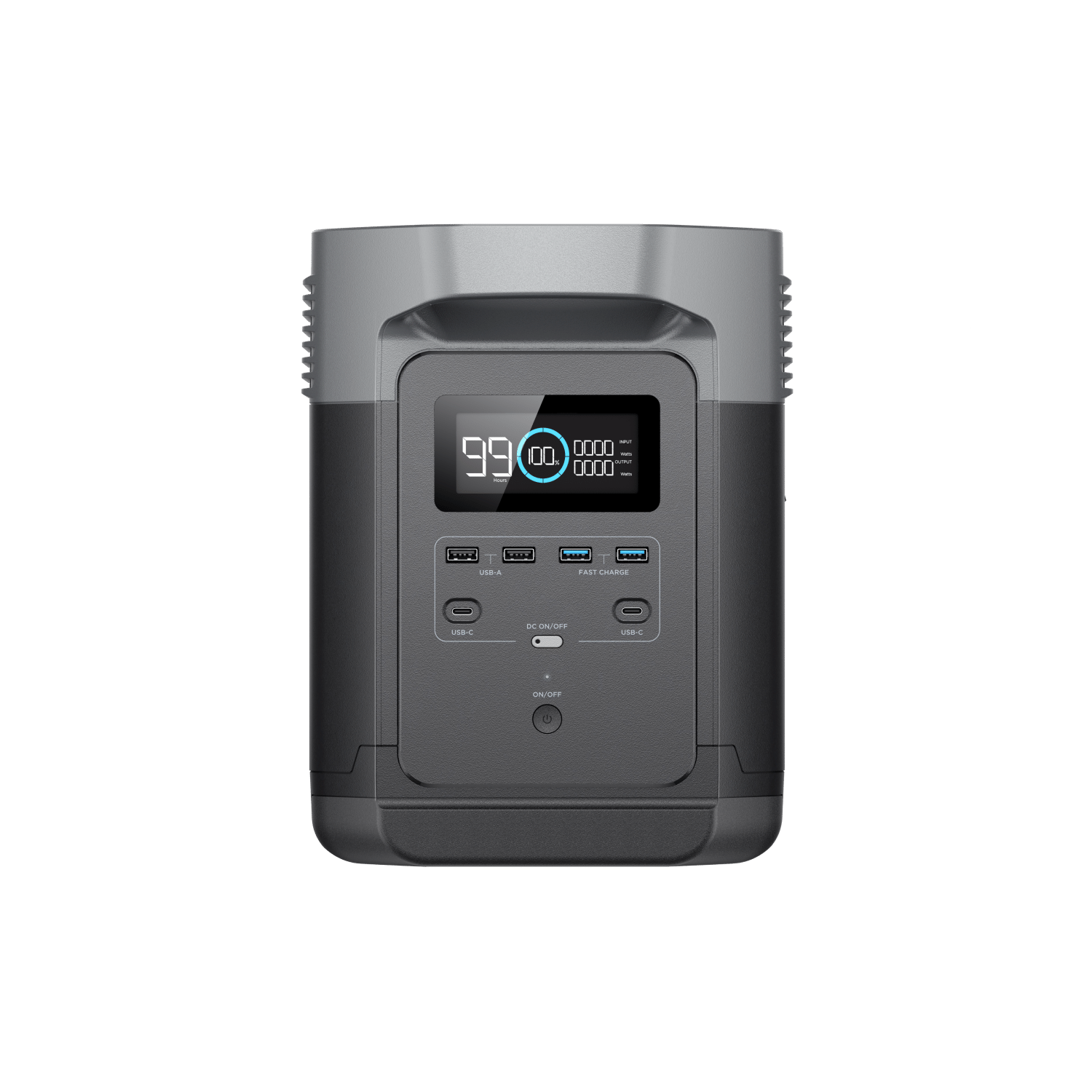
Maximum AC charging input is listed at 1,200 W. The car input is documented for 12 V or 24 V at 8 A; the station also has a 12 V car-style output rated 108.8 W. That direct-current outlet is useful for compatible vehicle accessories, but it does not make the unit a vehicle-starting battery or a substitute for checking the load’s connector and current needs. The front panel includes two USB-C outputs rated up to 60 W each, two regular USB-A ports rated up to 12 W each and two fast USB-A ports rated up to 18 W each. Those distinctions matter if your plan involves laptop charging rather than just small phones or lights.
Battery age and backup switching deserve a closer look
EcoFlow identifies the cells as NCM and claims 800 cycles before capacity reaches 80% under its stated cycle convention. Treat that as a manufacturer laboratory rating, not a promise about a particular unit’s history, calendar age or remaining capacity. This older model’s chemistry and cycle claim are materially different from newer LFP stations. A buyer prioritizing a newer chemistry may prefer a DELTA 3 model, while a buyer comparing old DELTA variants should keep the 1300’s higher nameplate capacity and 1,800 W output distinct from the 1000’s 1,008 Wh and 1,600 W.
The user manual gives an approximately 30 ms EPS transfer figure and cautions against equipment that requires 0 ms transfer. That is not evidence of universal computer, network or medical-device compatibility. Do not use this as a life-sustaining medical power source; follow the manual’s safety limits and test only noncritical equipment. It is also not a direct household panel connection: supplying house circuits requires correctly installed transfer equipment and qualified electrical advice, not an improvised cord into a wall outlet.
Storage guidance conflicts inside the manual
The manual has inconsistent long-storage advice: one passage describes discharging to 0% and charging to 60% every three months, while another directs storage nearer 30% before a 60% recharge. Those are not interchangeable instructions. Rather than selecting the more convenient sentence, check EcoFlow’s current guidance for this exact model before putting a long-term storage schedule into practice. Keep the vents clear, protect it from moisture and use the specified charging leads.
Who should shortlist this exact 1300
This configuration is worth comparing when you need a 120 V station with at least 1,200 Wh nameplate capacity, a 1,800 W continuous AC rating, a usable 12 V outlet and a modest 400 W solar-input ceiling, and you accept a roughly 31 lb legacy NCM unit with 30 ms EPS behavior. It is a poor fit if your essentials require 240 V, a supplied solar panel, 500 W or more of solar intake, 0–10 ms switching, or a confirmed extra-battery expansion path. Expansion support was not established in the reviewed product and manual sources, so the matcher does not treat unknown compatibility as a yes.
Choose the DELTA (1000) only if 1,008 Wh and 1,600 W are enough; its smaller ratings are not the same as the 1300’s. For a newer fixed-capacity alternative, compare the DELTA 3 Classic’s LFP chemistry and 10 ms published UPS figure, while noting its different ports and lower 1,024 Wh nameplate capacity. On the manufacturer snapshot archived for this review, the 1300 product page marked the listing sold out even as generic preorder language appeared elsewhere on the page. Availability is therefore not promised here. The image is EcoFlow’s shared DELTA-family illustration linked to both variants; it shows the exterior and port layout but does not prove a particular unit’s condition. No physical sample or runtime test was performed.
Key details at a glance
| Nameplate battery capacity | 1260 Wh |
|---|---|
| Rated AC output | 1800 W |
| Manufacturer surge rating | 3300 W |
| Maximum solar input | 400 W |
| Maximum USB-C output per port | 60 W |
| Listed weight | 30.9 lb |
| 12 V DC output | 108.8 W |
| Maximum AC recharge input | 1200 W |
| Manufacturer UPS transfer figure | 30 ms |
| AC outlet output | Yes |
| USB-C ports | 2 |
| Solar input ports | 1 |
| Battery chemistry | NCM |
Use the exact model’s instructions for operating limits, supplied equipment and version differences.
Sources for this assessment
A useful match starts with the loads that matter.
Use the finder for hard electrical requirements, then check appliance starting behavior, actual run time and the exact package in the full assessment.