
Your needs, this model
Does it fit your priorities?
Do you need a station plan with at least 2,048 Wh of nameplate storage and 2,400 W of 120 V AC output?
The EFD350 plan is 120 V, 2,400 W rated and 2,048 Wh before expansion. Surge and X-Boost figures are not continuous-output substitutes.
Explore this need in the finder →Would two compatible DELTA 2 Max Smart Extra Batteries help you reach 6,144 Wh of nameplate capacity?
EcoFlow documents up to two compatible 2,048 Wh expansion packs, for 4,096 Wh with one or 6,144 Wh with two. The station output remains 2,400 W; battery packs are separate products.
Explore this need in the finder →Are two solar inputs totaling up to 1,000 W and a 126 W shared 12 V section enough?
The manual rates each PV input at up to 500 W, within 11–60 V and 15 A; DC5521 ports share 126 W maximum with the car-style outlet. Array wiring and 12 V loads must fit these limits.
Explore this need in the finder →Who the DELTA 2 Max suits
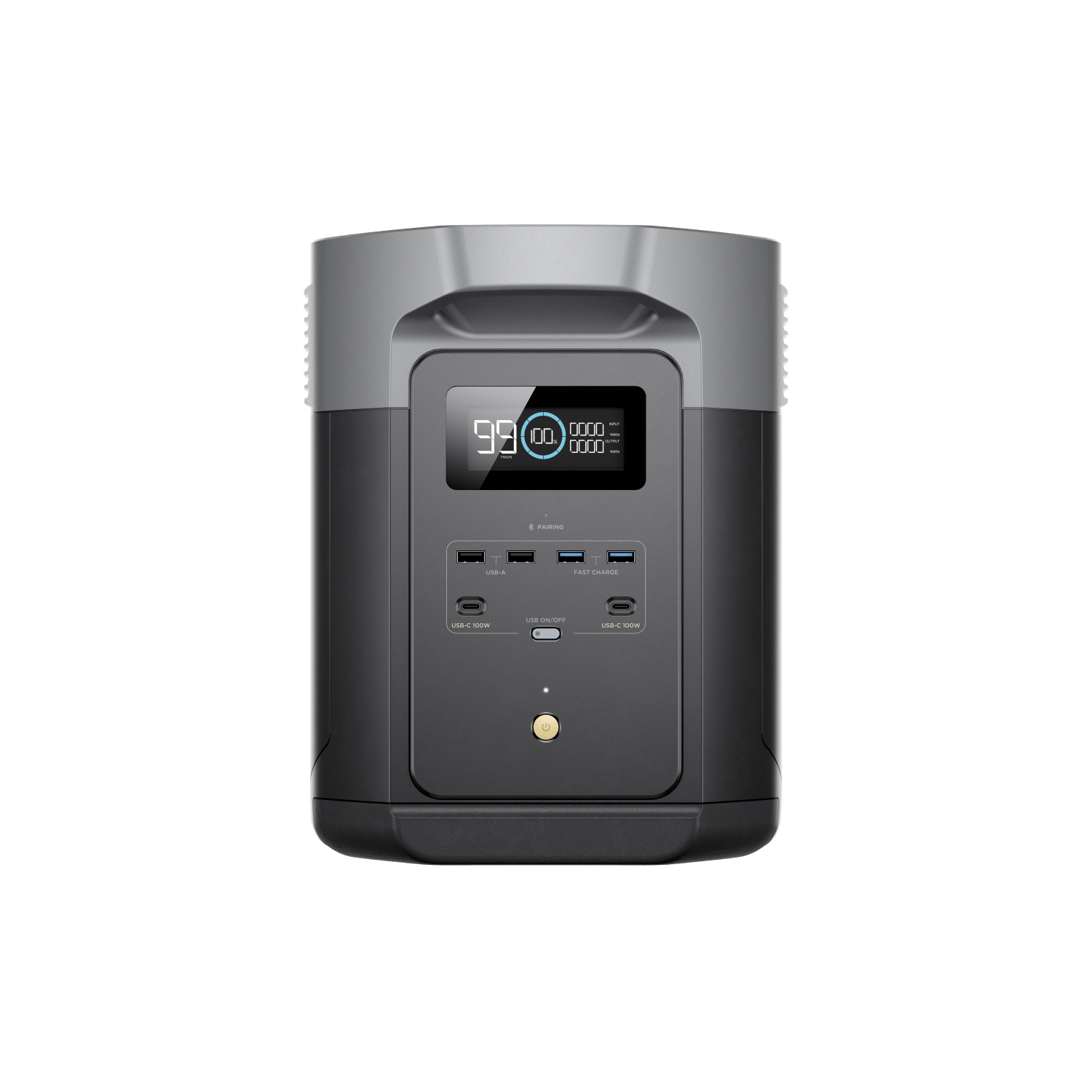
The EcoFlow DELTA 2 Max is a 2,048 Wh, 120 V station with two independent solar inputs and a 2,400 W inverter. Its current US standalone SKU is EFDELTA2Max-US; the matching manual identifies hardware model EFD350. It suits a planned 120 V appliance list and a recharge setup using wall AC, compatible solar, vehicle or generator power.
All six AC sockets share 2,400 W continuous output. Its 4,800 W surge rating is brief starting headroom, not another continuous rating. Add the running watts for simultaneous loads and check motor starts; extra batteries will not raise the inverter ceiling.
Six AC sockets, one 120 V supply
EcoFlow lists X-Boost up to 3,400 W, but its manual warns that this mode is not suitable for every appliance, particularly equipment with strict voltage requirements. Plan around 2,400 W. One DELTA 2 Max does not provide 240 V; for a 240 V range or well pump, compare a station with a documented split-phase plan such as the DELTA Pro 3.
Capacity can grow, but output does not
The base LFP battery is 2,048 Wh. Up to two DELTA 2 Max Smart Extra Batteries add 2,048 Wh each, yielding 2,048 Wh alone, 4,096 Wh with one pack, or 6,144 Wh with two. The packs are sold separately and add weight, floor space and cost, not inverter output: every plan remains 2,400 W at 120 V.
Nameplate capacity is not guaranteed AC energy. Conversion losses, appliance cycling and load size all affect runtime. Build an outage list around the actual refrigerator, network gear and lights, and leave reserve; app estimates are not a promise of load-specific runtime.
Two solar inputs give useful flexibility
Each solar port accepts up to 500 W at 11–60 V and 15 A; the dual-port ceiling is 1,000 W. Two arrays can help with separate orientations, but each still has to meet its port’s voltage and current limits. Panel watt labels alone cannot establish safe wiring. Shade, season and angle also make 1,000 W an input ceiling, not a daily-energy promise.
EcoFlow advertises rapid combined AC-and-solar charging for a specific input arrangement. Actual time depends on the wall circuit, charge settings and sunlight. The AC charging input is 100–120 V, up to 1,800 W; this charging capability does not provide 240 V output.
Connections and the small-print limits
There are two 100 W USB-C ports, two 12 W USB-A and two fast-charge USB-A ports rated at 18 W each. The 12 V section has a 126 W car socket and two DC5521 ports rated up to 38 W each; the manual says the car socket shares a 126 W maximum with the DC5521 outputs. There is no Anderson port, a meaningful limitation for some RV setups.
The manual specifies EPS transfer within 30 ms, not zero-millisecond switching; it is not a tested UPS guarantee. Check compatibility for sensitive equipment. Charging is specified from 0–45°C and discharge from −10–45°C. EcoFlow’s 3,000-cycle-to-80% figure is a manufacturer specification, not an independent lifetime test.
Packages and alternatives
The US options include standalone, extra-battery, solar-panel and 800 W alternator-charger packages, plus a bag and a DELTA 2 Max/WAVE 3 combination. They retain the same EFD350 station; the WAVE 3 is a separate appliance, and no bundle raises the inverter rating. The series page also lists a refurbished offer and foldable hand truck. Neither changes the station’s electrical identity; the truck and bag are not in the standalone box. Check exact package contents and panel wiring.
The DELTA 3 Max is another 2,048 Wh / 2,400 W 120 V option; compare its ports, solar ceiling, weight and documented battery support. The DELTA 3 Max Plus keeps the 2,048 Wh capacity but has higher rated output and solar input. For a single station with 240 V or 4,000 W output, the larger DELTA Pro 3 is a different class. Choose the DELTA 2 Max if 120 V, 2,400 W and up to 6,144 Wh storage fit your load list.
This assessment uses EcoFlow’s US product listing, its EFD350 user manual and the DELTA 2 Max Smart Extra Battery listing. No independent runtime, output, noise or transfer-time testing was performed.
Key details at a glance
| Nameplate battery capacity | 2048 Wh |
|---|---|
| Rated AC output | 2400 W |
| Manufacturer surge rating | 4800 W |
| Maximum solar input | 1000 W |
| Maximum USB-C output per port | 100 W |
| Listed weight | 50 lb |
| Compatible extra-battery expansion | Yes |
| 12 V DC output | 126 W |
| Maximum AC recharge input | 1800 W |
| X-Boost figure (not rated output) | 3400 W |
| Base warranty term | 5 years |
| USB-C ports | 2 |
| USB-A ports | 4 |
| Solar input ports | 2 |
| Battery chemistry | LFP |
Use the exact model’s instructions for operating limits, supplied equipment and version differences.
Sources for this assessment
A useful match starts with the loads that matter.
Use the finder for hard electrical requirements, then check appliance starting behavior, actual run time and the exact package in the full assessment.