
Your needs, this model
Does it fit your priorities?
Does your plan need 3,000 W rated US 120 V output from a 2,048 Wh station?
The Max Plus is listed for 3,000 W continuous 120 V output and 6,000 W surge. Its larger inverter rating does not add stored energy; confirm both the appliance's running draw and startup behavior.
Explore this need in the finder →Do you need a 1,000 W maximum solar input and up to 140 W from one USB-C port?
EcoFlow lists a 1,000 W solar ceiling through dual inputs and a 140 W USB-C port. The solar ceiling requires a compliant array, and the USB-C figure depends on device and cable negotiation.
Explore this need in the finder →Are compatible battery expansion and app-based Smart Output Priority both essential?
The station is compatible with the separately sold EF-DL3-MP-EB extra battery, and EcoFlow presents Smart Output Priority as a Max Plus feature. Expansion kit capacity, adapters and included pieces must match the exact selected configuration.
Explore this need in the finder →The Max Plus is the higher-output 2 kWh option
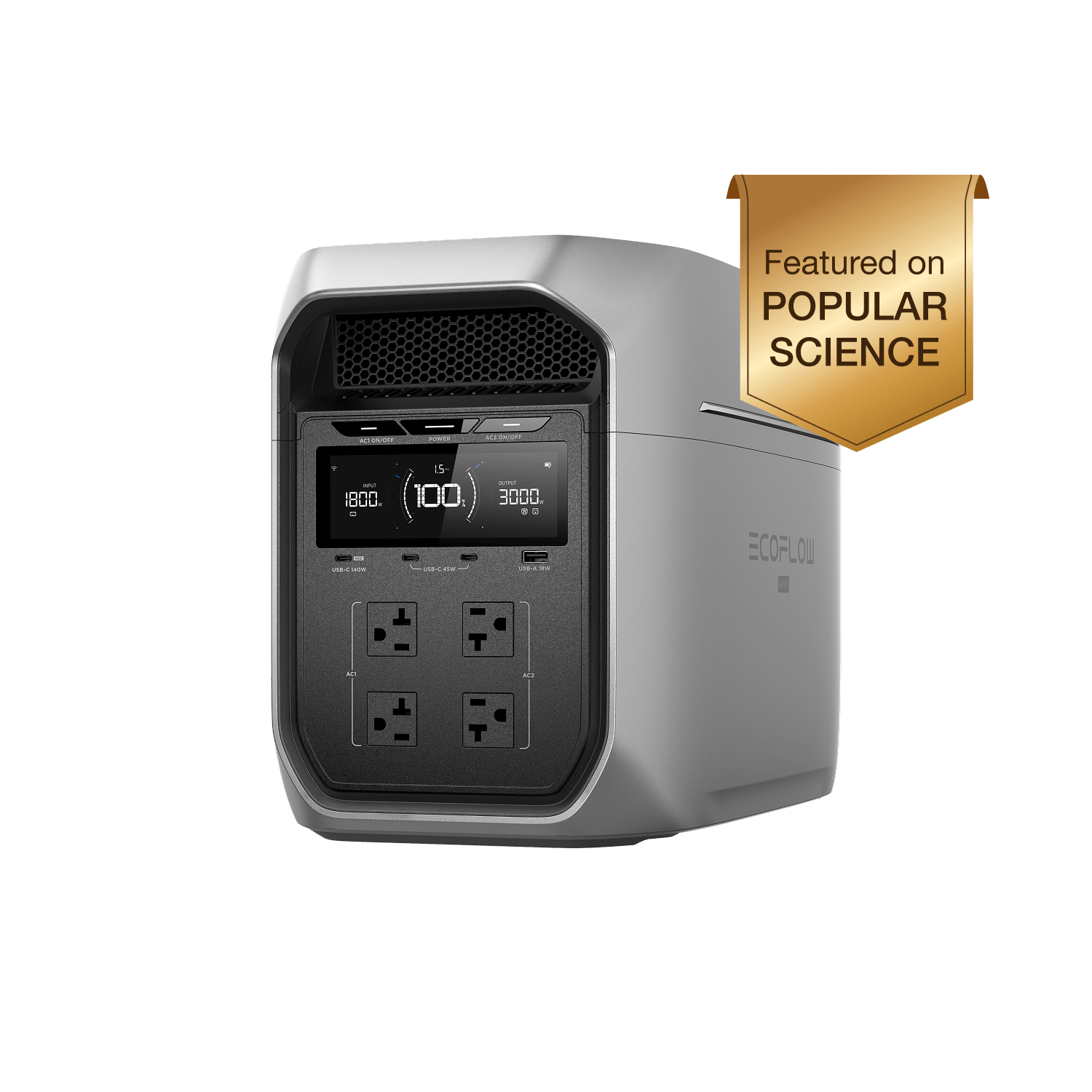
The DELTA 3 Max Plus retains the Max’s 2,048 Wh LFP battery but raises US rated AC output to 3,000 W, with a 6,000 W manufacturer surge rating. EcoFlow’s English-US manual identifies model EF-DL3-MP; the standalone SKU is EFD3MP-US. This is distinct from the regular DELTA 3 Max (EF-DL-H02-3M), the older DELTA Max 2000 and accessory bundles on the series page.
This is the Max family member to examine if an appliance list truly needs up to 3,000 W of continuous 120 V output, a higher solar-input ceiling, a stronger USB-C port, high-current 12 V DC or a compatible extra battery. It is not automatically the better choice for everyone: both Max models store the same 2,048 Wh, and the Plus is heavier. Its manual lists a net weight of approximately 22.1 kg (48.7 lb), before cables or accessories. The base station itself is already a substantial carry; a separate 2,048 Wh extra battery weighs about another 35.3 lb.
Rated output is different from X-Boost
Use 3,000 W as the continuous AC comparison figure and 6,000 W as a brief surge specification. EcoFlow lists X-Boost at 3,800 W, but the mode does not turn the Plus into a conventional 3,800 W inverter. The manual describes voltage-behavior restrictions, says X-Boost is more appropriate for some heating appliances and warns against voltage-protected equipment. Do not use it to dismiss a motor’s starting draw or a device maker’s voltage requirement. Four 120 V outlets share the station’s output ceiling; their separate 20 A port labels do not add up to four simultaneous 20 A loads.
The jump from 2,400 W on the regular Max to 3,000 W on the Plus is material, but stored energy is unchanged. If the load fits under 2,400 W, the Plus’s stronger inverter will not lengthen runtime. Neither Max suits a continuous load above 3,000 W or a 240 V/split-phase requirement.
More intake and different device charging
The Plus accepts up to 1,000 W solar input through dual ports in EcoFlow’s US listing. The manual’s voltage/current window governs the array; shade, angle and cable losses reduce real harvest. The regular Max is limited to one 500 W input, so the Plus suits a compliant larger array.
One USB-C port is rated to 140 W; two others are 45 W each but share a 45 W group ceiling, while USB-A reaches 18 W. Actual USB-C delivery depends on negotiation. The 378 W 12.6 V DC section is shared between Anderson and car-style outputs; the car socket alone reaches 126 W. Check Anderson connector, polarity, fuse and current needs.
Smart priority and expansion can matter—but add complexity
Smart Output Priority is managed through EcoFlow’s app and lets owners prioritize selected outputs as reserve falls. It adds no battery energy, inverter rating or guarantee that a specific load stays on. Set priorities before an outage and test the connected equipment.
The standalone unit holds 2,048 Wh. The separately sold DELTA 3 Max Plus Smart Extra Battery is model EF-DL3-MP-EB and adds another 2,048 Wh; EcoFlow’s product listing shows a bundle labeled 4 kWh total. Its broader 2–10 kWh system claim refers to supported configurations, not a battery included in every box. Higher-capacity configurations require additional compatible components and, in some layouts, the Extra Battery Expansion Adapter. Do not assume that every EcoFlow battery or adapter fits. Confirm the exact module, connector, included cable and total system configuration before relying on expanded capacity.
EcoFlow lists an 800 W alternator-charger bundle and says an adapter is required. Confirm the selected package includes that adapter and its cables; the standalone box is not every pictured accessory.
Backup limits are still important
EcoFlow lists less than 10 ms automatic switching and a three-year standard warranty with two extra years after app registration. Neither assures a server or PC will ride through. For a cycling refrigerator, set its app timeout appropriately and monitor the battery. Life-sustaining medical equipment is excluded; consult device makers about other medical equipment.
The Plus is a US 120 V source, not 240 V split-phase or a whole-home transfer switch. Keep ventilation clear and the station dry; fixed-circuit backup needs proper equipment and installation. Nameplate Wh and X-Boost do not guarantee runtime or override device ratings.
Which sibling deserves the shortlist?
Choose the regular DELTA 3 Max if the 2,400 W inverter, one 500 W solar input and 126 W car output fit, and about four pounds less weight is worthwhile. Choose the Max Plus only when its 3,000 W AC rating, 1,000 W solar ceiling, 140 W USB-C, high-current shared DC section, Smart Output Priority or documented extra-battery compatibility changes your plan. For a lighter 1 kWh setup, the DELTA 3 Plus offers two solar inputs and 140 W USB-C at 1,800 W AC, but with half the Max models’ nameplate battery capacity. The DELTA 3 Classic is lighter still, though it has no reviewed expansion support or 12 V output.
This assessment compares manufacturer facts, not hands-on testing, lab measurements or an exact runtime. Its product image includes a Popular Science badge, which is promotional artwork, not a review by this guide. Check current availability, exact SKU and box contents directly; the product page’s stock messages vary.
Key details at a glance
| Nameplate battery capacity | 2048 Wh |
|---|---|
| Rated AC output | 3000 W |
| Manufacturer surge rating | 6000 W |
| Maximum solar input | 1000 W |
| Maximum USB-C output per port | 140 W |
| Listed weight | 48.7 lb |
| Compatible extra-battery expansion | Yes |
| 12 V DC output | 378 W |
| Manufacturer UPS transfer figure | 10 ms |
| X-Boost figure (not rated output) | 3800 W |
| Base warranty term | 3 years |
| USB-C ports | 3 |
| USB-A ports | 1 |
| Solar input ports | 2 |
| Battery chemistry | LFP |
Use the exact model’s instructions for operating limits, supplied equipment and version differences.
Sources for this assessment
- EcoFlow US DELTA 3 Max Plus Portable Power Station
- EcoFlow US DELTA 3 Max Series landing and selected 2 kWh variants
- EcoFlow DELTA 3 Max Plus User Manual, English-US content
- EcoFlow DELTA 3 Max Plus Smart Extra Battery User Manual
- EcoFlow US Solar Generators collection
- CPSC recall notice for EcoFlow DELTA Max 2000, model EFD310
A useful match starts with the loads that matter.
Use the finder for hard electrical requirements, then check appliance starting behavior, actual run time and the exact package in the full assessment.