
Your needs, this model
Does it fit your priorities?
Would a 2,048 Wh nameplate battery and 2,400 W rated 120 V inverter meet your plan?
The exact US Max is listed at 2,048 Wh and 2,400 W continuous 120 V output. Allow for appliance surge, efficiency loss and the fact that EcoFlow does not publish a load-specific AC-delivered-energy figure in the reviewed materials.
Explore this need in the finder →Is a single 500 W maximum solar input enough for your recharge plan?
The manual identifies one XT60i solar/DC input with a maximum of 500 W and a specified voltage/current window. Adding panel watt labels does not override those electrical limits or guarantee field yield.
Explore this need in the finder →Do you need at least 126 W from a 12 V car-style output, rather than a higher-current DC port?
The Max lists a 12.6 V, 10 A, 126 W cigarette-lighter output. It is not the 378 W shared Anderson/car-output arrangement documented for the Max Plus.
Explore this need in the finder →What the Max adds—and what it does not
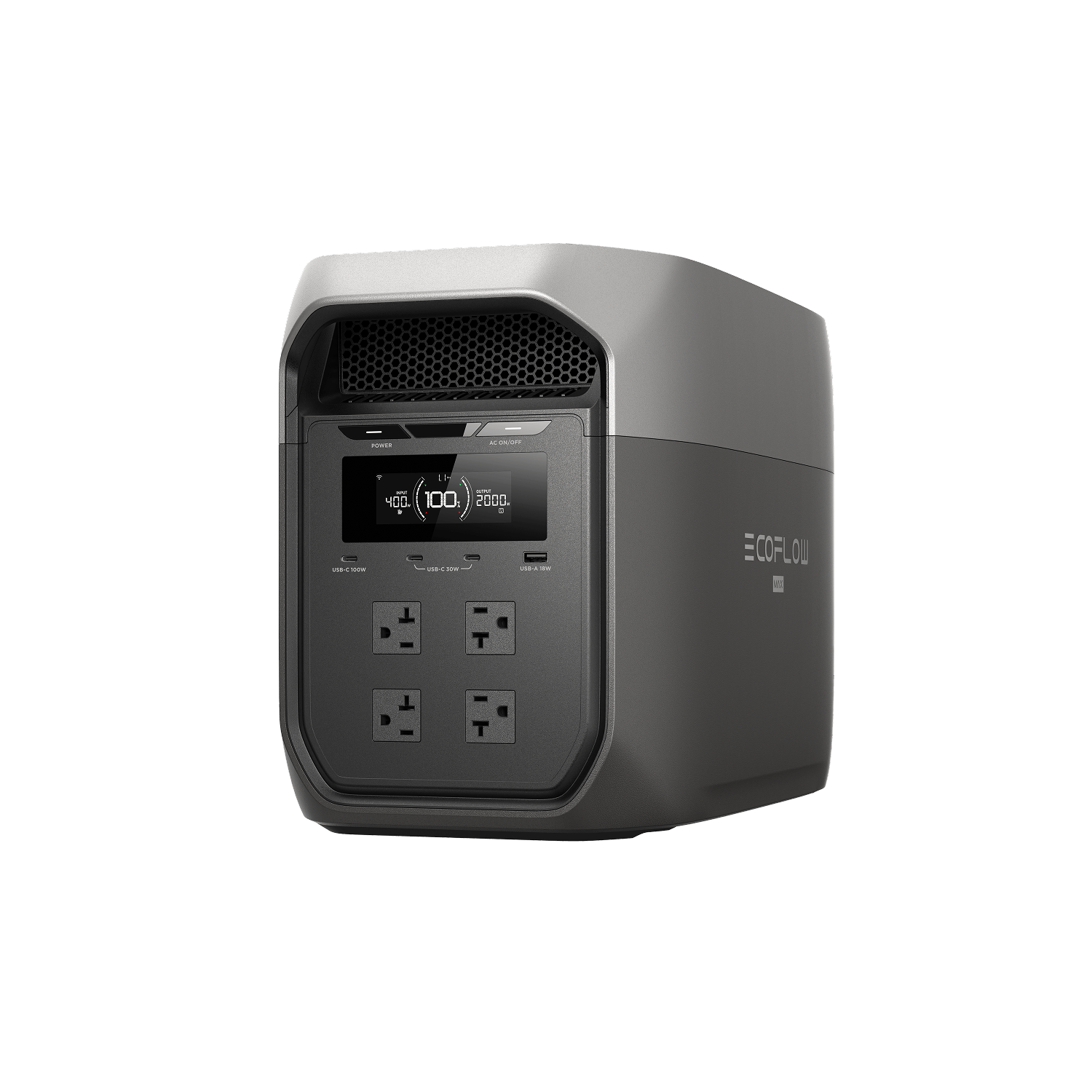
The DELTA 3 Max moves into EcoFlow’s 2 kWh size class: the US product page and English-US manual identify a 2,048 Wh LFP battery, 2,400 W continuous 120 V AC output and 4,800 W surge. Its model is EF-DL-H02-3M; the US standalone SKU is EFD3M-G-US. Do not confuse it with the older DELTA Max 2000, model EFD310, which was the subject of a separate CPSC recall.
The practical case is straightforward: if your appliance list needs more AC output and stored energy than a 1 kWh class station can provide, but does not require the Max Plus’s higher inverter or solar ceiling, this is the lighter of the two current DELTA 3 Max bodies. Its manual lists about 20.3 kg (44.8 lb) net. That is movable between a car, storage area and a room, but it is not a casual one-hand carry for many people, particularly with cables or a panel kit in the other hand.
Two kilowatt-hours still needs a load plan
EcoFlow’s 2,048 Wh number describes battery capacity, not a promise that a 2,048 Wh AC load will run at an outlet. Inverter losses, load size, temperature, battery state, device cycling and output-port behavior all affect actual runtime. The reviewed manufacturer materials do not give a delivered AC-energy result for a stated load. Work from the actual appliance labels and duty cycle, then leave reserve rather than treating a simple watt-hour division as a guaranteed outage duration.
The 2,400 W AC rating is the continuous limit to compare with a device’s running demand. The 4,800 W surge rating applies to a transient, not sustained operation. EcoFlow also lists X-Boost at 3,400 W, but that mode is not an ordinary 3,400 W rated supply. The manual says X-Boost can alter voltage behavior, is intended for some resistive heating loads, does not suit voltage-protected equipment and is unavailable during AC input/bypass. A motor, compressor or sensitive electronic appliance should be judged against its own startup and voltage requirements, not the biggest number in a product headline.
Solar and charging: one 500 W ceiling
The manual identifies one XT60i DC/solar input. Its solar window is 11–60 V, up to 13 A and 500 W maximum. That is a hard system boundary, not a daily-energy forecast. The panel or panel string must meet voltage, current and connector instructions; a panel whose nameplate watts total 500 W can still be a poor or incompatible match if its electrical values fall outside the input range. Clouds, shade, angle, temperature and cable losses further reduce harvest.
US AC input is listed at 100–120 V, 15 A, but the sources give no separate maximum charging-watt figure. EcoFlow advertises a short 0–80% wall-charge time under stated conditions; app settings, temperature, load and outlet affect a real recharge. Panel and alternator-charger bundles change the box contents, not the Max’s 500 W solar ceiling. Confirm what the selected package includes.
Outputs: enough variety, with a modest 12 V section
The Max has four 120 V AC outlets, a 12.6 V car-style DC port rated up to 10 A/126 W, one 18 W USB-A port and three USB-C ports. One USB-C port reaches 100 W; the other two are rated 30 W each but share a 30 W pair ceiling. Device and cable negotiation determine actual USB-C charging.
That 126 W car-style output covers many modest accessories, but not every 12 V load or high-current fridge. Compare the DELTA 3 Max Plus for its 378 W shared Anderson/car DC section; its car socket alone is 126 W. At lower needs, the DELTA 3 or DELTA 3 Plus is lighter.
Use it as a station, not as a transfer system
EcoFlow lists less than 10 ms automatic transfer behavior, but it does not prove every PC or server will switch without restarting. Test the exact setup first. The manual warns that AC output can time out when a load is idle; a cycling refrigerator needs the appropriate app timeout setting and regular battery checks. Life-sustaining medical equipment is excluded; ask device makers about other medical devices.
The station is a US 120 V source. Four household receptacles do not create 240 V or split-phase output, and a portable station should not feed house wiring through a wall receptacle or improvised backfeed cord. Keep cooling clear, keep the station dry and use an appropriately designed, code-compliant transfer arrangement if fixed circuits are part of the plan.
Choose it only if its limits fit
Pick the Max over the Max Plus when 2,400 W AC, 500 W solar and a 126 W car-style DC port cover your real needs, and the lighter listed body is useful. Pay attention to the 2 kWh Max series product page’s detachable-wheel package: it changes handling equipment, not the reviewed station’s core electrical ratings; verify the precise package at order time. The series page also shows a “Trail 200 DC” offer, but that is a separate device and is not treated as part of this Max assessment.
Choose the Max Plus if you need its 3,000 W continuous rating, 1,000 W solar ceiling, 140 W USB-C or compatible battery expansion. The regular DELTA 3 Plus is smaller and lighter while offering two solar inputs and 140 W USB-C, but stores half as much nameplate energy and is rated at 1,800 W AC. For any of these, the right comparison starts with appliance voltage and draw, then charging access, mass and the exact bundle—not a sale price or a watt-hour headline. This assessment is based on official product and manual materials; no hands-on sample, measured runtime or independent output test is claimed.
Key details at a glance
| Nameplate battery capacity | 2048 Wh |
|---|---|
| Rated AC output | 2400 W |
| Manufacturer surge rating | 4800 W |
| Maximum solar input | 500 W |
| Maximum USB-C output per port | 100 W |
| Listed weight | 44.8 lb |
| 12 V DC output | 126 W |
| Manufacturer UPS transfer figure | 10 ms |
| X-Boost figure (not rated output) | 3400 W |
| Base warranty term | 3 years |
| USB-C ports | 3 |
| USB-A ports | 1 |
| Solar input ports | 1 |
| Battery chemistry | LFP |
Use the exact model’s instructions for operating limits, supplied equipment and version differences.
Sources for this assessment
A useful match starts with the loads that matter.
Use the finder for hard electrical requirements, then check appliance starting behavior, actual run time and the exact package in the full assessment.