
Your needs, this model
Does it fit your priorities?
Do you need 3,600 W of rated US 120 V AC output and about 3 kWh of standalone nameplate storage?
The Ultra Plus has the same 3,072 Wh battery and 3,600 W AC rating as Ultra. It does not raise the AC ceiling; motor starts and voltage requirements still need separate checking.
Explore this need in the finder →Is documented expansion to roughly 5 kWh with one compatible Max Plus extra battery important?
EcoFlow lists the DELTA 3 Max Plus Smart Extra Battery as compatible with Ultra Plus. The manual identifies the 2,048 Wh pack; including it gives a 5,120 Wh nameplate plan, not a higher-output inverter.
Explore this need in the finder →Do you require all three: a 1,600 W maximum dual solar input, Smart Output Priority and a 378 W shared 12 V section?
These are documented Ultra Plus distinctions over Ultra. The 378 W DC rating is shared with its car socket, and reaching the solar ceiling requires a compliant array and suitable conditions.
Explore this need in the finder →The more adaptable 3 kWh configuration
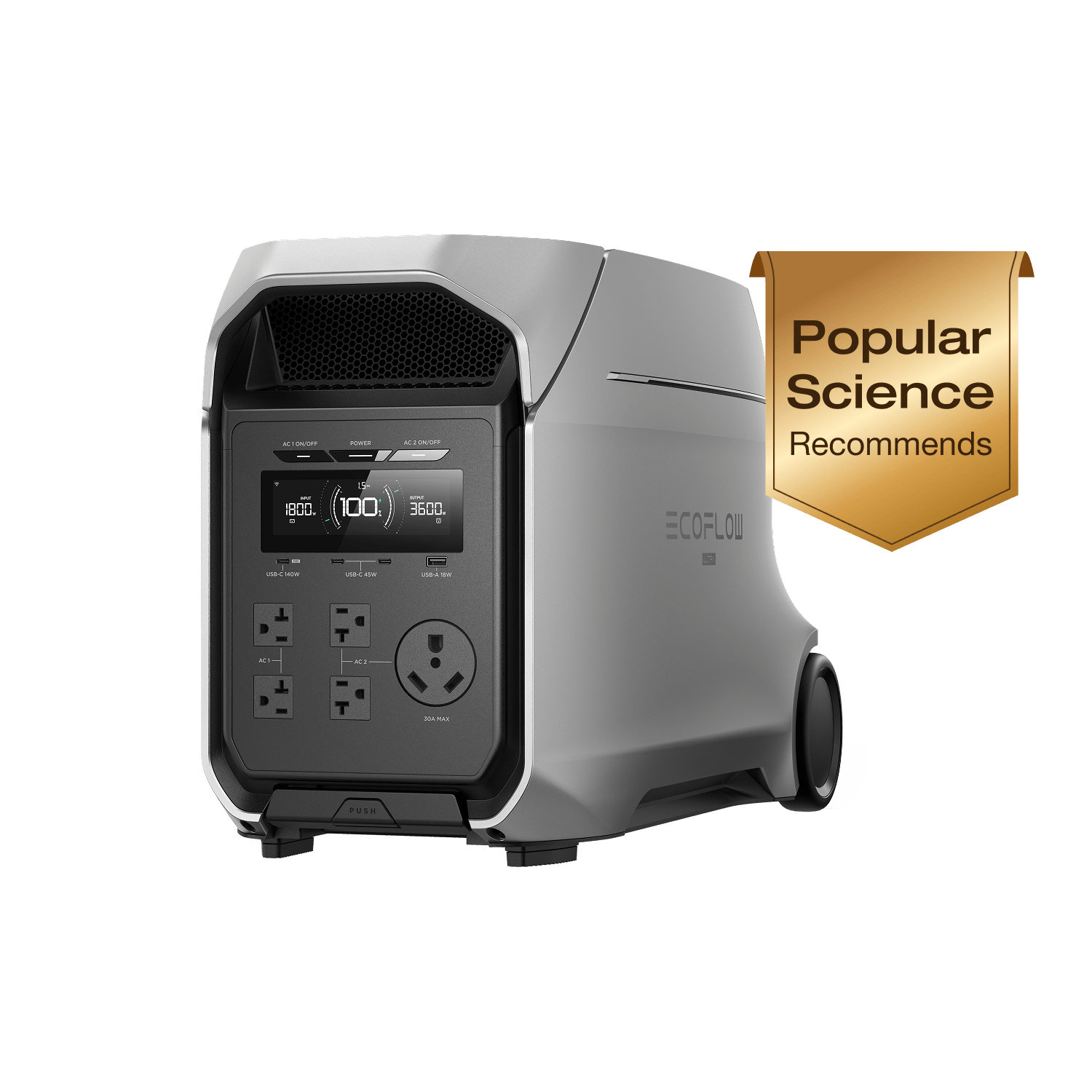
DELTA 3 Ultra Plus shares the Ultra’s 3,072 Wh LFP battery and 3,600 W rated 120 V AC output, but adds several system-level options. The exact US standalone SKU is EFDELTA3UPLUS-US; its matching English-US manual identifies model EF-DL-H02-3UP. The practical reasons to choose the Plus are not a stronger inverter or a larger standalone battery. They are its two solar inputs totaling up to 1,600 W, a 378 W shared 12 V DC section with an Anderson output, app-based Smart Output Priority and a documented extra-battery path.
Choose Plus when its recharge flexibility or expansion changes your backup plan. If neither matters, regular Ultra keeps the same base capacity and AC rating in a slightly lighter, fixed system.
Capacity and output are different questions
At 3,072 Wh, the Ultra Plus is a 3 kWh-class station. Its manual lists 3,600 W continuous AC output at 120 V, with a 7,200 W surge rating. The output face has four receptacles rated up to 20 A apiece and one 30 A receptacle, but the total station limit remains 3,600 W. A large surge figure does not mean the inverter can sustain a 7,200 W load; motors and compressors also need their real startup requirements checked.
EcoFlow lists 4,600 W in X-Boost, which adjusts voltage for some loads and is not suitable for voltage-protected equipment. Use the rated 3,600 W boundary, not surge or X-Boost, for continuous needs. The sources provide no load-specific AC-delivered-energy figure, so estimate runtime from actual draw, cycling and reserve rather than treating nameplate Wh as usable outlet energy.
The solar difference is meaningful when you can use it
The Ultra Plus manual specifies two solar inputs, each accepting 11–60 V and up to 18 A, with a maximum of 800 W per port and 1,600 W total. Ultra has one such input and an 800 W ceiling. Two independent inputs can make array layout more flexible, and the higher ceiling may help when a compatible larger array and strong sun are available. It does not make the station charge at 1,600 W throughout a day. Shade, orientation, temperature and wiring matter, and each input must stay within its voltage and current limits.
Solar bundles with 400 W or 500 W panels change box contents, not the station input limit. EcoFlow advertises a 48-minute 0–80% solar-plus-generator charge and a 53-minute generator claim for a Smart Generator 4000 setup; these are company figures under stated conditions. The manual lists US AC input at 100–120 V/15 A but no separate maximum AC charging wattage. Check the exact panel and cable package.
Expansion: useful, but count the right package
Unlike the Ultra, the Ultra Plus has a battery connection and a confirmed compatible accessory. EcoFlow’s DELTA 3 Max Plus Smart Extra Battery manual lists Ultra Plus model EF-DL-H02-3UP as compatible and identifies the pack as EF-DL3-MP-EB with 2,048 Wh. Add that separate battery to the station’s 3,072 Wh and the resulting nameplate storage is 5,120 Wh, commonly described in the US bundle as a 5 kWh system. That does not raise AC output above 3,600 W, and the extra pack weighs about 35 lb. It is not included in the base Ultra Plus package unless the selected SKU explicitly says so.
The 11 kWh promotion using two DELTA Pro 3 Extra Batteries remains an upper claim here: exact battery codes, topology and any required adapter were not fully established. The 5,120 Wh one-pack plan is confirmed separately; that added runtime brings extra cost, wiring and carrying load, and does not describe the standalone unit.
Ports, app feature and transport limits
The DC section is a real step up from Ultra if your setup uses Anderson. EcoFlow rates the 12.6 V Anderson output up to 30 A/378 W and the car socket at 10 A/126 W, with 378 W as the shared total. It is not 378 W available at each port simultaneously. Check the device connector, fuse, current draw and cable. The three USB-C outputs include one 140 W port and two others with a combined 45 W ceiling; USB-A is rated at 18 W. Actual USB-C delivery depends on compatible devices and cables. Smart Output Priority lets the app assign priority to selected outputs/circuits, but it cannot increase the battery or outlet rating.
At about 33.7 kg (74.3 lb), the Ultra Plus is a rolling station, not an easy carry. Its displayed wheeled handle is useful only on a suitable route; stairs, thresholds and vehicle loading still need a safe lifting plan. The body is IP20, so keep it dry and ventilated. The 10 ms auto-switch figure is not proof of compatibility with every computer or server; test the exact setup. The manufacturer excludes life-sustaining medical devices. Neither Ultra model provides US 240 V split-phase output.
Which version fits your plan?
Pick Ultra Plus if you need dual 1,600 W solar input, high-current DC, Smart Output Priority or the compatible extra battery. If those features are unnecessary, Ultra shares the same standalone capacity and AC rating with one 800 W solar input. For a lighter option, DELTA 3 Plus cuts capacity to 1,024 Wh and output to 1,800 W, but keeps dual solar inputs and 140 W USB-C. Compare DELTA Pro separately for larger-system needs and verify voltage and output.
For house circuits, use compatible transfer equipment installed by a qualified electrician; never improvise a backfeed connection through a wall outlet. Confirm the exact station SKU, accessory list and current manual before counting an expansion battery or generator into an outage routine. This is a source-based assessment of the US configuration, not a physical test: no run time, noise, UPS transition or output measurement is claimed.
Key details at a glance
| Nameplate battery capacity | 3072 Wh |
|---|---|
| Rated AC output | 3600 W |
| Manufacturer surge rating | 7200 W |
| Maximum solar input | 1600 W |
| Maximum USB-C output per port | 140 W |
| Listed weight | 74.3 lb |
| Compatible extra-battery expansion | Yes |
| 12 V DC output | 378 W |
| Manufacturer UPS transfer figure | 10 ms |
| X-Boost figure (not rated output) | 4600 W |
| Base warranty term | 3 years |
| USB-C ports | 3 |
| USB-A ports | 1 |
| Solar input ports | 2 |
| Battery chemistry | LFP |
Use the exact model’s instructions for operating limits, supplied equipment and version differences.
Sources for this assessment
A useful match starts with the loads that matter.
Use the finder for hard electrical requirements, then check appliance starting behavior, actual run time and the exact package in the full assessment.