
Your needs, this model
Does it fit your priorities?
Do your essential appliances fit a 3,600 W, 120 V station with about 3 kWh of nameplate storage?
EcoFlow identifies the US Ultra as 3,072 Wh and 3,600 W continuous at 120 V. Surges, appliance-specific startup, outlet limits and inverter losses still need separate planning.
Explore this need in the finder →Is one solar input capped at 800 W sufficient for your recharge plan?
Its manual specifies one 11–60 V, 18 A solar/DC input, capped at 800 W. More panel nameplate watts do not increase the station limit, and field harvest varies.
Explore this need in the finder →Can the setup stay fixed at its 3,072 Wh battery capacity, without later extra-battery expansion?
The EcoFlow Ultra/Ultra Plus comparison table lists zero scalability for the Ultra and 11 kWh for Ultra Plus. Do not count an expansion path for this variant.
Explore this need in the finder →Who the fixed-capacity Ultra is for
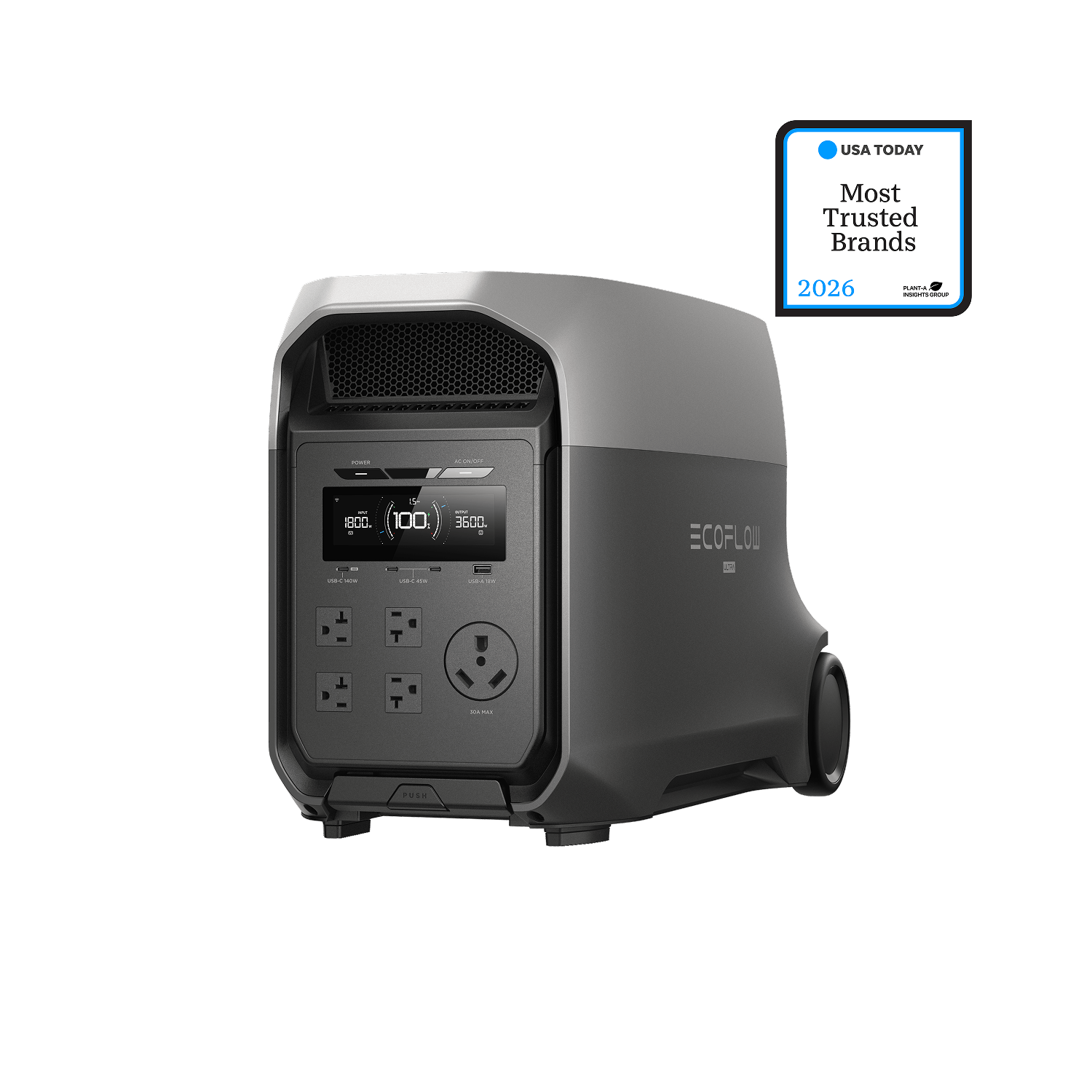
The EcoFlow DELTA 3 Ultra is the non-expandable member of EcoFlow’s new 3 kWh family. Its exact US standalone SKU is EFDELTA3U-US; the matching English-US manual identifies model EF-DL-H01-3U. EcoFlow lists a 3,072 Wh LFP battery and 3,600 W continuous 120 V AC output, with 7,200 W surge. That combination makes sense for a prepared US load list that needs a larger inverter and battery than the 1–2 kWh DELTA 3 models, but can remain within a fixed 3,072 Wh battery configuration.
“Fixed” is the deciding word. EcoFlow’s side-by-side Ultra/Ultra Plus comparison assigns zero extra-battery scalability to Ultra, while the Plus has expansion options. The Ultra is therefore a poor choice if your backup plan depends on buying another battery later. Its upside is not a special watt-hour bargain; it is that the standalone configuration already offers a high 3,600 W inverter and 800 W solar input without the Plus’s extra connections and expansion path. Think of it as a single large station, not a modular home battery.
Check the actual load, not just its biggest headline
For everyday planning, the number to compare with appliance labels is 3,600 W rated output. EcoFlow also advertises a 7,200 W surge rating and 4,600 W X-Boost capability, but those are not additional continuous output. The manual describes X-Boost as a voltage-adjusting mode; some voltage-protected equipment may not work properly, and it is not a substitute for checking a compressor’s start demand or a tool’s operating draw. If your essential device genuinely requires more than 3,600 W while running, this is not a fit. If your plan relies on several appliances at once, add their simultaneous running load and verify individual outlet limits as well as the 3,600 W total.
The 3,072 Wh nameplate is battery capacity, not a load-specific amount of usable AC energy. The reviewed materials do not publish an AC-delivered-energy result for a stated load. Inverter losses, cycling behavior, battery reserve, temperature and appliance duty cycle all change runtime. For an outage, identify the actual must-run devices and estimate their real use before deciding that a 3 kWh battery provides a particular number of hours.
One solar input, one 800 W ceiling
Ultra’s manual lists a single solar/DC input rated for 11–60 V and up to 18 A, with an 800 W solar maximum. That is the station’s ceiling regardless of how a bundle describes its panels. EcoFlow’s product page shows two 220 W panels, a four-panel 500 W kit and a 400 W panel as package choices. These are panel-and-station offers, not changes to the station’s input. Their electrical values must fit the manual; adding panel nameplate watts does not guarantee delivered power or safe compatibility. Shade, orientation, temperature, cable length and weather further reduce collection.
EcoFlow describes four charging methods and says an AC or generator charging setup can reach 80% in 89 minutes under its stated conditions. That is a manufacturer charge-time claim, not a promise for every wall outlet, setting, temperature or concurrent load. The US manual lists 100–120 V AC at 15 A, but I did not find a separate AC input-watt rating in its specification table. Car and generator routes also depend on the correct connection and compatible equipment. Do not treat a panel bundle or a generator sold separately as part of the standalone station box.
Large output, limited expansion and high carrying weight
The US model provides four AC receptacles rated up to 20 A each and one 30 A receptacle, subject to the combined 3,600 W ceiling. It also has three USB-C ports: one rated up to 140 W and two more with a 45 W combined ceiling, plus an 18 W USB-A port. USB-C charging depends on the device and cable. The 12 V section is one car-style outlet rated 12.6 V, 10 A or 126 W. That will not satisfy every high-current DC appliance. If you need the higher-current Anderson port and 378 W shared DC rating, the Ultra Plus is the relevant sibling.
The station weighs about 32.7 kg (72.1 lb) before cables or accessories. Its wheels and telescoping handle help move it over suitable surfaces, but this is not a lightweight unit to lift into a vehicle or carry up stairs. It is also rated IP20, so it needs a dry, protected location rather than rain or splash exposure. Keep the vents clear, use a stable surface, and observe the manual’s temperature and storage rules. EcoFlow’s 10 ms automatic-switch claim may matter in a UPS plan, but it does not establish uninterrupted operation with a particular NAS or computer; test the exact equipment. The manufacturer excludes life-sustaining medical devices.
When the Ultra Plus changes the answer
Choose Ultra if a single 800 W solar input is enough, the base 3,072 Wh is your intended battery size and expansion is not essential. Choose Ultra Plus if you want two solar inputs totaling up to 1,600 W, Smart Output Priority in the app, an Anderson output or a confirmed expansion route. Both are rated at 3,072 Wh and 3,600 W AC in their standalone forms, and neither supplies 240 V split-phase power. A second 120 V receptacle does not change that.
There are bundles for solar panels and Smart Generator 3000 equipment. They can make setup easier when the listed components match the need, but the station’s core ratings remain the same. A two-unit offer is two separate Ultra stations, not expansion of one unit. Home-circuit connections require compatible transfer equipment installed according to its instructions and applicable electrical code; do not backfeed house wiring through a receptacle. This assessment is based on EcoFlow’s US page and matching English-US manual, not a hands-on test. No independent output, noise, runtime or UPS measurement is claimed.
Key details at a glance
| Nameplate battery capacity | 3072 Wh |
|---|---|
| Rated AC output | 3600 W |
| Manufacturer surge rating | 7200 W |
| Maximum solar input | 800 W |
| Maximum USB-C output per port | 140 W |
| Listed weight | 72.1 lb |
| Compatible extra-battery expansion | No |
| 12 V DC output | 126 W |
| Manufacturer UPS transfer figure | 10 ms |
| X-Boost figure (not rated output) | 4600 W |
| Base warranty term | 3 years |
| USB-C ports | 3 |
| USB-A ports | 1 |
| Solar input ports | 1 |
| Battery chemistry | LFP |
Use the exact model’s instructions for operating limits, supplied equipment and version differences.
Sources for this assessment
A useful match starts with the loads that matter.
Use the finder for hard electrical requirements, then check appliance starting behavior, actual run time and the exact package in the full assessment.