
Your needs, this model
Does it fit your priorities?
Do you need a US 240 V split-phase output, with at least 4,000 W of rated AC power?
Yes. The US manual identifies a 240 V NEMA 6-20R and a 120/240 V L14-30R; EcoFlow rates the station at 4,000 W total. Its high- and low-voltage output controls cannot be used simultaneously, so confirm your exact multi-voltage setup.
Explore this need in the finder →Would a documented 8,192 Wh or 12.2 kWh single-station expansion plan be useful?
EcoFlow lists one 4,096 Wh extra battery for an 8,192 Wh station-plus-pack package or two for 12.2 kWh. Storage rises; the 4,000 W AC ceiling does not. The extra batteries are separate equipment.
Explore this need in the finder →Do your panel arrays need the manufacturer-listed 2,600 W combined solar-input ceiling?
The manual specifies 1,600 W on the high-PV input and 1,000 W on the low-PV input, with different voltage/current limits. A compatible array may meet a 2,600 W nameplate input threshold; real solar harvest is weather- and setup-dependent.
Explore this need in the finder →Who the DELTA Pro 3 is for
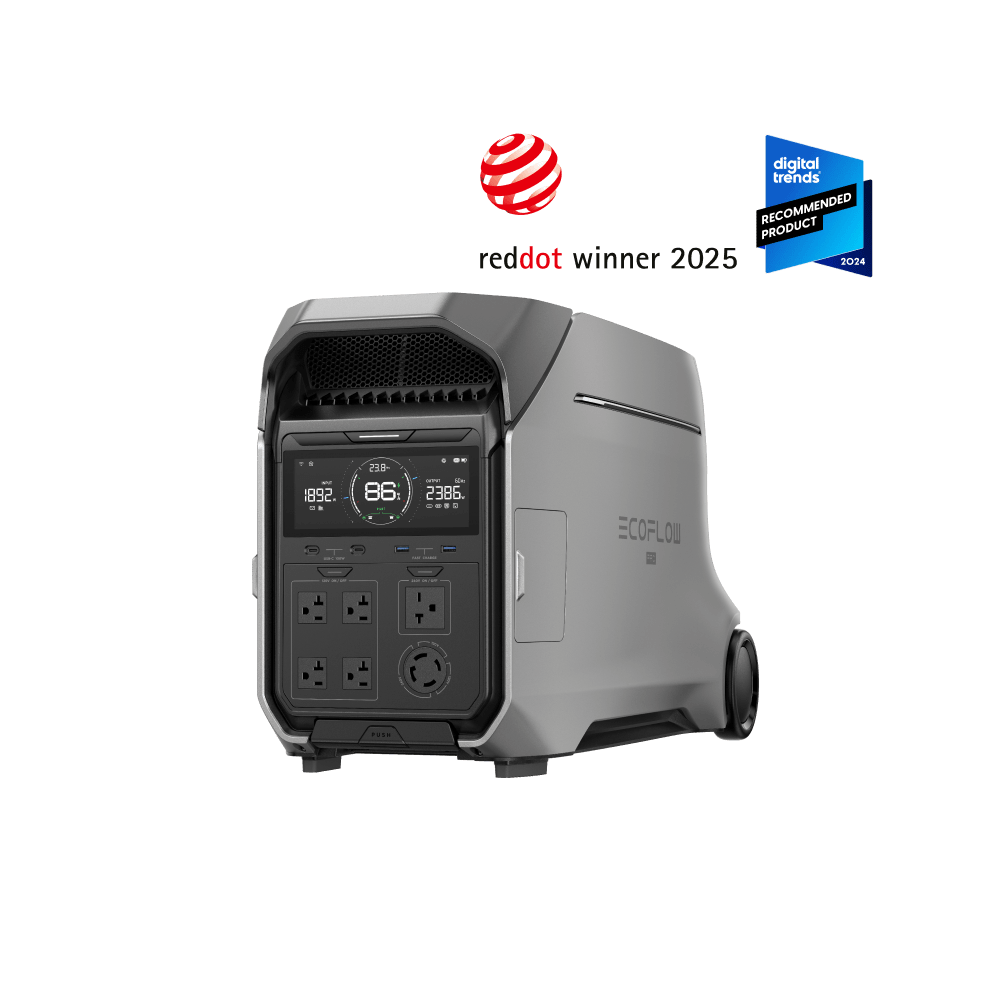
EcoFlow’s wheeled DELTA Pro 3 suits a specific 120 V/240 V load plan. Its US standalone SKU is EFDELTAPRO3-US; the matching English-US manual identifies model EFD521. The base configuration stores 4,096 Wh in an LFP battery and is rated for 4,000 W continuous AC output with 8,000 W surge. Unlike the DELTA 3 Max or Ultra, it prioritizes dual-voltage output and expansion over easy carrying.
Its size is the first filter. EcoFlow lists an approximate net weight of 51.5 kg, about 113.5 lb, before cables or extra batteries. Wheels help on smooth ground, but stairs and vehicle loading remain difficult. Check access and storage before buying.
What 4,000 W and 240 V mean
The US manual lists four 20 A NEMA 5-20R outlets, one 30 A TT-30R outlet, a 240 V NEMA 6-20R outlet and a 120/240 V L14-30R outlet. These support varied 120 V and 240 V loads, but do not let every outlet deliver its faceplate rating at once. The station’s total continuous AC ceiling is 4,000 W. The 8,000 W surge rating concerns starting demand, not extra sustained capacity.
The manual says the US high- and low-voltage AC output controls cannot both be enabled at once. If you must run 120 V and 240 V equipment simultaneously, check the current instructions for the exact outlet behavior instead of assuming both voltage modes operate together. A portable receptacle is not a home transfer switch: use compatible transfer equipment installed to its instructions and applicable code, and never backfeed house wiring through an ordinary outlet.
EcoFlow advertises 6,000 W X-Boost, but that is not the rated output. X-Boost adjusts voltage for some loads; the manual warns that voltage-protected equipment may not work properly. For motors and tools, check running and starting demand against the 4,000 W rating. A headline surge value is not a guarantee that a particular motor will start.
Expansion adds energy, not inverter output
The base 4,096 Wh unit accepts up to two compatible DELTA Pro 3 Extra Batteries. EcoFlow lists a 4,096 Wh add-on, an 8,192 Wh station-plus-one package and a 12.2 kWh station-plus-two package. These expansion plans add nameplate storage, not AC output; they remain rated at 4,000 W continuous. Extra batteries are not included with the standalone EFDELTAPRO3-US order unless the selected package names them, and each pack adds weight. The higher 36 kWh and 48 kWh system claims involve other system equipment, not just one station and two packs.
Expansion suits buyers who expect more storage and have room for the extra equipment, but not those limited by output rather than runtime. More Wh cannot raise the inverter ceiling, and nameplate capacity alone cannot predict AC runtime without the actual load, losses, reserve settings and duty cycle.
Solar and recharging require compatible wiring
The manual lists two photovoltaic inputs, up to 1,600 W on high-PV and 1,000 W on low-PV, for 2,600 W total. Their ranges differ: 30–150 V and 15 A on high-PV; 11–60 V and 20 A on low-PV. Each array must fit its limits; a bundle’s panel wattage alone does not prove compatibility. Shade, orientation, heat and cable losses reduce collection.
AC charging accepts a 100–240 V, 15 A input, but the reviewed manual does not state one maximum wattage for every charging arrangement. Panel, generator, battery and transfer-equipment packages change box contents, not core ratings. Verify the exact equipment and cables; bundles do not raise the 2,600 W solar ceiling.
Important connector, weather and continuity limits
The 12 V section is rated 378 W total through an Anderson output, with a DC5521 port rated up to 5 A. There is no familiar cigarette-lighter socket. Check connector and current needs before counting on it. The station also has two USB-C ports rated up to 100 W each and two USB-A ports up to 18 W each, subject to device protocols and the manual’s output limits.
EcoFlow lists IP65 for the internal battery pack only; that is not an IP65 rating for the whole station, so keep the enclosure dry and protected. The manual gives a 0–45°C charging range and −10–45°C discharge range. Its 4,000-cycle-to-80% figure is a manufacturer specification under 0.5C cycling at 25°C, not a lifespan guarantee for every climate. The 10 ms UPS figure is not proof a computer or medical device will remain uninterrupted. Follow the device maker’s requirements and do not rely on this station as life-support backup.
When a smaller station is better
Choose the DELTA Pro 3 if you need a documented 240 V split-phase option, 4,000 W continuous output, high solar input or an 8,192–12,288 Wh expansion plan—and have a practical way to position and protect it. If your loads are 120 V and lighter, compare the 3,072 Wh DELTA 3 Ultra Plus or 2,048 Wh DELTA 3 Max Plus; they have lower output and storage but may suit a shorter load list. The 1,024 Wh DELTA 3 models are a different, more carryable compromise. Read the three-way fit comparison before treating the largest station as the safest choice.
This assessment uses EcoFlow’s US product page, the English-US DELTA Pro 3 manual and EcoFlow’s DELTA Pro 3 Extra Battery page. No independent runtime, noise, output, surge or UPS testing was performed.
Key details at a glance
| Nameplate battery capacity | 4096 Wh |
|---|---|
| Rated AC output | 4000 W |
| Manufacturer surge rating | 8000 W |
| Maximum solar input | 2600 W |
| Maximum USB-C output per port | 100 W |
| Listed weight | 113.54 lb |
| Compatible extra-battery expansion | Yes |
| 12 V DC output | 378 W |
| Manufacturer UPS transfer figure | 10 ms |
| X-Boost figure (not rated output) | 6000 W |
| USB-C ports | 2 |
| USB-A ports | 2 |
| Solar input ports | 2 |
| Battery chemistry | LFP |
Use the exact model’s instructions for operating limits, supplied equipment and version differences.
Sources for this assessment
A useful match starts with the loads that matter.
Use the finder for hard electrical requirements, then check appliance starting behavior, actual run time and the exact package in the full assessment.