
Your needs, this model
Does it fit your priorities?
Is 12,000 W of 120/240 V continuous output a hard requirement?
The standard one-inverter/two-battery US package is rated for 12 kW total at 120/240 V. The outlet and overall load limits still apply; this is not 12 kW available from each receptacle.
Explore this need in the finder →Do you need at least 10,000 W of compatible solar input and room to expand storage beyond the included 12,288 Wh?
The manual gives two 80–500 V, 15 A PV ports, up to 5,000 W each. One inverter can connect to up to ten 6,144 Wh packs, but array voltage, current, cables, and installation routing must fit the manual.
Explore this need in the finder →Is a 12 V or USB port essential for directly charging small devices?
The exact Ultra X manual shows AC outputs but no USB sockets, and EcoFlow's FAQ expressly states there is no DC output port. It therefore fails a required 12 V DC-output match even though its AC output is substantial.
Explore this need in the finder →Start with what the standard bundle actually contains
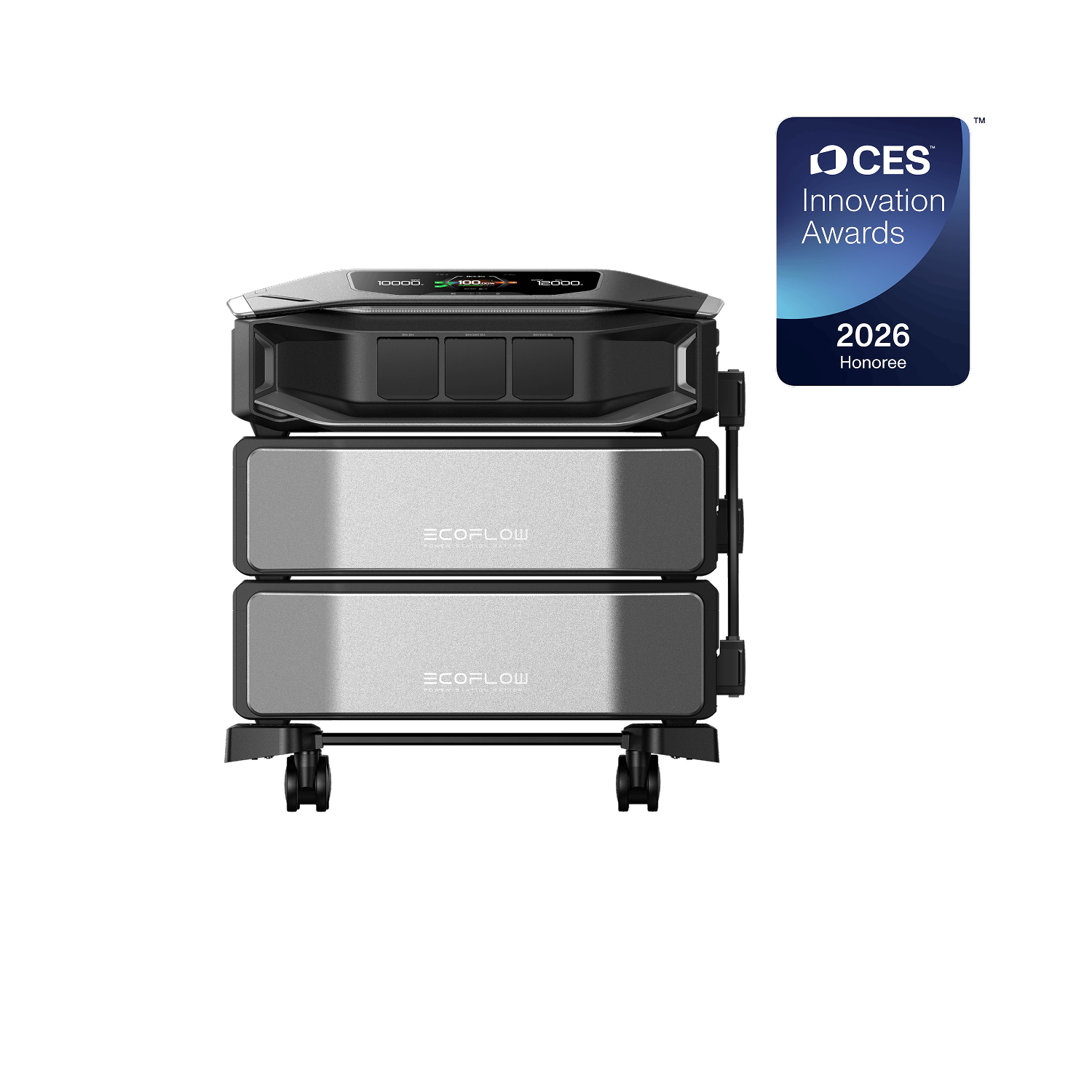
EcoFlow's current US DELTA Pro Ultra X option DPUX-US consists of one EF-DU-001 inverter and two EFYJ751-BP battery modules. Those batteries are each rated at 6,144 Wh, so this standard package starts at 12,288 Wh of LFP nameplate capacity. The inverter is rated for 12,000 W of 120/240 V AC output. It is a home-backup system in modular pieces, not a small station to lift into a vehicle.
Weight matters before any wiring discussion. The English-US manual lists the inverter at about 34.5 kg and each battery at 50.5 kg; the base bundle is roughly 135.5 kg, or 299 lb, divided among three modules. The manual pairs its inverter mass with an inconsistent 70.06 lb conversion; 34.5 kg is about 76 lb. Use the metric values as the conservative basis here and plan separate handling, floor space and ventilation rather than counting on one person to move the assembled stack.
12 kW is a combined 120/240 V rating
The manual lists two 120 V/20 A NEMA 5-20 outlets, one 120/240 V L14-30 and one 120/240 V 14-50 receptacle. Total AC output is 12 kW. A high-current outlet's nameplate is not the amount available in addition to every other port: the inverter remains a shared system ceiling. Match the total simultaneous load and the requirements of the specific circuits, not just the largest single appliance.
This is also a different kind of purchase from buying a station for a few extension cords. The product page lists Smart Home Panel 3 and Smart Gateway packages and calls out current transformers for rooftop solar through the panel or gateway. Those are installed home-energy configurations, with specific wiring, transfer and site requirements. The base DPUX-US package is not itself a professionally installed automatic home transfer system. Have the complete selected configuration checked and installed according to the current manual and local electrical rules; never connect an output to house wiring through an ordinary receptacle.
The extra capacity is real, but requires more modules
EcoFlow rates each compatible battery at 6,144 Wh and says one inverter can connect up to ten batteries, for a maximum 61,440 Wh nameplate total. The current US list includes a one-inverter/four-battery package when paired with Smart Home Panel 3; that is 24,576 Wh from the two included plus two additional modules. The expansion plans increase storage, not the 12 kW inverter rating. At the one-inverter maximum, eight extra batteries beyond the standard pair add roughly 890 lb using the manual's module weight, before any panel, cable or installation equipment.
So ask whether duration or output is the bottleneck. More batteries may help a lower average load last longer when recharge is limited; they cannot supply more than the inverter's rated total. Nameplate watt-hours are not delivered AC energy. Conversion losses, reserve limits, temperature and variable appliance demand all matter, so use a measured load list and test the actual priorities rather than taking a marketing run-time scenario as a guarantee.
Solar input and charging connections need careful planning
The manual lists two high-PV inputs, each with an 80–500 V range, up to 15 A and 5,000 W; the combined solar maximum is 10 kW. High voltage can make large arrays practical, but string design still has to respect voltage in cold conditions and the current limit. The current product page says 10 kW solar input; it does not make every panel combination compatible. Use the exact array and cable guidance for the inverter, and account for shade and season rather than promising that a 10 kW-rated system will constantly produce 10 kW.
AC charging also depends on the selected inlet and cable. The manual lists separate 120 V/15 A, 120/240 V/30 A and 120/240 V/50 A routes, with a maximum 12 kW input under the specified arrangement. These are not interchangeable wall-plug promises; installation and upstream supply determine what applies. Follow the manual for bypass operation and transfer equipment.
Know the missing small-device outputs
The standard X inverter's manual lists AC output receptacles and says there is no DC output port. It does not list USB-C or USB-A outlets either. That can be acceptable in a fixed house-backup arrangement where a separate USB charger is part of the planned setup, but it is a poor match if the same box must directly charge 12 V vehicle gear, USB devices or a camper socket. The original DELTA Pro Ultra, by contrast, lists a 378 W 12 V output plus USB ports, though it offers less inverter and solar input.
EcoFlow lists IP54 for the X system, operating temperature limits, and UPS switching under 10 ms standalone or under 20 ms with Smart Home Panel 3. These are manufacturer figures and conditions, not independent weather, acoustic or continuity tests. The transfer specification does not certify operation with a particular medical or sensitive electronic device. Follow each device maker's instructions, test it in place, and do not rely on this station as life-support backup. A home system this large also needs a protected location and a concrete installation plan.
Choose by the whole operating plan
Choose the DELTA Pro Ultra X when 12 kW at 120/240 V, a large starting battery stack and the 10 kW solar ceiling are central, and you have the space, installed electrical route and ability to handle several heavy modules. The older DELTA Pro Ultra begins at half the battery capacity and 7.2 kW output, but has direct USB and 12 V outputs; it may suit a mixed backup/off-grid plan with those connections. Smaller dual-voltage stations such as the DELTA Pro 3 give up substantial output and storage while remaining far easier to place. The side-by-side DPU and DPUX guide lays out when the extra scale helps and when it does not.
This assessment uses EcoFlow's current US product/options pages and English-US manual. No independent load, runtime, solar, noise, transfer or electrical-installation testing was performed.
Key details at a glance
| Nameplate battery capacity | 12288 Wh |
|---|---|
| Rated AC output | 12000 W |
| Maximum solar input | 10000 W |
| Listed weight | 298.7 lb |
| Compatible extra-battery expansion | Yes |
| 12 V DC output | 0 W |
| Maximum AC recharge input | 12000 W |
| Base warranty term | 5 years |
| Total rated DC output | 0 W |
| AC outlet output | Yes |
| Solar input ports | 2 |
| Battery chemistry | LFP |
| Ingress rating | IP54; observe protective-cap/when-not-in-use conditions in the manual |
Use the exact model’s instructions for operating limits, supplied equipment and version differences.
Sources for this assessment
A useful match starts with the loads that matter.
Use the finder for hard electrical requirements, then check appliance starting behavior, actual run time and the exact package in the full assessment.