
Your needs, this model
Does it fit your priorities?
Is a genuine 240 V output route essential for your load plan?
The English-US manual identifies a 240 V/30 A receptacle and a 120/240 V system. The 7,200 W total is shared across AC output; use the exact load and installation requirements rather than adding receptacle ratings together.
Explore this need in the finder →Do you need capacity beyond the included single 6,144 Wh battery?
EcoFlow specifies one compatible 6,144 Wh DELTA Pro Ultra Battery and up to five packs on one inverter. The base DPU-US package is one inverter plus one battery, so extra packs raise stored energy but not the 7,200 W AC ceiling.
Explore this need in the finder →Does your plan require a physical 12 V car-style output socket as well as household AC?
The manual lists a 12.6 V, 30 A/378 W DC output and labels the DC port for cigarette-lighter loads. Confirm that exact connector suits the device; 12 V output is not the same as a vehicle recharging input.
Explore this need in the finder →Who the DELTA Pro Ultra is for
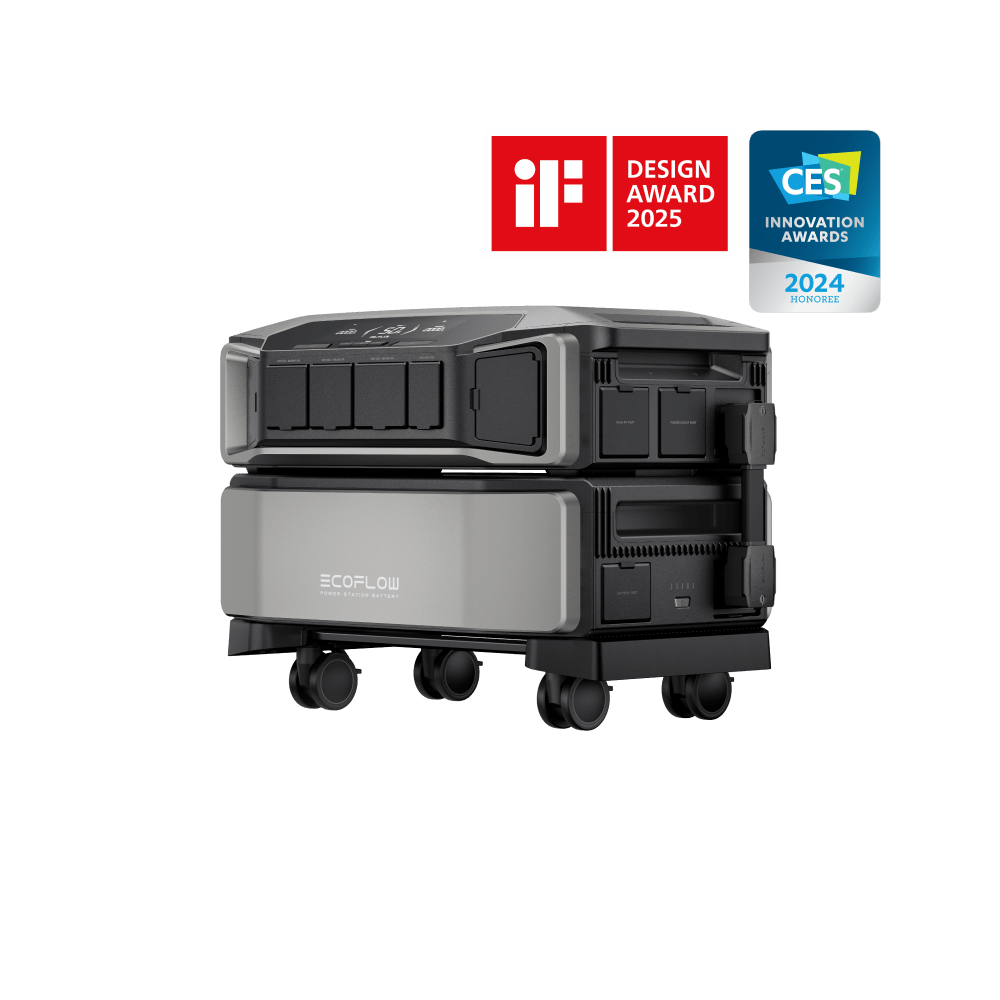
The US base package, SKU DPU-US, is a modular system rather than a single carryable box: one EFYJ751-PCS-US inverter sits with one EFYJ751-BP battery. That base pairing holds 6,144 Wh of LFP nameplate energy and provides 7,200 W rated AC output. It makes sense for someone planning a fixed backup location, a substantial mixed-voltage load list or later battery expansion. It is not an easy choice if your main criterion is moving a station into a car by yourself.
EcoFlow's English-US manual lists an inverter of about 32.1 kg (70.8 lb) and a battery of about 50.5 kg (111.3 lb). They are separate modules; together the base pair is around 182 lb, before cables. The current product page shows slightly different module weights. Check the labels and move the pieces separately, with a route and support surface suited to each. The system is large enough that an empty corner is not a complete installation plan.
Its 120/240 V output is useful, but shared
The manual's US AC table lists four 120 V/20 A outlets, a 120 V/30 A outlet and a 240 V/30 A outlet. EcoFlow rates the station at 7,200 W total continuous output and 10,800 W surge. Those totals do not mean each receptacle can independently deliver its faceplate maximum while all others do so too. The workhorse distinction is that the US unit has a real 240 V option, not merely two 120 V receptacles that happen to be in the same enclosure.
Make a device list with each appliance's voltage, running watts and starting behavior, then compare the combined simultaneous demand with the total. The surge rating is a brief starting allowance, not a second continuous rating or a promise for every motor. For home circuits, the separate Smart Home Panel 2 and transfer equipment are installation components, not included with the DPU-US base package. Follow EcoFlow's wiring instructions, applicable local code and a qualified installer's advice. Never backfeed home wiring through a household outlet.
Battery expansion changes duration, not output
EcoFlow's current option list names one-, two- and three-battery arrangements. The US manual documents up to five 6,144 Wh batteries on one inverter: the base is 6,144 Wh, adding one pack gives 12,288 Wh, adding two gives 18,432 Wh, and five total packs reach 30,720 Wh by nameplate arithmetic. The larger configuration requires four extra battery modules beyond the included one. These are supported arrangements, not claims that a given load will run a particular number of days. AC conversion losses, reserve settings and duty cycle all affect useful runtime.
Choose expansion if your limiting concern is stored energy and you have safe space for the heavy packs. It does not raise the 7,200 W inverter ceiling. If output is the limit, a bigger battery stack will not fix it. The product page also presents solar, home-panel, monitor, EV-charger and trolley packages. Those names tell you something is bundled, but not that an array or household installation is ready for your site; verify exact kit components, cables and installation requirements. Some options use repeated or promotional SKUs, so a short SKU alone is not enough to identify the whole package.
Solar input is high and split into different windows
The manual rates two solar inputs at up to 5,600 W combined: the high-PV port accepts 80–450 V at up to 15 A and 4,000 W, while the low-PV port accepts 30–150 V at up to 15 A and 1,600 W. These are not interchangeable panel sockets. Check array voltage and current against the proper input window, and plan the cable and series/parallel arrangement from the manual rather than from the panel-kit wattage alone. The input ceiling describes the station, not guaranteed harvest; sunlight, angle, shade and temperature change actual collection.
Small outputs and placement deserve attention
For a smaller 12 V load, the manual lists a 12.6 V, 30 A, 378 W DC output and identifies a cigarette-lighter-style DC port. It also lists two 100 W USB-C ports and two 12 W USB-A ports. Check the connector and simultaneous-load limits for the device you actually use. EcoFlow lists IP54, with the manual qualifying protection when the system is not in use and its protection is in place; do not treat that as permission to leave the assembly exposed to weather.
The manual describes Backup UPS switching under 20 ms and an Online UPS mode at 0 ms. Those manufacturer modes are not independent switching tests or a guarantee of compatibility with a particular computer, router or medical device. Test ordinary electronics in their intended setup and follow the equipment maker's instructions; do not use this article as medical-backup advice. EcoFlow's 3,500-cycle-to-80% figure is also a manufacturer test condition at 0.5C and 25 °C, not an observed lifetime result.
When another EcoFlow is the better fit
The DELTA Pro Ultra X steps up to 12 kW output and a standard two-battery, 12,288 Wh bundle, with a higher 10 kW solar-input ceiling, but it is heavier and the exact manual does not list USB or DC outputs. The DELTA Pro 3 is much smaller and lighter but has a 4,000 W inverter and a different set of solar and expansion limits. A 120 V-only plan that does not need this system's scale may be better served by a 3 kWh DELTA 3 Ultra Plus. Use the DELTA Pro Ultra family comparison to work through those tradeoffs.
This assessment is based on EcoFlow's US product and option pages and the English-US manual. I did not independently test output, recharge time, noise, UPS transfer, weather resistance or runtime.
Key details at a glance
| Nameplate battery capacity | 6144 Wh |
|---|---|
| Rated AC output | 7200 W |
| Manufacturer surge rating | 10800 W |
| Maximum solar input | 5600 W |
| Maximum USB-C output per port | 100 W |
| Listed weight | 182.1 lb |
| Compatible extra-battery expansion | Yes |
| 12 V DC output | 378 W |
| Base warranty term | 5 years |
| AC outlet output | Yes |
| USB-C ports | 2 |
| USB-A ports | 2 |
| Solar input ports | 2 |
| Battery chemistry | LFP |
| Ingress rating | IP54; observe protective-cap/when-not-in-use conditions in the manual |
Use the exact model’s instructions for operating limits, supplied equipment and version differences.
Sources for this assessment
A useful match starts with the loads that matter.
Use the finder for hard electrical requirements, then check appliance starting behavior, actual run time and the exact package in the full assessment.