
Your needs, this model
Does it fit your priorities?
Do your essential appliances need US 120 V output with at least 3,600 W of rated AC power?
The DELTA Pro’s single-station US configuration is rated at 120 V and 3,600 W total. The 240 V AC input is a recharge option, not 240 V output; a separate Double Voltage Hub is not represented as a single-station match.
Explore this need in the finder →Would one or two compatible 3,600 Wh DELTA Pro Smart Extra Batteries help your storage plan?
EcoFlow lists one added battery for a 7,200 Wh arrangement and two for 10,800 Wh. Extra batteries increase nameplate storage, not the station’s 3,600 W inverter rating, and must be included in the selected order.
Explore this need in the finder →Do you need up to 1,600 W of manufacturer-rated solar input?
The manual lists a 1,600 W maximum over an 11–150 V, 15 A input. A panel array must fit those limits and real output depends on conditions; 1,601 W is outside the reviewed station ceiling.
Explore this need in the finder →Who the DELTA Pro is for
The EcoFlow DELTA Pro is a large wheeled 120 V station for high-output loads and expandable storage. EcoFlow’s US standalone SKU is DELTAPro-1600W-US; its English-US manual identifies the matching DELTA Pro configuration but does not state another hardware model code. The base LFP battery is 3,600 Wh, with 3,600 W rated AC output and 7,200 W surge.
At about 99 lb, this is not a casual camping battery. Wheels help on smooth ground, but stairs, vehicle lifts and storage placement still demand planning. Buy it for a 120 V load list and a real need for extra battery capacity, not just a large headline number.
Strong 120 V output, but not a 240 V outlet
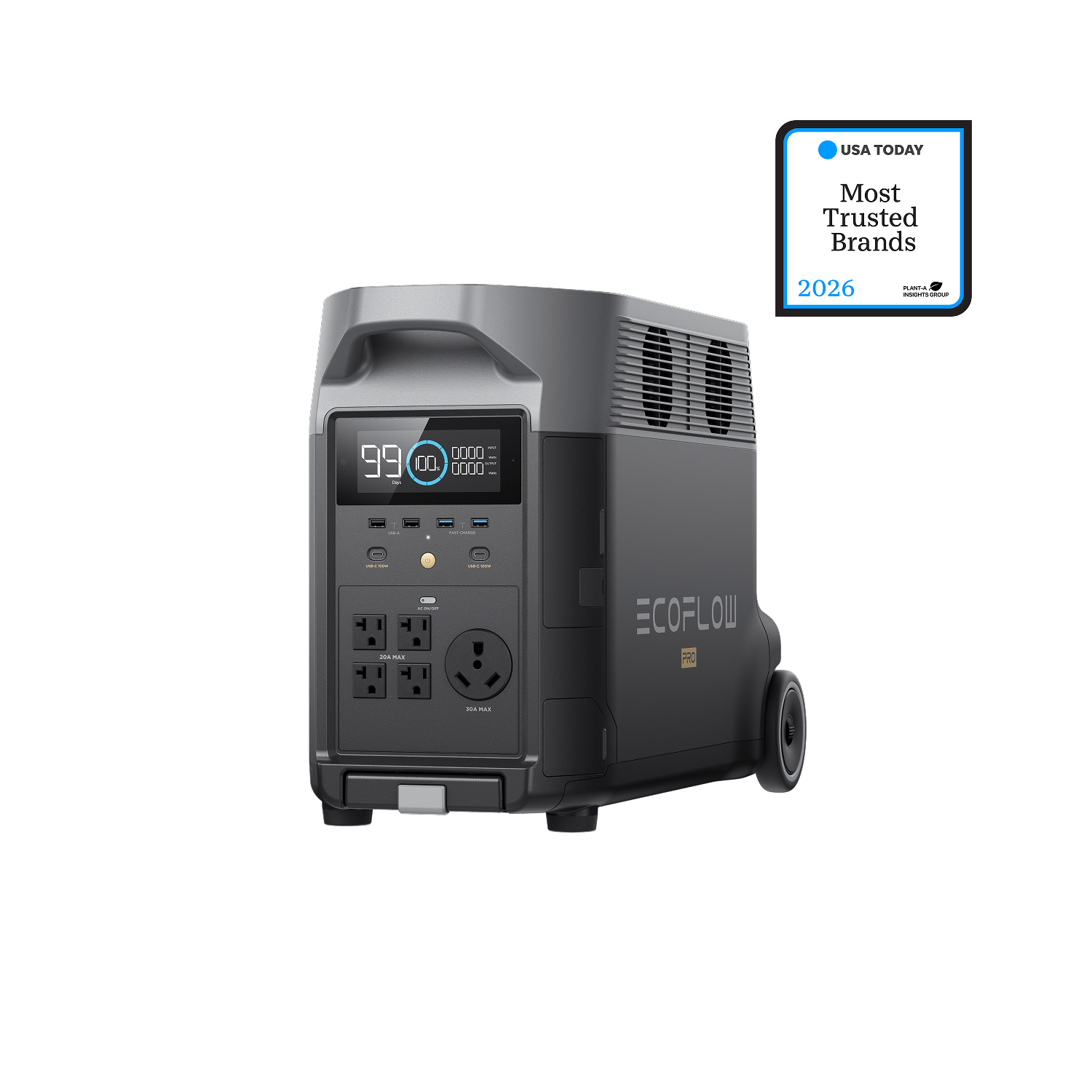
EcoFlow lists five AC outlets and 3,600 W total rated output; the product image shows four standard receptacles and a larger 30 A outlet. The US manual specifies 120 V output and no 240 V output from one station. A 240 V charging input is not a 240 V outlet. Although the manual lists a separate Double Voltage Hub, this review does not establish its exact two-station arrangement as a supported plan. For essential 240 V loads, see the DELTA Pro 3 assessment.
The 3,600 W rating is a station-wide ceiling, not a per-outlet allowance. EcoFlow advertises 7,200 W surge and 4,500 W X-Boost, but X-Boost adjusts voltage and is not extra continuous output. Check motor start demand and voltage-sensitive loads against the manual.
The manual describes EPS transfer in up to 30 ms and says 0 ms switching is unsupported; test the exact load and do not assume compatibility with data or medical devices.
Expansion changes stored energy, not output
The station supports up to two DELTA Pro Smart Extra Batteries, each rated at 3,600 Wh and sold separately. One added pack makes a named 7,200 Wh station-plus-battery plan; two bring the single-station total to 10,800 Wh. The inverter remains 3,600 W in each configuration. EcoFlow’s separate page for the battery says it is compatible with DELTA Pro and weighs about 84 lb, so expansion is a major handling and floor-space decision, not just a number on an app screen.
EcoFlow’s up-to-25 kWh claim describes a complete system using two stations, batteries and Smart Generators—not one station or the two-battery plan above. The standalone SKU does not include an extra battery, generator, Double Voltage Hub or Smart Home Panel unless the selected bundle explicitly lists it. Confirm component models, cables and installation instructions before treating a package as a ready home system.
Solar and wall charging are stronger than on smaller stations
The manual rates solar input at up to 1,600 W, over an 11–150 V range and up to 15 A. The panel string must stay within those limits; adding panel nameplate watts or mixing a bundle’s panels does not make an incompatible array safe. Shade, orientation, temperature, cable length and weather limit real collection. This is a useful input ceiling for larger solar plans, but it is not a promise of a particular daily energy harvest.
EcoFlow lists up to 1,800 W AC charging from 120 V and 3,000 W from 240 V AC input, with a manufacturer claim of a roughly 2.7-hour full charge under its stated conditions. The manual also lists 12 V/24 V vehicle charging, with an 8 A default, and compatible generator and EV-charging options. The actual equipment and wall circuit matter; a station’s ability to charge from 240 V does not change its 120 V AC output.
Port details and practical limits
The 12 V section is versatile but has shared limits. EcoFlow lists a 378 W Anderson output, two DC5521 ports rated at up to 38 W each, and a 126 W car-style outlet; the manual says the car outlet shares power with the DC5521 output. There are two 100 W USB-C ports, two regular 12 W USB-A ports and two fast-charge USB-A ports rated up to 18 W each. These are maximum port ratings, not guarantees that every connected device draws its listed maximum at once.
The manual gives a 0–45°C charging range and −10–45°C discharge range. EcoFlow’s 3,500-cycle-to-80% claim is a published specification, not a lifetime guarantee. Keep the station dry and ventilated; home-circuit backup requires compatible transfer equipment installed to its instructions and code.
When the DELTA Pro 3 is a better fit
The older DELTA Pro can be attractive if 3,600 W at 120 V, 1,600 W solar input and up to 10.8 kWh from one station plus two compatible batteries meet your plan. It weighs about 14.5 lb less than the DELTA Pro 3, but it does not provide single-station 240 V output. Choose the DELTA Pro 3 when you need the documented 120/240 V split-phase outlet option, 4,000 W rated output, 2,600 W solar ceiling or newer 4,096 Wh expansion path. If you need only 120 V and a lighter unit, compare the 3,072 Wh DELTA 3 Ultra Plus or 2,048 Wh DELTA 3 Max Plus. The four-model comparison separates those operating plans.
This assessment is based on EcoFlow’s US product page, the English-US DELTA Pro manual and the compatible Smart Extra Battery page. No independent runtime, output, noise or EPS-transfer testing was performed.
Key details at a glance
| Nameplate battery capacity | 3600 Wh |
|---|---|
| Rated AC output | 3600 W |
| Manufacturer surge rating | 7200 W |
| Maximum solar input | 1600 W |
| Maximum USB-C output per port | 100 W |
| Listed weight | 99 lb |
| Compatible extra-battery expansion | Yes |
| 12 V DC output | 378 W |
| Maximum AC recharge input | 3000 W |
| X-Boost figure (not rated output) | 4500 W |
| USB-C ports | 2 |
| USB-A ports | 4 |
| Solar input ports | 1 |
| Battery chemistry | LFP |
Use the exact model’s instructions for operating limits, supplied equipment and version differences.
Sources for this assessment
A useful match starts with the loads that matter.
Use the finder for hard electrical requirements, then check appliance starting behavior, actual run time and the exact package in the full assessment.