
Your needs, this model
Does it fit your priorities?
Do you want a manufacturer-bundled 572 Wh, 120 V setup, while keeping AC load at or below the rated 600 W?
The Max bundle includes the 286 Wh Plus and 286 Wh EB300; its rated AC output remains 600 W.
Explore this need in the finder →Would two USB-C ports—one on the station up to 100 W and one on the EB300 up to 140 W—fit your charging plan?
The connected system exposes the station’s 100 W USB-C and the EB300’s 140 W USB-C; the per-port ratings are not a promise of all-port simultaneous maximum output.
Explore this need in the finder →Do you need the station’s single 220 W solar input and 126 W car output for a 572 Wh small-load plan?
The system retains the base RIVER 3 Plus solar/car input limits and 126 W car-style outlet; confirm panel voltage, current and the exact cable separately.
Explore this need in the finder →The RIVER 3 Max is a bundled configuration
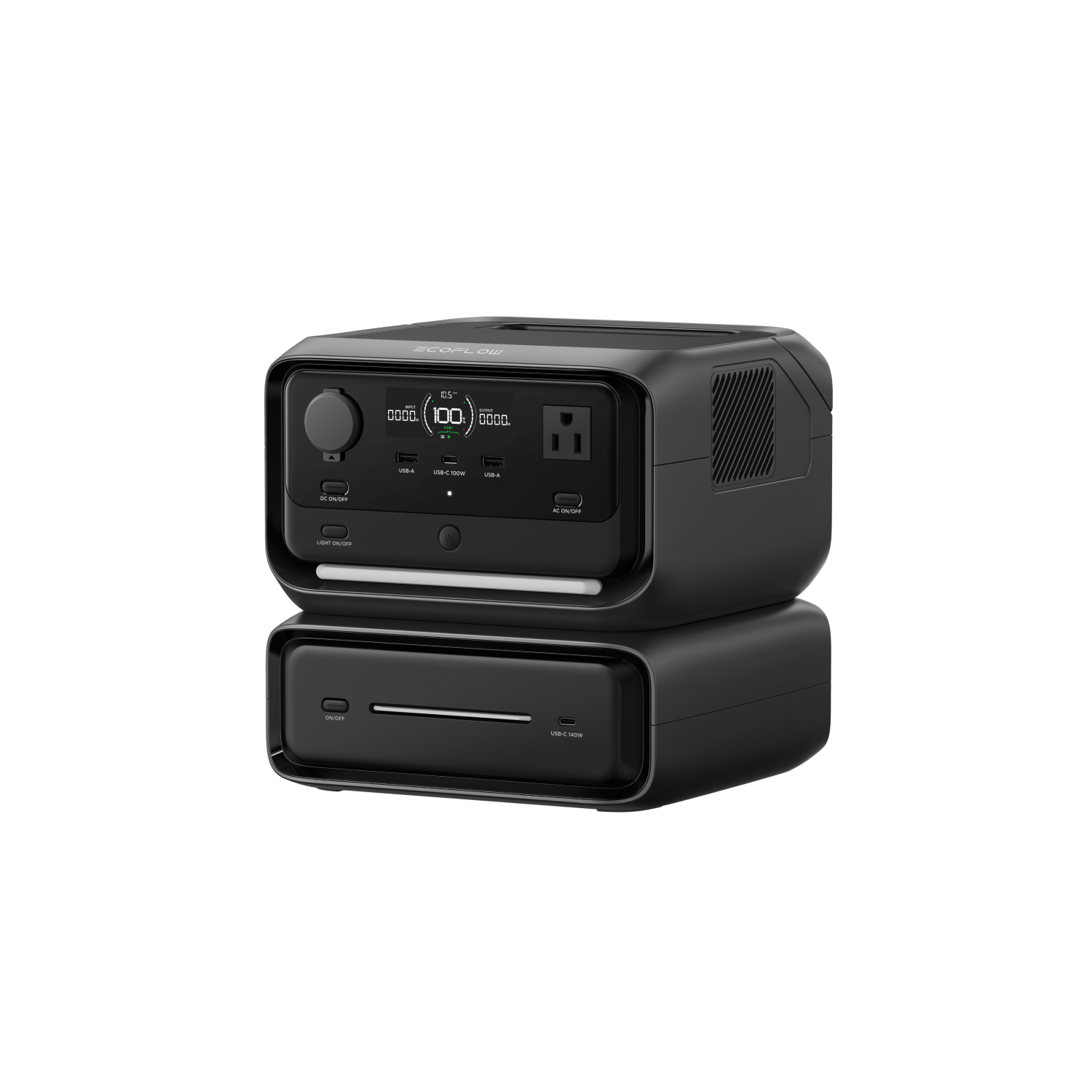
EcoFlow's US RIVER 3 Max offer is not a different 600 W inverter model: it pairs a RIVER 3 Plus station with the EB300 Smart Extra Battery. The exact US option calls the bundle “RIVER 3 Max (RIVER 3 Plus + Extra Battery 300)” and uses SKU EFRIVER3Max-US. The station is model EF-RV-H02-1; the included EB300 is model EF-RV-E01-1. The manufacturer page lists 572 Wh total. That exact combination is the important shopping identity—do not confuse it with the standalone RIVER 3 Plus or a separately sold EB600.
For a small 120 V setup that needs more reserve than the 286 Wh standalone Plus, the Max makes sense when the extra capacity is wanted on day one. The base unit's inverter remains 600 W pure sine wave. The extra battery increases stored energy, not continuous AC output, surge rating or appliance compatibility. If a refrigerator, pump or tool needs more than 600 W of rated AC, this is not the workaround; compare a larger inverter station instead.
Capacity changes, output does not
The system combines a 286 Wh RIVER 3 Plus with a 286 Wh EB300 for 572 Wh of nameplate battery capacity. The manufacturer rates the base's AC output at 600 W total, with 1,200 W X-Boost for certain loads; EcoFlow's manual distinguishes X-Boost from the normal rated output. Use the 600 W limit when deciding whether the appliance belongs in the plan, and don't assume that a higher nameplate battery capacity will make a high-power load safe or compatible.
The station supplies one USB-C port rated up to 100 W and two USB-A ports rated up to 12 W each. The EB300 adds a separate USB-C port rated up to 140 W. Both battery and station are available as output sources when connected, according to EcoFlow's battery instructions, but individual port maxima are not a promise of all-port simultaneous output. The station's 12.6 V/10 A car outlet is rated up to 126 W. The 220 W solar input belongs to the station; the added battery does not create another solar input. Solar panel and charging cable must be acquired separately unless the exact purchase package explicitly includes them.
EcoFlow lists 380 W maximum AC input for the power station alone and up to 650 W for the station-plus-extra-battery setup. Its solar/car input is separately described with maximums up to 220 W; those input specifications do not state how fast a particular setup will recharge under real conditions. The panel voltage, current, weather, cable and chosen charge settings all matter.
What the Max answers—and what it does not
The RIVER 3 Max is a useful middle step between a pocket-size power bank and a large rolling backup station. Its advertised 572 Wh capacity is double the base Plus nameplate capacity, while retaining the same 600 W AC ceiling and the base model's 120 V US outlets. If your essential loads are a router, phones, a small computer setup or a carefully checked low-draw appliance, the bundled battery can provide more reserve without asking you to source an accessory separately. Actual runtime depends on the loads, conversion losses, battery state, temperature and how much reserve you keep.
EcoFlow describes the unit as having a within-10-ms standby UPS transfer. Treat that as a manufacturer specification rather than an independent test or a guarantee that a given NAS, workstation, refrigerator or medical device will ride through a transition. The manual cautions against life-support use. Test device behavior with the actual load in a non-critical situation, including whether it restarts when grid power returns, and use a professionally designed backup system where continuity is essential.
The RIVER 3 Plus hardware supports one compatible Smart Extra Battery. With an EB300 already included, this Max configuration should be treated as a completed 572 Wh setup, not a promise that a second battery stacks on top. The accessory catalogue also lists EB600, which is a different capacity choice for the Plus platform; do not count both an included EB300 and an extra EB600 in this Max offer unless the retailer documents a separate exact package and the manual's one-battery limit is satisfied.
Trade-offs and practical setup
The bundle's published components weigh about 10.36 lb for the station and 7.72 lb for the EB300. A simple sum is roughly 18.1 lb, but EcoFlow's product page does not give an independently confirmed assembled-package weight; carry the station and battery as distinct pieces and verify the exact carton contents. A typical stack image shows the EB300 beneath the station. It is a manufacturer rendering, not a field photograph, and the linked gallery image's text labels one selection as the Plus even though the picture visibly shows the Plus resting on the EB300.
Keep the cooling vents unobstructed and the equipment dry. The manual's AC outlets, vehicle socket and solar input each have separate limits; adapters cannot increase them. A 120 V appliance with high starting demand can exceed the inverter's capability even if its average draw seems low. If you need sustained higher AC output, 240 V, whole-home transfer integration or a high-power motor start, look above the RIVER class and assess that system's exact wiring and approved accessories.
Choose the package that fits the real plan
Pick the RIVER 3 Plus standalone if lower carried weight and 286 Wh are enough, or if you want to decide later between a 286 Wh EB300 and 572 Wh EB600. Pick the RIVER 3 Max when the EB300-backed 572 Wh setup is the exact combination you want. For loads needing over 600 W of continuous AC or substantially longer backup, look at a larger station such as DELTA 3 Classic or another model whose rated output and battery configuration match the load. The current US listing and option data establish the bundle identity and the Plus and EB300 manuals establish component behavior. No independent runtime, charging, UPS, drop or output test was performed, and stock status can change.
Key details at a glance
| Nameplate battery capacity | 572 Wh |
|---|---|
| Rated AC output | 600 W |
| Maximum solar input | 220 W |
| Maximum USB-C output per port | 140 W |
| Compatible extra-battery expansion | No |
| 12 V DC output | 126 W |
| Maximum AC recharge input | 650 W |
| Manufacturer UPS transfer figure | 10 ms |
| X-Boost figure (not rated output) | 1200 W |
| AC outlet output | Yes |
| USB-C ports | 2 |
| USB-A ports | 2 |
| Solar input ports | 1 |
| 12 V car-style output | 126 W |
| Vehicle charge input | 220 W |
| Battery chemistry | LFP |
Use the exact model’s instructions for operating limits, supplied equipment and version differences.
Sources for this assessment
- EcoFlow US RIVER 3 Max (RIVER 3 Plus + Extra Battery 300)
- EcoFlow US RIVER 3 Max product option JSON
- EcoFlow RIVER 3 Plus Portable Power Station User Manual
- EcoFlow RIVER 3 Plus Smart Extra Battery US product page
- EcoFlow US RIVER 3 Plus Extra Battery option JSON
- EcoFlow RIVER 3 Plus Smart Extra Battery User Manual
A useful match starts with the loads that matter.
Use the finder for hard electrical requirements, then check appliance starting behavior, actual run time and the exact package in the full assessment.