
Your needs, this model
Does it fit your priorities?
Do you need ordinary 120 V AC at up to 600 W continuous from a portable LFP station?
The US RIVER 3 Plus is rated at 120 V and 600 W total pure-sine AC; verify appliance start-up demands separately.
Explore this need in the finder →Would one supported add-on battery meet your nameplate capacity target without increasing inverter output?
The 286 Wh station supports one compatible EB300 (286 Wh) or EB600 (572 Wh); the respective combined nameplate configurations are 572 Wh or 858 Wh, while rated AC output remains 600 W.
Explore this need in the finder →Do you need a 126 W 12 V car socket and solar input, but only one 100 W USB-C port on the station?
The base station lists a 126 W car output, 220 W maximum solar input and one 100 W USB-C port; any required simultaneous loads must fit the actual port and total-output limits.
Explore this need in the finder →Who the RIVER 3 Plus suits
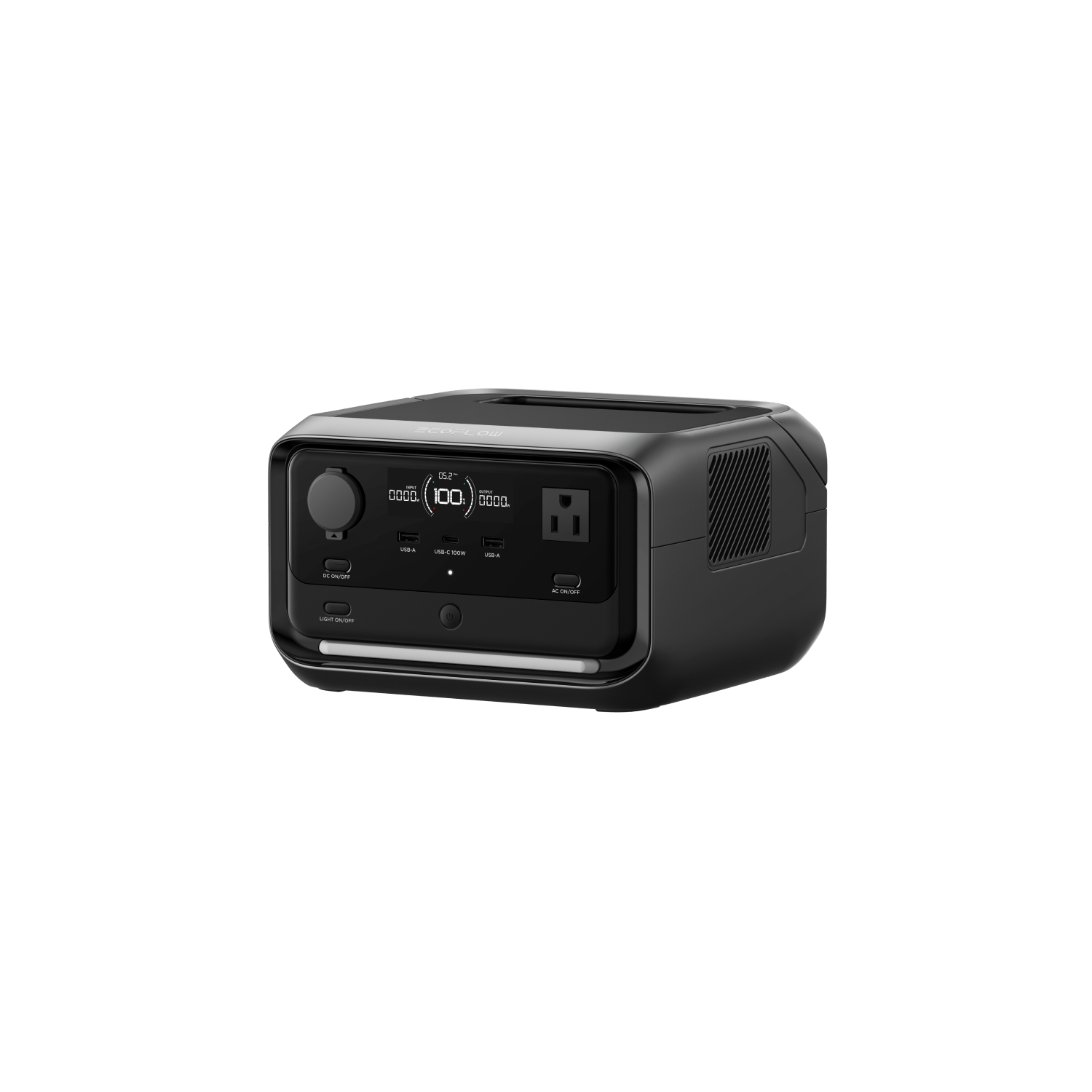
The EcoFlow RIVER 3 Plus is a small 120 V AC station for trips, desk equipment and short, carefully chosen outage loads. The US manual names the 286 Wh model EF-RV-H02-1; EcoFlow's US option data identifies the standalone retail offer as EFRIVER3Plus-US. It is a 600 W pure-sine-wave inverter model, not a larger household backup unit. Choose it when one compact AC source and USB charging are more important than long runtime or high appliance starting headroom.
The base station weighs about 10.36 lb and carries 286 Wh of LFP battery capacity. Those numbers suit a portable kit, but watt-hours are stored energy rather than an AC-runtime promise: inverter losses, load profile, temperature, reserve settings and battery condition all change delivered energy. For an outage plan, list the actual devices, their running and startup demands, and the hours you need. A refrigerator's compressor cycling or a small motor can behave differently from a steady resistive load; the 600 W continuous rating alone does not guarantee startup compatibility.
What changes when you choose expansion
As a standalone configuration, the Plus has one 100 W USB-C port, two USB-A ports rated up to 12 W each, a 12.6 V/10 A (126 W maximum) car-style output, and its AC outlets. Solar input is rated up to 220 W with a 11–55 V window and 13 A maximum. The solar panel and solar charging cable are not included in the station box, so verify the exact package and the array's electrical limits before counting on a recharge route. The manual also specifies a separate vehicle-input path rated up to 220 W; that does not make the car-style output and charge input interchangeable.
One RIVER 3 Plus Smart Extra Battery can connect wirelessly. EcoFlow's accessory manual lists EB300 at 286 Wh and EB600 at 572 Wh, giving supported nameplate configurations of 572 Wh or 858 Wh when paired with the 286 Wh base. The add-on has its own 140 W USB-C input/output port and adds a distinct charging point; its capacity is not an inverter upgrade. The AC inverter remains rated 600 W in every configuration. The model page's 1,200 W X-Boost figure is not a 1,200 W rated AC output and should not be used to size a critical or precision appliance.
Connections and limits that matter
The US manual lists 120 V, 60 Hz AC and pure sine wave, with up to 600 W total rated output. It also lists the car output at 126 W maximum. In ordinary matching, a 120 V outlet requirement, a 126 W car-socket threshold, the number of USB-C ports and the rated 600 W inverter are more useful than treating the headline watt-hour number as a universal measure of capability. If a 600 W heater, pump or appliance has a high start surge, check that exact load against the unit's limits rather than assuming X-Boost will solve it.
EcoFlow specifies an AC recharge input up to 380 W for the station alone and up to 650 W with an extra battery connected. Those are input limits, not delivered output or guaranteed wall-to-full time. Solar input is capped at 220 W and depends on panel voltage, current, sun and cable. The manual says the standby UPS transfer is within 10 ms; that is a manufacturer claim, not an independent transfer test. It is not a medical-device continuity guarantee. EcoFlow cautions against life-support equipment, and a computer, network appliance or intermittent-load refrigerator should be checked for its own transfer and restart behavior.
Portability, handling and setup
At roughly 9.21 × 9.13 × 5.75 inches, the base is easy to place near a desk or carry with other gear. A compatible extra battery adds both weight and a separate component; do not compare an expanded configuration's runtime with the base unit while ignoring the added load and charging equipment. A 140 W USB-C port on the battery can help power a compatible laptop, but device negotiation and simultaneous-output limits still matter. The station also has a light and app connectivity, though neither feature replaces an electrical plan.
Keep vents clear and the unit dry. The manual warns against wet or immersed use, and it describes safety, temperature and storage limits that should be read before leaving the unit in a vehicle or unattended backup setup. The within-10-ms transfer statement and supported operating temperature do not establish compatibility with every connected device. Follow the manual's AC connection instructions, use the supplied charging cable, and leave room for airflow.
Alternatives and the exact identity to check
Choose the RIVER 3 Max if you want the 286 Wh base bundled with the EB300 battery for a 572 Wh configuration from the start; its AC rating remains 600 W. The RIVER 3 Plus alone is the more direct choice if you value a lighter 286 Wh setup and want to decide separately whether an EB300 or EB600 add-on fits. If a required load exceeds 600 W continuous AC, compare a larger 120 V station such as EcoFlow's DELTA 3 Classic or a suitable higher-output model rather than treating X-Boost as extra rated capacity.
One product manual also covers a separately named RIVER 3 Plus (270), model EF-RV-H03-1, at 268 Wh. The currently reviewed US standalone option identifies EF-RV-H02-1 at 286 Wh; this review does not merge those identities or treat the 270 variant as the same SKU. Check the model plate and included battery configuration when buying. This assessment is based on the US product page, its option data and the two relevant EcoFlow manuals; no independent runtime, inverter, recharge-time or UPS testing was performed.
Key details at a glance
| Nameplate battery capacity | 286 Wh |
|---|---|
| Rated AC output | 600 W |
| Maximum solar input | 220 W |
| Maximum USB-C output per port | 100 W |
| Listed weight | 10.36 lb |
| Compatible extra-battery expansion | Yes |
| 12 V DC output | 126 W |
| Maximum AC recharge input | 380 W |
| Manufacturer UPS transfer figure | 10 ms |
| X-Boost figure (not rated output) | 1200 W |
| AC outlet output | Yes |
| USB-C ports | 1 |
| USB-A ports | 2 |
| Solar input ports | 1 |
| 12 V car-style output | 126 W |
| Vehicle charge input | 220 W |
| Battery chemistry | LFP |
Use the exact model’s instructions for operating limits, supplied equipment and version differences.
Sources for this assessment
- EcoFlow US RIVER 3 Plus Portable Power Station
- EcoFlow US RIVER 3 Plus product option JSON
- EcoFlow RIVER 3 Plus Portable Power Station User Manual
- EcoFlow RIVER 3 Plus Smart Extra Battery US product page
- EcoFlow US RIVER 3 Plus Extra Battery option JSON
- EcoFlow RIVER 3 Plus Smart Extra Battery User Manual
A useful match starts with the loads that matter.
Use the finder for hard electrical requirements, then check appliance starting behavior, actual run time and the exact package in the full assessment.