
Your needs, this model
Does it fit your priorities?
Do you need two 400 W panels in the exact TITAN Classic offer, for 800 W combined nameplate?
The selected TTC-400W-2 title names two 400 W panels. Exact panel revisions and included connection parts remain unknown.
Explore this need in the finder →Is 120 V enough, with at least 4,000 W station output?
The Classic is specified for 120 V and 4,000 W. The TITAN family name must not be read as 240 V capability.
Explore this need in the finder →Would a 240 V requirement rule this Classic offer out?
The saved exact-model specification lists the Classic as 120 V only. A 240 V load needs a different documented configuration.
Explore this need in the finder →The Classic’s 120 V boundary is the first decision
This page assesses EcoFlow’s exact U.S. product option “TITAN 5000 Classic + 2 × 400W Portable Solar Panel,” SKU TTC-400W-2, variant 55913028976713. The archived manufacturer option list marked that selection unavailable on October 25, 2026. That is a dated stock observation, not a prediction about current supply. The named kit belongs to the TITAN 5000 Classic station, not the regular TITAN 5000 or 5000 Plus; the three page variants have different electrical limits.
The most important limit is voltage: EcoFlow lists the Classic for 120 V output, not 240 V split-phase. Its rated AC output is 4,000 W. If a 240 V well pump, range, transfer arrangement or other appliance is essential, this configuration does not meet that requirement even though it carries the TITAN name and comes with solar panels. The reviewed facts point to its 120 V operating route. Do not infer 240 V capability from a family member or image.
A supplied pair rated at 800 W, with important unknowns
The Classic page’s selected-option title names two 400 W Portable Solar Panels, a combined 800 W nameplate total by arithmetic. That is the strongest package-level solar fact in the captured option. It does not identify each panel’s part number or revision, list every lead and adapter, or publish the combined weight of station plus panels. The exact charging route and connection details should be checked against the current manufacturer manual and box list before assembling the set.
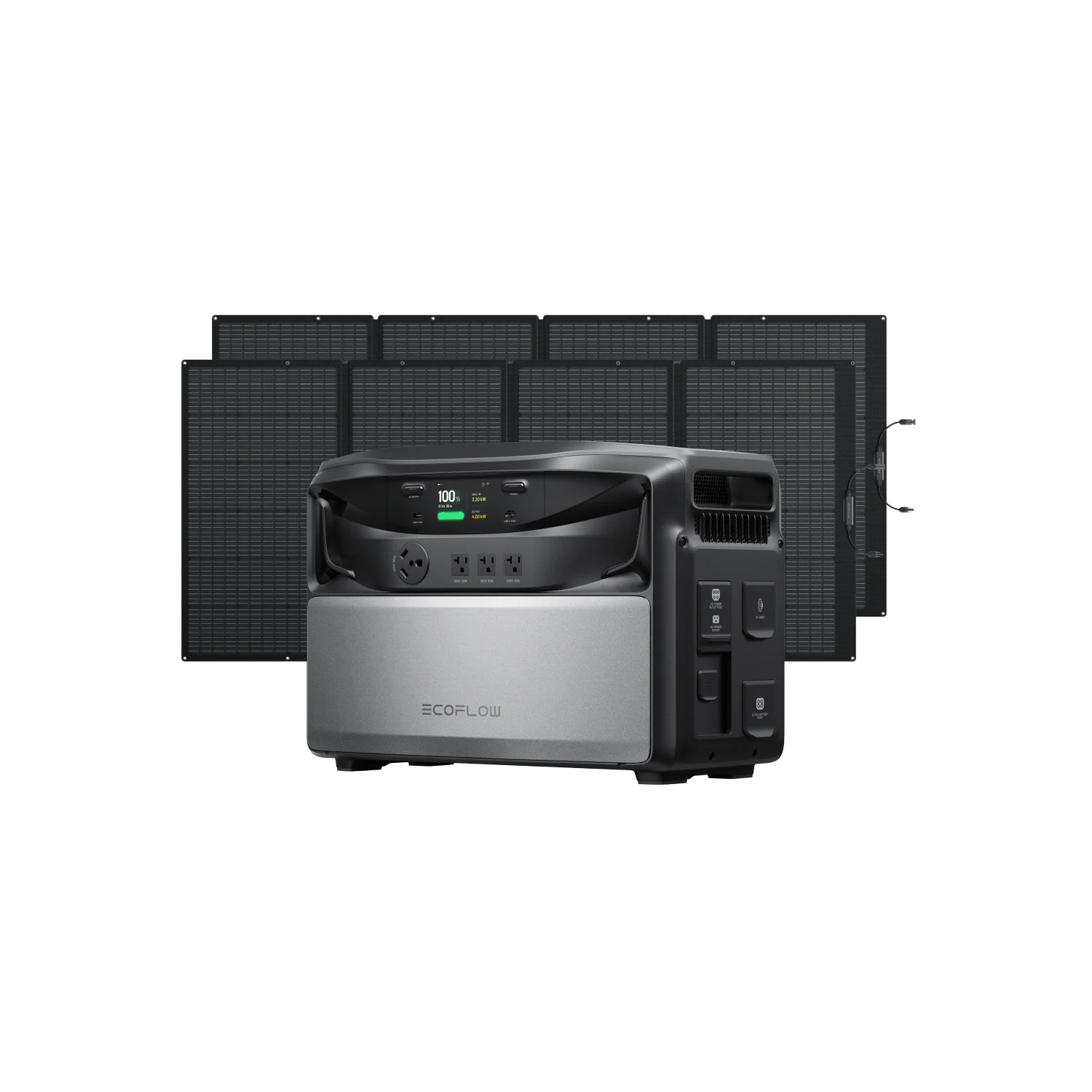
The variant-linked image shows a promotional array considerably larger than the two panels named in TTC-400W-2. It identifies the Classic station family, but does not tell you how many panels are included. The image caption explains the mismatch so a shopper does not mistake a marketing composite for a kit photograph. The exact selected-offer title, SKU and variant ID are the evidence for the two-panel configuration.
Classic tradeoffs: weight and outlets versus output
The Classic’s station specification lists 5,017.6 Wh of LFP capacity, a 3,200 W solar-input maximum, and a 30–250 V input range. The 800 W panel set is below that input ceiling; it does not fill the station’s full solar capability, and actual harvest depends on conditions. This package may make sense when the buyer wants panels included now and does not need to scale the array much beyond the named pair. A larger future array remains bounded by the Classic’s own 3,200 W specification, not by what a different TITAN model accepts.
The station alone is listed at 102.5 lb, less than the regular and Plus models, yet still a substantial piece of equipment. That is not the weight of the complete kit; the exact panel mass and total carrying load are unverified. The Classic has a 60 W USB-C and 18 W USB-A output in its published table, unlike the Plus specification, and its direct-output set includes a TT-30 receptacle. A TT-30 label is only a connector type: it does not guarantee 30 A continuous output. Check the exact current and watt limits in the manufacturer instructions against your RV loads.
Which needs does this package answer?
It is worth comparing when your essential equipment is 120 V, the 4,000 W AC rating is adequate, and you want two panels named in the selected bundle. The solar input remains separate from the home AC output: panel watts do not add inverter power. Also separate the station’s 5,017.6 Wh nameplate capacity from usable energy at an AC outlet. No runtime or time-to-charge can be computed from the manufacturer’s nameplate figures alone.
Do not choose the Classic only because its model name says “5000.” If 240 V is mandatory, examine the regular TITAN 5000 two-panel offer or the Plus two-panel offer, with their own output and package limits. The Plus offers more solar-input headroom but no USB-A or USB-C in its listed edition; the standard model falls between the Classic and Plus on solar input. For 120 V-only loads, the Classic may instead avoid buying a larger split-phase platform you will not use.
Bottom line
TTC-400W-2 combines an individually identified U.S. Classic option with a title-level pair of 400 W panels. It suits a buyer who can stay within its 120 V / 4,000 W station limits and wants a supplied 800 W nameplate panel set. Its lower listed station weight and small-device ports are practical differences, but the package’s full mass, panel identities, accessories and connection details are unknown. The offer was unavailable in the saved manufacturer snapshot; recheck the exact SKU and supplied parts. If you need 240 V or a confirmed installation package, choose a configuration that documents those requirements instead. No live availability, price, measured charging performance or personal ownership is claimed.
Key details at a glance
| Nameplate battery capacity | 5017.6 Wh |
|---|---|
| Rated AC output | 4000 W |
| Maximum solar input | 3200 W |
| Included panels, combined nameplate | 800 W |
| Maximum USB-C output per port | 60 W |
| Listed weight | 102.5 lb |
| Compatible extra-battery expansion | Yes |
| Manufacturer UPS transfer figure | 20 ms |
| Base warranty term | 5 years |
| AC outlet output | Yes |
| USB-C ports | 1 |
| USB-A ports | 1 |
| Solar input ports | 1 |
| Battery chemistry | LFP |
| Ingress rating | IP20 |
| HPP 120/240 V split-phase | No |
| Solar panels in exact offer | 2 |
Use the exact model’s instructions for operating limits, supplied equipment and version differences.
Sources for this assessment

A useful match starts with the loads that matter.
Use the finder for hard electrical requirements, then check appliance starting behavior, actual run time and the exact package in the full assessment.