
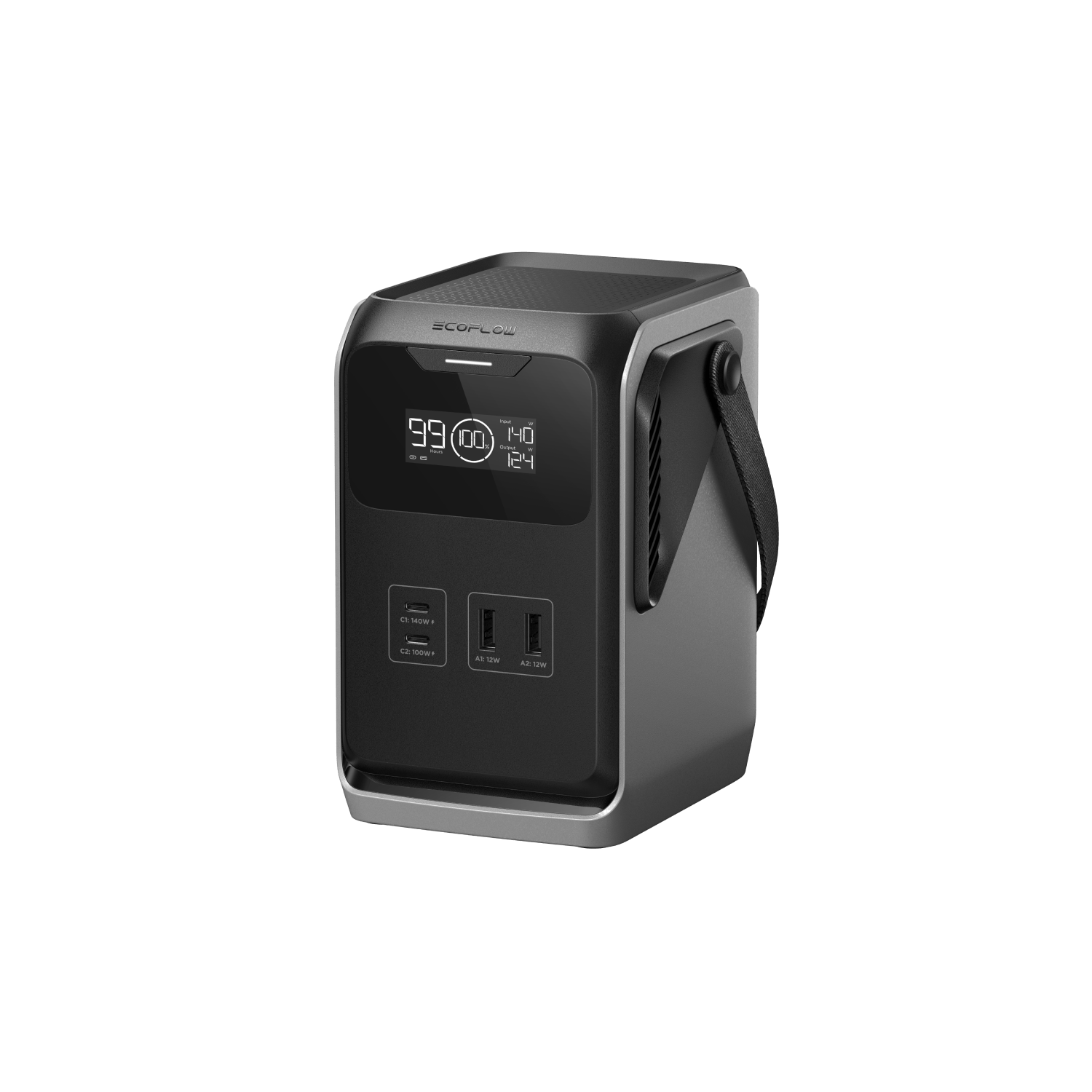
Your needs, this model
Does it fit your priorities?
Do you need a light USB-only station under 5 lb for a 192 Wh device-charging plan?
This model is listed at 4.03 lb and 192 Wh, with a 140 W USB-C port and a 220 W total DC output ceiling; nameplate capacity is not a guaranteed charge count.
Explore this need in the finder →Is one USB-C port rated to 140 W and a second at 100 W enough for your USB-C devices?
The shared user manual specifies one 140 W and one 100 W USB-C input/output port, plus two 12 W USB-A outputs; combined draw still must fit the station's 220 W ceiling.
Explore this need in the finder →Can your setup work without a car socket or a solar charging input?
Yes, if the plan is USB-only: the TRAIL 200 DC has no 12 V car outlet and no solar/car input, so it cannot meet either requirement.
Explore this need in the finder →Who the TRAIL 200 DC suits
The EcoFlow TRAIL 200 DC is a 192 Wh LFP battery in a roughly four-pound, carry-by-hand package. Its exact US retail SKU is EF-TRAIL200-USAMZ-N and the shared manufacturer manual identifies model EF-TX-192. It is a very small direct-current station for USB devices, not a miniature household backup inverter. That distinction is the first and most important fit question.
EcoFlow rates its total output at 220 W. The front panel has two USB-C ports, one rated up to 140 W and the other up to 100 W, plus two USB-A ports rated up to 12 W apiece. The USB-C ports are bidirectional, so they can charge the battery or devices. A compatible USB-C PD laptop, camera, phone, tablet or small accessory can be a sensible load; actual power depends on the device's negotiated profile. The individual port maxima are not a promise that every port can provide its maximum at once: total station output is still 220 W.
No AC outlet, car socket or solar port
Despite the word “station,” this model has no 120 V receptacle. It cannot power an appliance whose only input is an AC plug, and an adapter does not create an inverter. It also lacks a 12 V car-style output and the XT60 solar/car input found on the TRAIL 300 DC. Plan to recharge this model through USB-C, not with a panel or a vehicle charging lead. If your camera rig, radio or campsite appliance expects a cigarette-lighter socket, that omission rules the 200 out even when its wattage seems adequate.
The choice is consequently quite specific: choose it when the load list is USB-only, the 192 Wh nameplate capacity is enough for your planned charging, and minimizing carry weight matters. Do not translate 192 Wh into a guaranteed number of laptop or phone charges. Conversion, device draw, battery condition and how much reserve you keep all change delivered energy. EcoFlow does not publish load-specific runtime in the sources reviewed here.
Useful controls, with a small-device step
The display reports battery level and input/output status. For low-current USB-A accessories such as a watch or earbuds, the manual says to double-press the multifunction button to enable low-current mode; the display icon flashes and the mode lasts about three hours unless ended sooner. USB-C can power low-current equipment without that special mode. This is a practical detail for a device whose likely loads include small electronics, but it requires learning the button sequence rather than assuming every accessory will behave like a wall charger.
The page lists a three-year warranty and IP30 protection. IP30 is not a rain rating, and the manual explicitly says not to expose the station to rain or snow. Keep it dry and ventilated rather than relying on the marketing language about outdoor use. The battery is not user-replaceable and the unit has no user-serviceable parts. For long-term storage, EcoFlow says to cycle the product every three months, then store it near 60 percent, and warns against leaving it unused or uncharged for more than six months.
Check the exact dimensions before packing
The product page and shared manual disagree on the TRAIL 200's listed dimensions: the US specifications page gives 167 × 115 × 126 mm (HWD), while the manual lists approximately 143 × 115 × 167 mm. Both describe a compact four-pound unit, but the size mismatch is material if it must fit a close-fitting case or camera bag. Confirm the body dimensions with EcoFlow before designing a tight storage space around either figure. This assessment does not resolve that documentation conflict by guessing.
Alternatives and limits
Move up to the TRAIL 300 DC if you need a car socket, solar charging, vehicle input or its larger 300 W total DC ceiling. The 300 is heavier but remains under six pounds; it is a different port arrangement, not an expansion battery for the 200. If the required device needs 120 V AC, compare a small inverter station such as EcoFlow's DELTA 3 Classic instead, accepting a much larger battery and carrying weight. For a solar-capable DC-only trip with a 12 V load, the TRAIL 300 is the closest in-family alternative.
The assessment is based on EcoFlow's US listing, its variant data and the English TRAIL 200 DC / TRAIL 300 DC manual. I did not independently test capacity, output, charge time, drop resistance or waterproofing. The exact model and market matter: the TRAIL 200 is the USB-only member, not a reduced-output version that keeps the larger model's car or solar ports.
Key details at a glance
| Nameplate battery capacity | 192 Wh |
|---|---|
| Maximum solar input | 0 W |
| Maximum USB-C output per port | 140 W |
| Listed weight | 4.03 lb |
| Compatible extra-battery expansion | No |
| 12 V DC output | 0 W |
| Base warranty term | 3 years |
| Total rated DC output | 220 W |
| AC outlet output | No |
| USB-C ports | 2 |
| USB-A ports | 2 |
| Solar input ports | 0 |
| 12 V car-style output | 0 W |
| Vehicle charge input | 0 W |
| Battery chemistry | LFP |
| Ingress rating | IP30 |
Use the exact model’s instructions for operating limits, supplied equipment and version differences.
Sources for this assessment
A useful match starts with the loads that matter.
Use the finder for hard electrical requirements, then check appliance starting behavior, actual run time and the exact package in the full assessment.