
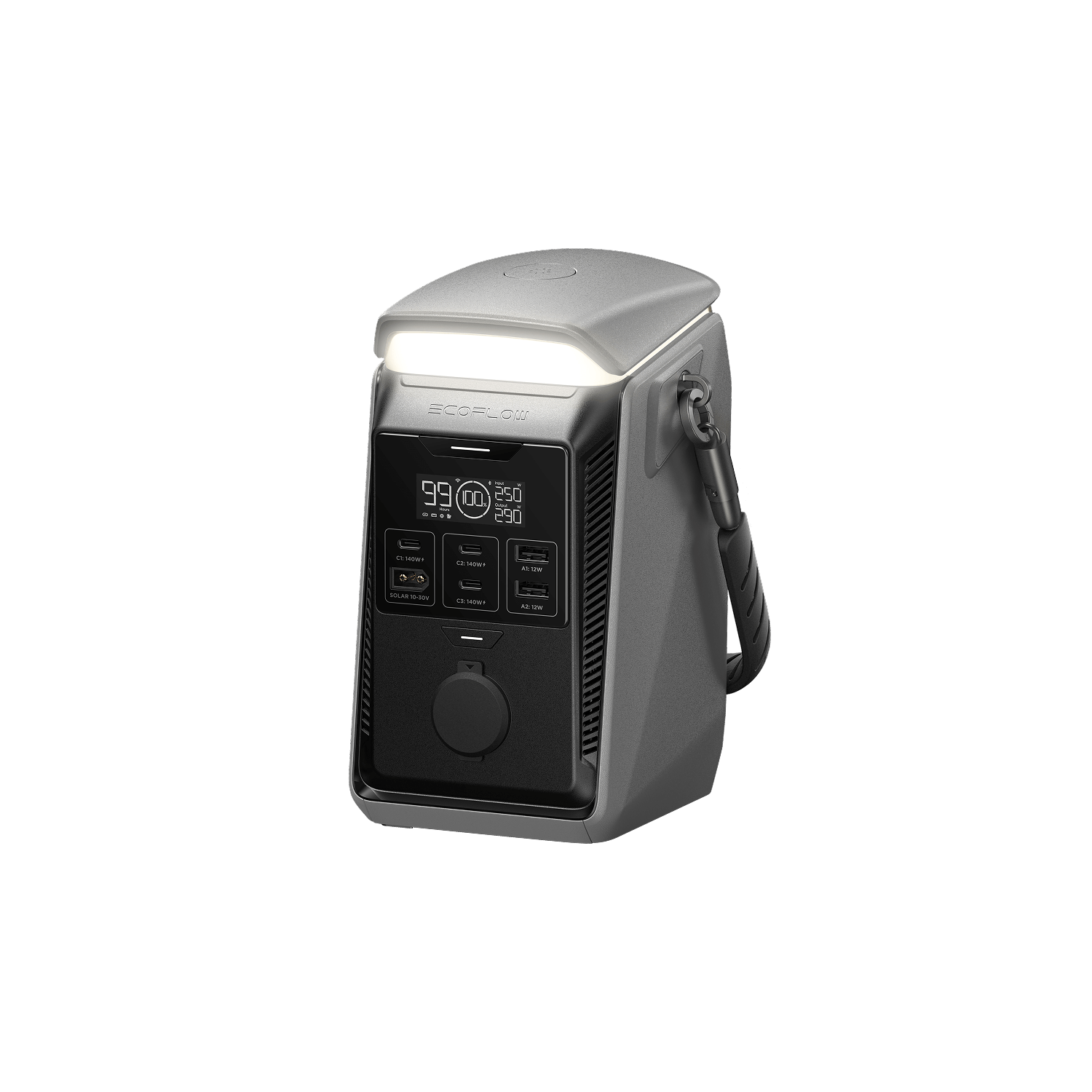
Your needs, this model
Does it fit your priorities?
Do you need three high-output USB-C ports and a built-in light, while staying with direct DC rather than AC?
The TRAIL Plus 300 DC lists three bidirectional 140 W USB-C ports, a multi-function camping light and 300 W total DC output. It has no AC inverter, and its per-port maxima do not stack above the 300 W total ceiling.
Explore this need in the finder →Must one compact station power USB gear and a 12 V car-style accessory without an inverter?
The Plus lists a 120 W 12 V car outlet, three USB-C ports and a 300 W total DC limit. Check the accessory's startup draw and connector; an AC-only load remains incompatible.
Explore this need in the finder →Is a small solar or vehicle recharge route essential for a light 288 Wh DC kit?
The EF-TX-288P V1.0 manual specifies the shared Solar/Car XT60 input at 10–30 V, up to 10 A / 110 W, and says solar-panel output must be below 30 V. It supports 12 V car charging via a separately sold cable; USB-C3 and Solar/Car cannot charge together. Check the current EcoFlow Support manual and the exact package before connecting a source.
Explore this need in the finder →Who the TRAIL Plus 300 DC suits
EcoFlow's TRAIL Plus 300 DC is a small, direct-current station for camp or vehicle kits built around USB devices and a modest 12 V accessory. The US specification gives it 288 Wh, a 300 W total discharge limit and a 4.98 lb listed weight. Its layout is unusually USB-C-heavy: three bidirectional USB-C ports rated up to 140 W, two 12 W USB-A ports, a 120 W car-style outlet, a built-in multi-mode light and a detachable 140 W charging-cable handle. That combination may be useful when laptops, cameras and lights matter more than AC sockets.
It is not a tiny household-backup inverter. EcoFlow classifies the Plus as pure DC and publishes no AC outlet or rated AC output. An AC-only appliance will not work through a plug adapter. The exact hardware model is EF-TX-288P; it should not be confused with the similarly named TRAIL 300 DC (EF-TX-288), which has LFP cells, two USB-C ports and a different operating manual.
What changes versus the TRAIL 300 DC
The regular 300 DC and Plus share 288 Wh, a 300 W total DC ceiling, two USB-A ports and a 120 W 12 V outlet. Standard TRAIL 300 uses LFP cells; the Plus uses NCM. That's a genuine chemistry difference, not proof of a longer life for either one. EcoFlow lists the Plus at 4.98 lb (2.26 kg), while the V1.0 manual rounds it to about 2.3 kg / 5.1 lb; treat it as a roughly five-pound carry. The Plus adds USB-C, app support, a camping light and cable-handle feature; the regular 300 has a woven handle. Neither provides AC.
Each USB-C port is rated to 140 W, but the station's total DC output is 300 W and the car socket is rated 120 W; port labels do not make 420 W available at once. Count real device loads and startup draw. The manual also warns that USB-C3 and the Solar/Car input cannot charge the station simultaneously. If Solar/Car is connected first, USB-C3 output is disabled.
Choose it for the connections, not just the capacity label
The third high-power USB-C port is the clearest reason to choose the Plus over the standard TRAIL 300. It may make cable management easier for a small group sharing laptops, camera gear or tablets, while the light adds utility at camp. The detachable handle doubles as a 140 W USB-C cable for compatible devices. If your needs are only a phone and a small light, the lighter TRAIL 200 DC may be enough, but it has just 192 Wh, a 220 W output ceiling, no 12 V outlet and no solar/car input.
For a 12 V cooler, pump or vehicle accessory, check the plug, running draw and startup surge against the device instructions. The Plus's car outlet is rated 12 V / 10 A (120 W); that is not a guarantee that every nominally 12 V appliance will run, nor does it predict runtime. Its 288 Wh is nameplate energy, not usable energy or a load-specific runtime result. List each essential device and its expected hours, then retain a reserve. If one must-have device has an AC plug, compare an inverter station such as the RIVER 3 Plus instead of counting on an adapter.
Charging details that matter in a small setup
The exact EF-TX-288P V1.0 manual lists USB-C input/output up to 140 W and a shared XT60 Solar/Car input rated 10–30 V, 10 A and 110 W. It says solar-panel output must be below 30 V. Vehicle charging uses a 12 V car outlet and separate cable; the manual gives no separate car-input watt rating. Solar and car cables are sold separately. Its standalone box list names the station and a Product Document Bundle, not the contents of the 45 W or 60 W panel offers.
The manual allows charging at 0–45 °C and discharge at −10–45 °C. For long storage it recommends a dry, ventilated place and recharging/discharging every three months, leaving the battery around 60%. It says the warranty will be void if the unit remains unused and uncharged for more than six months. IP30 is not weatherproof: EcoFlow says not to expose it to rain or snow. The battery is not replaceable by the user. Follow current instructions rather than borrowing limits from the LFP model.
Availability and exact-model checks
The archived EcoFlow U.S. option record identifies two separate Plus packages: variant 54590654873673 / SKU EF-TRAIL300Plus-45W is titled TRAIL Plus 300 DC + 45W Solar Panel, and variant 54590654906441 / SKU EF-TRAIL300Plus-60W is titled TRAIL Plus 300 DC + 60W Solar Panel. In the October 23, 2026 store snapshot, both panel options were sold out and the standalone Plus showed Coming Soon. The exact station in each title is the reviewed EF-TX-288P, but the option records and images do not establish the panel model or complete accessories. Its 110 W Solar/Car ceiling remains the input limit; a panel's rated watts do not guarantee charging under shade, heat or poor sun.
EcoFlow's separate 45 W Type-C page identifies SKU EFSOLAR45-TYPE-C: 45 W (±5), 25.6 V open circuit and 22 V / 1.98 A at maximum power. Those figures fit the Plus manual's solar limits. The panel's own box graphic lists a DC5521-to-XT60i cable and hooks, but the Plus bundle page does not link that SKU or itemize its package. Treat this as a likely component, not verified bundle contents. The separate 60 W panel page was not reachable, so its exact model remains unconfirmed.
Neither option image is a parts list: the 45 W box graphic names standard TRAIL 300 DC, not Plus; the 60 W shows the Plus and documents only. Confirm the exact panel code and lead. The V1.0 manual copy was dealer-hosted; check EcoFlow Support for a newer revision.
In the finder, requiring AC output rules this model out; choosing DC-only and needing its three USB-C ports, light or 12 V outlet makes those differences relevant. Raise the minimum solar-input need above 110 W and it no longer fits. A preference for LFP also points away from this NCM model. No sample was independently tested, and no measured runtime, charge time, usable capacity or drop resistance is claimed.
Key details at a glance
| Nameplate battery capacity | 288 Wh |
|---|---|
| Maximum solar input | 110 W |
| Maximum USB-C output per port | 140 W |
| Listed weight | 4.98 lb |
| 12 V DC output | 120 W |
| Base warranty term | 3 years |
| Total rated DC output | 300 W |
| AC outlet output | No |
| USB-C ports | 3 |
| USB-A ports | 2 |
| Solar input ports | 1 |
| 12 V car-style output | 120 W |
| Battery chemistry | NCM |
| Ingress rating | IP30 |
Use the exact model’s instructions for operating limits, supplied equipment and version differences.
Sources for this assessment
- EcoFlow US TRAIL Plus 300 DC product option
- EcoFlow US TRAIL Series specifications
- EcoFlow US TRAIL Series
- EcoFlow US TRAIL Series product-option JSON
- EcoFlow TRAIL Plus 300 DC important safety instructions filed for FCC ID 2A2P9-EFTX288
- EcoFlow TRAIL Plus 300 DC Portable Power Station (288Wh), User Manual V1.0
- EcoFlow US Support: App, Manuals & Downloads
A useful match starts with the loads that matter.
Use the finder for hard electrical requirements, then check appliance starting behavior, actual run time and the exact package in the full assessment.