
Your needs, this model
Does it fit your priorities?
Do your essential U.S. appliances fit within 2,000 W continuous at 120 V, with 1,505.28 Wh of nameplate energy?
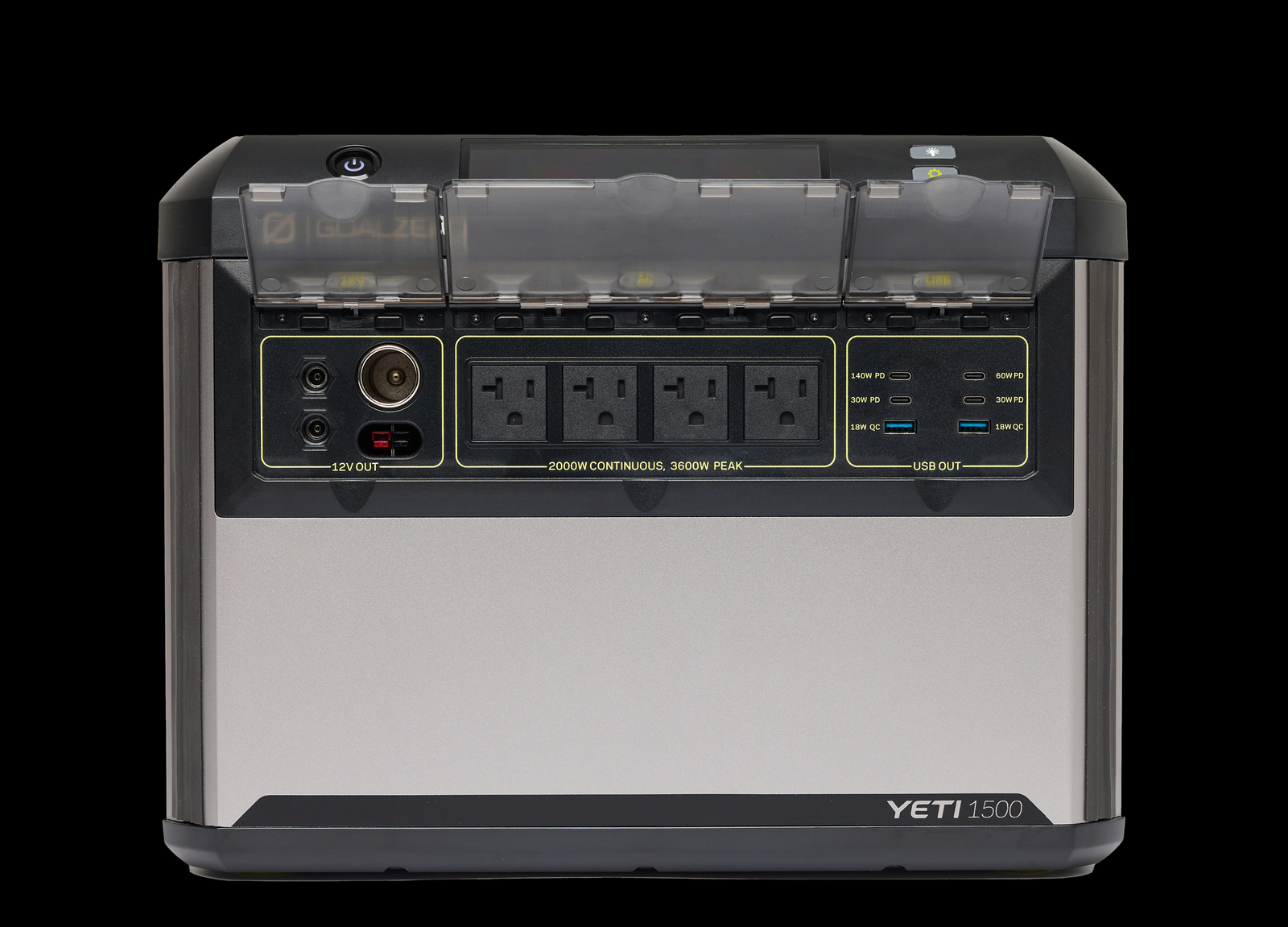
The Yeti 1500 6G is rated for 2,000 W continuous at 120 V and has 1,505.28 Wh of nameplate storage. Four outlets share the same station-wide ceiling; the surge rating is not a sustained load limit.
Explore this need in the finder →Would fast wall charging or a two-branch solar setup matter more than keeping the station light?
The official guide lists up to 1,500 W fast AC input and separate HPP/8 mm solar inputs totaling at most 900 W. The unit weighs about 53 lb, and compatible panels/cables are not in the standalone box.
Explore this need in the finder →Do you need battery expansion, 240 V, or a no-break/zero-transfer power supply?
This exact station is a single 120 V unit, does not accept older Yeti Tank/Link expansion, and its manufacturer describes APS under 15 ms rather than zero-time transfer.
Explore this need in the finder →The Goal Zero Yeti 1500 (6th generation, U.S. SKU 37300) is a single, 1,505.28 Wh LiFePO₄ station with four 120 V AC outlets and a 2,000 W continuous inverter. It is a useful middle ground for a household outage kit, vehicle basecamp or work setup that needs more reserve than the Yeti 700 but does not need 240 V. Its “1500” name is not its output rating: 1,500 refers to the capacity class, while the continuous AC ceiling is 2,000 W across the station.
What the larger body buys you
The 1,505 Wh figure is nameplate battery energy, not a promise that an AC appliance can use all 1,505 Wh at its wall plug. Inverter overhead, load cycling, temperature and the reserve you keep all affect the energy available for a particular job. Goal Zero does not publish an AC-delivered usable-energy figure for this model, so do not turn capacity into a precise runtime estimate without measuring your own load. The inverter is rated for 2,000 W continuous and 3,600 W surge; four outlets do not provide four independent 2,000 W supplies, and all outputs combined remain limited to 2,000 W.
For ordinary 120 V equipment, that ceiling can support many household and campsite appliances whose running demand and startup surge fit the rating. It is still not a whole-home 240 V source: there is no documented split-phase output, TT-30 receptacle, transfer-switch kit in the standalone box or compatible expansion tank. An older Yeti Tank battery or Yeti Link does not turn this 6G model into an expandable system. If you need a backed-up panel, more stored energy or 240 V, choose a specifically documented larger system instead.
Fast refill, two solar inputs
Wall charging is the standout practical difference. Goal Zero lists up to 1,500 W fast AC input and a 750 W lower-speed mode. The guide gives about 1.1 hours for a full fast charge and 2.2 hours at low speed, while the current product page gives 2.4 hours for low speed; treat that modest discrepancy as a published estimate, not a promised refill time. Fast charging draws heavily from a household circuit, so reduce the input limit or avoid sharing a breaker with other heavy loads if that circuit trips. The station supports pass-through operation, but that does not establish uninterrupted service for every electronic device.
Solar is unusually flexible for this capacity: the rear has separate HPP and 8 mm inputs, rated up to 600 W and 300 W respectively, for a 900 W combined ceiling. The voltage and current limits differ by input, so the combined wattage is not permission to connect any arbitrary panel arrangement. A source must fit that input’s voltage, current and connector limits. Goal Zero says compatible legacy HPP and 8 mm solar equipment can work, but the standalone offer includes no panel or solar lead. A compatible 200 W panel is a much slower refill than a strong two-input array; actual harvest varies with sun, angle, shade and temperature.
Useful ports, with outdoor and storage limits
Alongside the four AC outlets, the station provides two USB-A ports, four USB-C ports (one up to 140 W, one 60 W and two 30 W), a 12 V auxiliary socket and dedicated high-current HPP and 6 mm outputs. The manufacturer’s combined 12 V ceiling is 405 W; respect the individual current limits rather than adding every printed port maximum. The box lists the station and AC charging cable. The solar panel, vehicle-charge cable and carrying accessories are separate choices.
Goal Zero lists IPX4 splash resistance, a 52.75 lb weight, a five-year warranty and operating ranges of 0 to 40 °C for charging and −20 to 40 °C for discharge. IPX4 is not waterproofing: keep port covers closed and move the unit to a dry, sheltered place rather than running live loads in rain. The guide says the battery is not user-replaceable and advises storing it in a dry, climate-controlled place; an unplugged station should be recharged every three to six months. The 4,000-cycle figure is a manufacturer rating to about 80% capacity under stated conditions, not a guaranteed lifespan for every use pattern.
Who should compare another station?
Choose the Yeti 1500 when you want substantial single-station reserve, 2 kW of 120 V output, fast wall refill and up to 900 W of solar input, and can handle a roughly 53 lb lift. It makes more sense than the compact Yeti 500 or 700 for loads that need both greater energy and greater inverter capacity; the 700 tops out at 600 W continuous and 677 Wh. The tradeoff is that the 1500 is heavier and still has no battery expansion. If your essential load needs 240 V, exceeds 2,000 W continuously, requires more than the documented 12 V or solar limits, or must remain uninterrupted through a zero-millisecond transfer, it is not a fit. The manual describes automatic power switching under 15 ms, not a zero-time UPS, and Goal Zero cautions against life-saving medical equipment. Do not treat an advertised appliance runtime as a tested result or medical-use approval.
Primary references: Goal Zero U.S. Yeti 1500 product page and selected SKU 37300, Goal Zero Yeti 1000/1500 6th Generation User Guide, and CPSC YETI 3000X recall scope notice (that notice identifies the 3000X model, not SKU 37300). Manufacturer rates and recharge times are not independent test results; no physical sample was tested.
Key details at a glance
| Nameplate battery capacity | 1505.28 Wh |
|---|---|
| Rated AC output | 2000 W |
| Manufacturer surge rating | 3600 W |
| Maximum solar input | 900 W |
| Included panels, combined nameplate | 0 W |
| Maximum USB-C output per port | 140 W |
| Listed weight | 52.75 lb |
| Compatible extra-battery expansion | No |
| 12 V DC output | 405 W |
| Maximum AC recharge input | 1500 W |
| Base warranty term | 5 years |
| AC outlet output | Yes |
| USB-C ports | 4 |
| USB-A ports | 2 |
| Solar input ports | 2 |
| 12 V car-style output | 162 W |
| Battery chemistry | LFP |
| Ingress rating | IPX4 |
| Manufacturer minimum charge temperature | 0 °C |
| Manufacturer minimum discharge temperature | -20 °C |
| Solar panels in exact offer | 0 |
Use the exact model’s instructions for operating limits, supplied equipment and version differences.
Sources for this assessment
A useful match starts with the loads that matter.
Use the finder for hard electrical requirements, then check appliance starting behavior, actual run time and the exact package in the full assessment.