
Your needs, this model
Does it fit your priorities?
Are your essential AC loads standard 120 V and within 2,000 W continuous, with at least 1,516 Wh of nameplate storage?
The exact Open Box SKU 36300R retains the Yeti 1500X ratings: 120 V, 2,000 W continuous, 3,500 W surge, and 1,516 Wh nameplate. Its two AC outlets share one inverter ceiling; runtime depends on the actual load and conversion losses.
Explore this need in the finder →Do you need a solar input ceiling above 600 W, or is 600 W enough for your panel plan?
The manufacturer lists 600 W maximum across the solar inputs. The user guide is more conservative than the product page about each 8 mm input, so check panel voltage and connector and do not exceed 50 V.
Explore this need in the finder →Is open-box condition acceptable, including a six-month warranty and final-sale/no-return terms?
This is the exact Goal Zero Open Box SKU 36300R, not a new retail Yeti 1500X. Goal Zero states open-box units are tested working, may have cosmetic marks or lack retail packaging, carry a six-month warranty and are final sale.
Explore this need in the finder →Would you add a compatible battery system for more reserve, while keeping the same 120 V / 2,000 W inverter?
A current Link Expansion Module V3 SKU 98212 and two or four Tank V3 batteries are optional, heavy components. The station alone is 1,516 Wh; the documented 2,400 Wh or 4,800 Wh Tank add-on plan has a summed nameplate total of 3,916 Wh or 6,316 Wh.
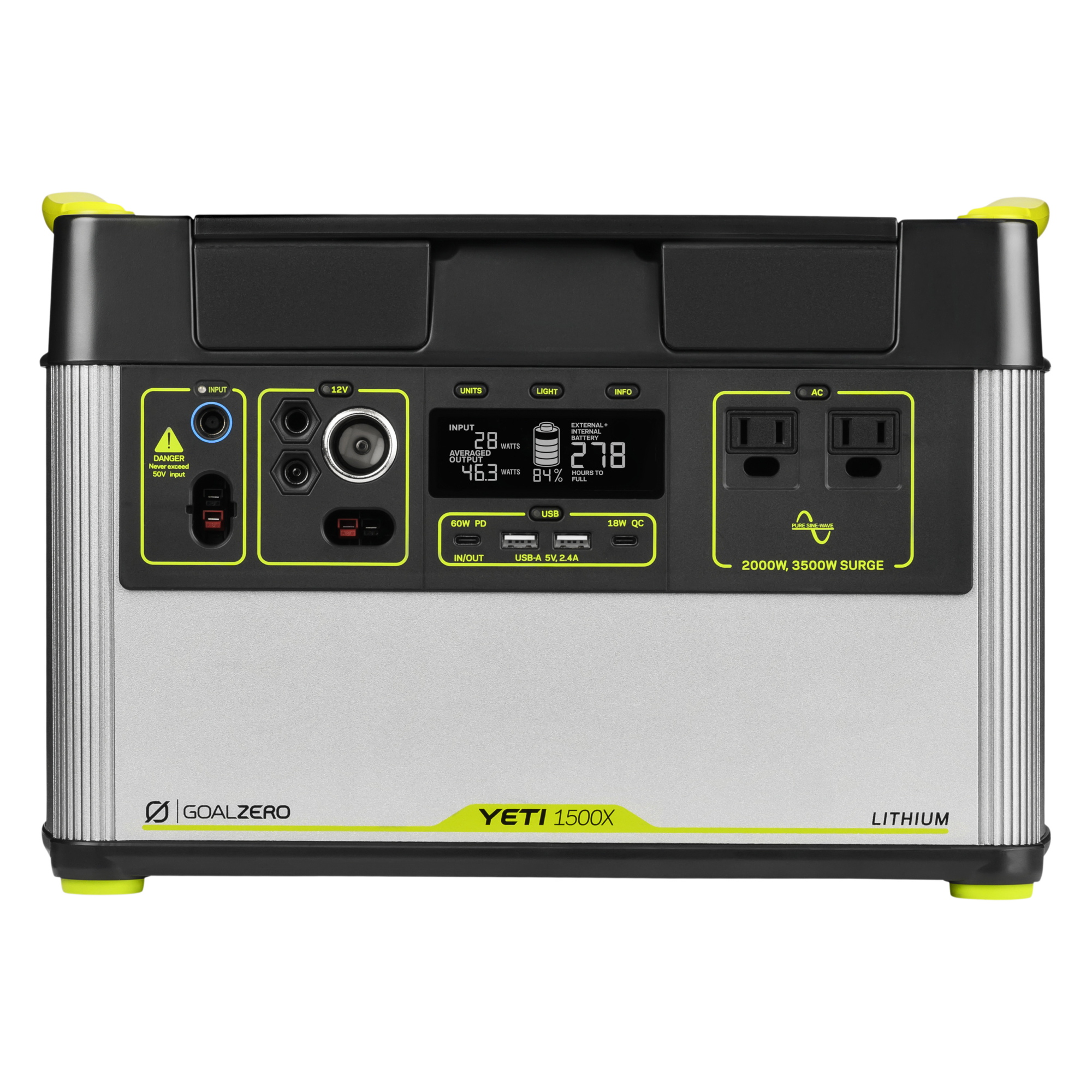
Explore this need in the finder →The Goal Zero Yeti 1500X Open Box is the older X-series station, not the newer Yeti 1500 6th Generation. The exact U.S. offer is product 7518946001065, variant 42316564037801, SKU 36300R, barcode 847974010396. It has a 1,516 Wh lithium-ion NMC battery and two 120 V AC outlets rated for 2,000 W continuous and 3,500 W surge. Its case for purchase depends as much on your willingness to buy open-box as on those specifications.
Open-box condition is the key tradeoff
Goal Zero says these units are tested and working but may be unused returns, demo/photo units, packaging-defect returns or cosmetically marked, and may lack retail packaging. The exact offer lists a six-month warranty and final-sale terms with no returns or exchanges. Its Open Box FAQ says original in-box items, including charging cables and user guides, are included. That is different from receiving a new Yeti 1500X with the standard two-year coverage. If you require a new-only condition, choose another offer; do not mistake this for the newer Yeti 1500 6G, which is a separate model with a different chemistry and power specification.
Two AC outlets, one shared 2,000 W inverter
The X provides standard U.S. 120 V AC, not 240 V split-phase. Its two household receptacles share a single 2,000 W continuous limit; 3,500 W is a surge rating, not sustained output. Add the running draw of simultaneous appliances and check startup needs. It can suit a selected set of lights, networking gear, a refrigerator or workshop tools if their actual draw fits, but it is not a whole-house connection by itself. Fixed-circuit backup needs compatible equipment and professional installation.
The manual lists a 60 W USB-C Power Delivery port that also accepts input, a separate USB-C port up to 18 W, and two USB-A ports up to 12 W each. Its DC ports include one 12 V car outlet up to 160 W, two 6 mm outlets up to 120 W each and two High Power Port outlets up to 360 W each. Those are individual-port limits; Goal Zero does not publish a combined DC-output ceiling here. The station itself weighs 45.64 lb. A roll cart is sold separately, and this open-box station listing does not include it.
Charging requires a compatible accessory plan
The base Yeti 1500X box lists the station and a 120 W AC wall supply. The open-box offer includes original in-box contents, but no solar panel or vehicle charging cable is listed. Goal Zero’s manual estimates about 12.5 hours from the 120 W wall supply in its table and about 13 hours in its instructions; the current product page says 14 hours. The maker also lists three hours using an optional 600 W supply and seven with an optional 230 W supply. These are manufacturer estimates, not measurements of this unit.
Solar input tops out at 600 W across the charging inputs. The High Power Port is rated up to 600 W; the manual describes each of two 8 mm inputs as up to 120 W, within that same total. The product page instead lists 150 W per 8 mm input, so use the lower manual limit when selecting a cable or combining sources. The guide also warns not to exceed 50 V. Goal Zero’s 100 W and 200 W panel recharge ranges assume sun exposure and are not guaranteed harvest. For vehicle charging, use the specified Yeti cable; a generic lead can damage the station.
Expansion is supported, but is not included
Goal Zero’s current Yeti Link Expansion Module V3 (SKU 98212) explicitly lists the 1500X as compatible and connects separately sold Tank V3 batteries. Two Tanks add 2,400 Wh of nameplate storage; four add 4,800 Wh. The corresponding station-plus-expansion nameplate totals are 3,916 Wh and 6,316 Wh, while AC remains 120 V and 2,000 W continuous. This is a home-base plan, not a portable package: each Tank weighs 77.1 lb, before counting the station and Link. Neither Link nor Tank batteries come with the open-box station.
Check expansion accessory labels carefully. CPSC’s 2024 notice named earlier Yeti Link models 98200/98210 and particular EC8 cables; Goal Zero’s current Link V3 page specifies SKU 98212. Do not assume a secondhand Link or cable is safe from its appearance alone—verify the exact model and recall remedy before connecting it.
Who should choose it—and who should pass
Consider this offer if your essential loads fit 120 V and 2,000 W continuous, the 1,516 Wh nameplate reserve suits your plan, and you accept a tested open-box unit with six months of coverage and final-sale terms. Pass if you need 240 V, more than 600 W solar input, a light hand-carry station, an included panel or new-only condition. Do not treat its 3,500 W surge figure as an ordinary continuous rating or its nameplate capacity as published AC energy delivered.
Questionnaire answers should change the recommendation: a 120 V load plan within the inverter rating can qualify; a 240 V requirement, a solar threshold above 600 W or an explicit new-only condition should exclude this offer. Expansion can qualify only as a separately assembled plan with compatible Link V3 and Tank V3 accessories, and it becomes very heavy. Goal Zero notes conversion losses; no physical unit, load, noise or runtime test was performed for this review. Check the exact appliance draw and live offer status before deciding.
Primary references: Goal Zero’s U.S. Yeti 1500X Open Box offer, Open Box terms and Yeti 1500X User Guide; the Link Module V3 and Tank V3 specifications; and the CPSC Yeti Link/EC8 recall notice. The page/manual input and recharge estimates differ; conservative limits are stated above.
Key details at a glance
| Nameplate battery capacity | 1516 Wh |
|---|---|
| Rated AC output | 2000 W |
| Manufacturer surge rating | 3500 W |
| Maximum solar input | 600 W |
| Included panels, combined nameplate | 0 W |
| Maximum USB-C output per port | 60 W |
| Listed weight | 45.64 lb |
| Compatible extra-battery expansion | Yes |
| 12 V DC output | 360 W |
| Maximum AC recharge input | 600 W |
| Base warranty term | 0.5 years |
| AC outlet output | Yes |
| USB-C ports | 2 |
| USB-A ports | 2 |
| Solar input ports | 3 |
| 12 V car-style output | 160 W |
| Battery chemistry | NCM |
| Manufacturer minimum charge temperature | 0 °C |
| Manufacturer minimum discharge temperature | 0 °C |
| Expansion battery in this package | No |
| Home Power Panel in this package | No |
| Separate station units in offer | 1 |
| Smart Transfer Switch in this package | No |
| Expansion packs in exact offer | 0 |
| Solar panels in exact offer | 0 |
Use the exact model’s instructions for operating limits, supplied equipment and version differences.
Sources for this assessment
- Goal Zero U.S. Yeti 1500X Open Box offer
- Goal Zero Shopify object for Yeti 1500X Open Box
- Goal Zero Yeti 1500X User Guide (English section, archived official PDF)
- Goal Zero U.S. Open Box/Refurbished Products terms
- Goal Zero U.S. Yeti 1500X base-offer specification page
- Goal Zero Yeti Link Expansion Module V3 page
- Goal Zero Yeti Tank Expansion Battery V3 page
- Goal Zero Yeti Link & Tank Expansion V3 collection
- U.S. Consumer Product Safety Commission Goal Zero Yeti Link/EC8 cable recall 24-270
A useful match starts with the loads that matter.
Use the finder for hard electrical requirements, then check appliance starting behavior, actual run time and the exact package in the full assessment.