
Your needs, this model
Does it fit your priorities?
Does your single-station 120 V load plan need up to 3,600 W continuous and about 4 kWh nameplate capacity?
The Yeti PRO 4000 is a 120 V-only station rated for 3,600 W continuous and 3,993.6 Wh nameplate storage. Its five AC receptacles share that inverter ceiling; this is not a 240 V plan.
Explore this need in the finder →Will you provide compatible panels and cabling for a high-input solar setup?
Goal Zero lists up to 3,000 W solar input, but the compatible panel array, voltage/current limits and connecting cable must be selected separately. No solar panel or lead is in the base box.
Explore this need in the finder →Do you need the option to expand stored energy beyond one station?
The Yeti PRO 4000 supports up to four separately sold Tank PRO 4000 batteries; the combined nameplate total is about 19,968 Wh, while the 120 V inverter remains rated at 3,600 W.
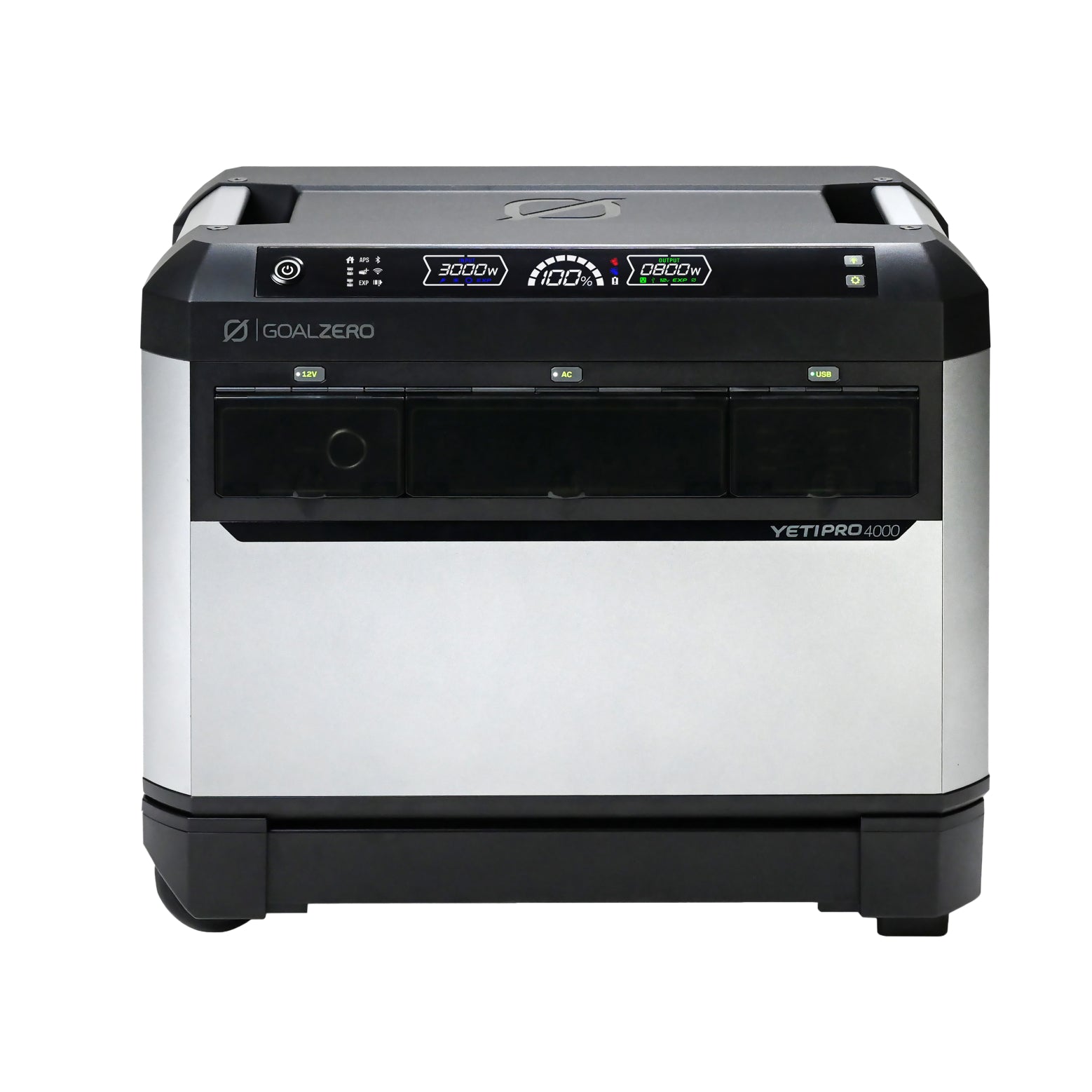
Explore this need in the finder →The Goal Zero Yeti PRO 4000 (U.S. SKU 37500) is a heavy, wheeled 120 V power station built around a 3,993.6 Wh LiFePO₄ battery and a 3,600 W continuous inverter. Its appeal is not that it is easy to carry: the station itself weighs 115.7 lb, and the included roll cart brings the listed combination to 125.7 lb. It is for a fixed home, garage, RV or worksite base where several kilowatt-hours, a 30 A RV receptacle and a documented expansion path matter more than lifting the unit by hand.
Large reserve, still one 120 V station
Battery capacity is nameplate energy, not a published measure of AC energy delivered to appliances. Conversion losses and cycling loads change runtime. The inverter is rated 3,600 W continuous and 7,200 W surge, all at 120 V—not split-phase 240 V. If a well pump, range or other essential load needs 240 V, choose a system whose exact operating plan documents it; a 30 A RV receptacle does not make this one split-phase.
The front panel has four 20 A AC receptacles and a separate TT-30R 30 A RV receptacle. All share the 3,600 W station ceiling. A single ordinary port is listed for up to 2,400 W and the TT-30R for 3,600 W. Check appliance running and startup demand; five sockets are not five independent inverters.
Charging and the connections you must plan
Goal Zero rates wall input at 1,800 W and estimates a full charge in under three hours. Solar input is listed up to 3,000 W; its page estimates two hours from empty while the manual says 1.7 hours at maximum input. Both are idealized manufacturer estimates. The high-voltage input is listed at 13.3–150 V, but the page and manual differ on current (30 A versus 40 A). Keep to the 3,000 W limit and confirm panel, voltage and connector compatibility. A separate low-voltage input is limited to 275 W.
The standalone box includes the station, roll cart and AC cable, not solar panels/leads or a vehicle cable. The 12 V vehicle cable is sold separately; the maker estimates about 37 hours, while a direct 400 W alternator hookup requires a qualified vehicle technician. CPSC has announced a separate Goal Zero Solar Series Combiner Cable recall, but its notice did not load during this review. This is an accessory issue, not an identification of the Yeti PRO station as recalled; check the exact cable and remedy before using a series combiner.
Useful USB and 12 V output, with shared limits
For electronics, the station provides three USB-C ports (one rated 100 W and two at 30 W each) and three USB-A ports rated up to 18 W apiece. Goal Zero lists the USB-C group at 160 W combined. The 12 V section includes a car-style socket, an HPP outlet and two 6 mm outlets. Although individual ports have separate ratings, the product page lists a 375 W combined 12 V limit; the manual instead states that the 12 V ports share 30 A at 13.5 V, equivalent to 405 W. Because those published totals do not agree, do not plan on adding each port’s maximum together. For an essential 12 V load close to that boundary, ask Goal Zero to confirm the applicable limit for your intended connection.
Expansion adds energy, not inverter power
Up to four separately sold Tank PRO 4000 batteries can connect to the Yeti. Each is rated 3,993.6 Wh, giving 19,968 Wh from five packs by nameplate arithmetic—the maker rounds this to “up to 20 kWh.” They equalize and charge/discharge as one system but do not raise the Yeti’s 3,600 W AC limit or provide 240 V. The Tank guide requires a mounting plate when stacking and calls for a two-person lift. This is a heavy base installation, not a grab-and-go kit; no expansion battery comes with the standalone SKU.
For household circuit backup, the manufacturer describes pairing the Yeti with its Haven 10 manual transfer switch for up to ten selected circuits. That is an additional system with its own wiring and compatibility requirements, not something accomplished by plugging the station into a wall outlet. Use a qualified electrician and the current Haven documentation; this station is not a substitute for a correctly installed transfer arrangement.
Who should choose it—and who should not
Choose this model if your loads fit 120 V/3,600 W, you need nearly four kilowatt-hours of nameplate storage and a cart or fixed base suits your space. It is a poor fit if you must lift it often, need 240 V, expect solar equipment in the base package or require published AC-usable energy. The lighter Yeti 1500 6th Generation offers only 2,000 W continuous and 1,505 Wh; for split-phase, pick a system with an exact documented 240 V plan. Goal Zero cautions against using the PRO 4000 with life-saving medical equipment and does not certify it as a hospital-grade UPS. No physical sample or appliance runtime was tested.
Primary references: Goal Zero U.S. Yeti PRO 4000 product page and SKU 37500; Yeti PRO 4000 User Guide, Revision I; Goal Zero Tank PRO 4000 expansion battery page and its user guide. Goal Zero specifies a 3,600 W/7,200 W surge 120 V AC plan and 3,993.6 Wh capacity. Manuals and product pages contain the small output, solar-current, temperature and charge-time differences described above; limits are not independent lab measurements. The CPSC Solar Series Combiner Cable recall page was not retrievable during this review; check its current notice before using any affected cable.
Key details at a glance
| Nameplate battery capacity | 3993.6 Wh |
|---|---|
| Rated AC output | 3600 W |
| Manufacturer surge rating | 7200 W |
| Maximum solar input | 3000 W |
| Maximum USB-C output per port | 100 W |
| Listed weight | 115.7 lb |
| Compatible extra-battery expansion | Yes |
| 12 V DC output | 375 W |
| Maximum AC recharge input | 1800 W |
| Base warranty term | 5 years |
| AC outlet output | Yes |
| USB-C ports | 3 |
| USB-A ports | 3 |
| Solar input ports | 2 |
| 12 V car-style output | 162 W |
| Battery chemistry | LiFePO4 |
| Manufacturer minimum charge temperature | 0 °C |
| Manufacturer minimum discharge temperature | -20 °C |
Use the exact model’s instructions for operating limits, supplied equipment and version differences.
Sources for this assessment
A useful match starts with the loads that matter.
Use the finder for hard electrical requirements, then check appliance starting behavior, actual run time and the exact package in the full assessment.