
Your needs, this model
Does it fit your priorities?
Does your single-station 120 V load plan need up to 3,600 W continuous and about 4 kWh nameplate capacity?
The Yeti PRO 4000 is a 120 V-only station rated for 3,600 W continuous and 3,993.6 Wh nameplate storage. Its five AC receptacles share that inverter ceiling; this is not a 240 V plan.
Explore this need in the finder →Will you provide compatible panels and cabling for a high-input solar setup?
Goal Zero lists up to 3,000 W solar input, but the compatible panel array, voltage/current limits and connecting cable must be selected separately. No solar panel or lead is in the base box.
Explore this need in the finder →Do you need the option to expand stored energy beyond one station?
The Yeti PRO 4000 supports up to four separately sold Tank PRO 4000 batteries; the combined nameplate total is about 19,968 Wh, while the 120 V inverter remains rated at 3,600 W.
Explore this need in the finder →Goal Zero Yeti PRO 8000 review: a 7,988 Wh station-and-battery system
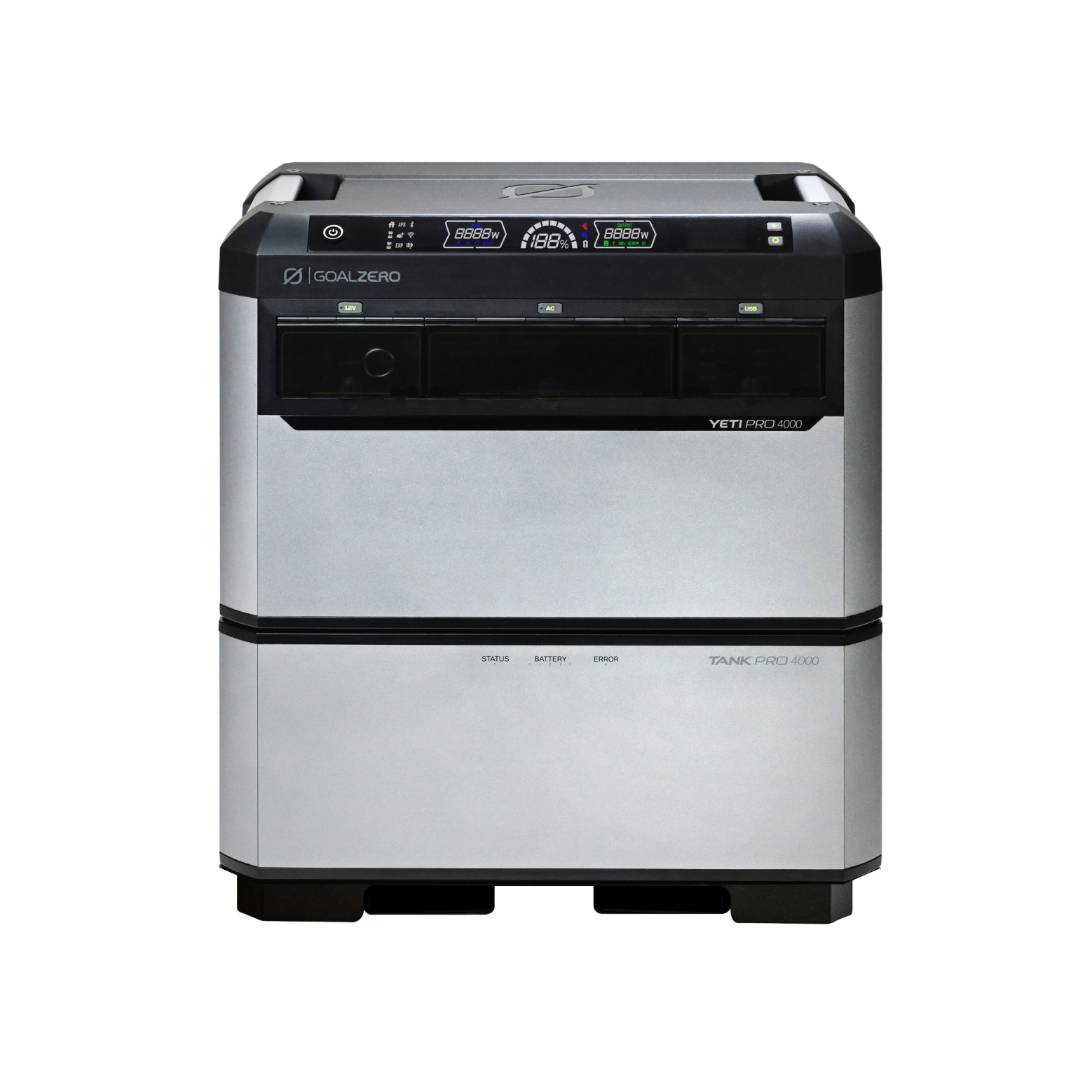
The name sounds like a single 8 kWh power station, but Goal Zero’s U.S. Yeti PRO 8000 offer is a two-piece system: one Yeti PRO 4000 station and one Tank PRO 4000 expansion battery, joined by a Tank-to-Yeti cable. The selected package page calls the system 7,988 Wh and labels the kit SKU 44571. Its underlying station is SKU 37500; the included Tank is the separate battery model SKU 23110. The product page says the pair synchronizes as one battery, but they remain two substantial cases. That distinction matters for lifting, storage, cabling and fault-finding.
In the selected SKU 44571 package, the Tank adds stored energy but does not add an inverter: the bundle contains one PRO 4000 host, not two independently usable AC stations. If you already own a PRO 4000, check a Tank-only offer instead; this particular bundle also includes another PRO 4000 station. Think “roughly twice the reserve of a standalone PRO 4000,” not “8,000 watts.”
What changes when the Tank is included?
The included station is rated for 120 V AC, 3,600 W continuous and 7,200 W surge. Those ratings do not double when the Tank is connected. The station’s receptacles and TT-30R are still bounded by one host inverter, so add up simultaneous AC loads against 3,600 W continuous. A 240 V or split-phase essential load is outside this one-station setup. The display and ports belong to the Yeti PRO 4000; the Tank contributes battery storage, not another set of household outlets.
Goal Zero lists 7,988 Wh for the paired offer. That is nameplate storage, not a promise of 7,988 Wh delivered to AC equipment: inverter conversion, load shape and reserve limits change usable energy. No independent runtime or load test is claimed here. If your non-negotiable need is more than 3,600 W continuous at the output, a larger capacity package will not solve it; look for a documented multi-station or higher-output arrangement instead.
Contents, charging and expansion
The selected offer’s box list names the Yeti PRO 4000, its roll cart and charging cable, one Tank PRO 4000, and the Tank-to-Yeti chaining cable. It does not list a solar panel or solar lead, nor the optional Haven transfer switch. The station’s manual lists up to 3,000 W solar input, but the exact panel array, voltage, current and compatible connecting lead still need to be chosen to the station’s limits. A high maximum input is not a panel included in the box.
One Tank is included in the PRO 8000 package. Goal Zero says the PRO 4000 can use up to four Tank PRO 4000 batteries; the extra batteries are separate purchases, not hidden contents of this offer. Using the manufacturer-listed station and Tank capacities, a four-Tank arrangement approaches 20 kWh nameplate, while the inverter remains 3,600 W. Each added Tank increases stored reserve and system mass. The Tank manual identifies SKU 23110 as a compatible 3,994 Wh LiFePO4 battery; check the actual Tank label and chaining connection before mixing components.
For a home-circuit plan, the station page describes pairing with a Haven 10 Manual Transfer Switch for up to ten circuits. That switch is not in the PRO 8000 box list. Installation is not a casual extension-cord task: have a qualified electrician verify the transfer equipment and the applicable wiring arrangement. This review does not claim the package is a whole-home standby generator or that every appliance will start from it.
Plan for two heavy modules
The station is listed at 115.7 lb, or 125.7 lb with its included roll cart; the Tank PRO 4000 is listed at 80.3 lb. Together, those published component weights total about 206 lb with the cart. The cart helps move the station, but it does not make the separate battery light or prove that every floor, vehicle or doorway can support the assembled arrangement. Check dimensions and lifting access in both manuals before ordering. If you need a unit that one person can carry between campsite and vehicle, this is the wrong scale.
Who should choose this exact kit?
It suits a buyer with an equipment plan that benefits from about 8 kWh of nameplate storage at one 120 V, 3,600 W station output, and a fixed place to keep the station and its linked battery. It is especially relevant when the extra Tank is part of the desired configuration from day one. If roughly 4 kWh is enough, the standalone Yeti PRO 4000 is the simpler comparison: it has the same 120 V inverter ceiling and avoids the included expansion battery’s extra bulk. If you require 240 V, a panel included in the box, a lighter carry system or more than 3,600 W from one station, those answers should change the shortlist.
The deal-breaker check is the exact configuration: the page’s SKU 44571 is the Yeti PRO 4000 plus one Tank PRO 4000, not a new 8,000 W inverter and not a Tank-only accessory. Verify that the selected seller still describes both components, the chaining cable and the warranty for each item. Capacity is a manufacturer nameplate claim, not a field measurement. This is a source-based assessment; no physical unit, battery-health test or runtime test was performed.
Sources: Goal Zero Yeti PRO 8000 selected package page, Yeti PRO 4000 station page, Tank PRO 4000 page, and the linked U.S. user guides.
Key details at a glance
| Nameplate battery capacity | 7988 Wh |
|---|---|
| Rated AC output | 3600 W |
| Manufacturer surge rating | 7200 W |
| Maximum solar input | 3000 W |
| Included panels, combined nameplate | 0 W |
| Maximum USB-C output per port | 100 W |
| Listed weight | 115.7 lb |
| Compatible extra-battery expansion | Yes |
| 12 V DC output | 375 W |
| Maximum AC recharge input | 1800 W |
| Base warranty term | 5 years |
| AC outlet output | Yes |
| USB-C ports | 3 |
| USB-A ports | 3 |
| Solar input ports | 2 |
| 12 V car-style output | 162 W |
| Battery chemistry | LiFePO4 |
| Manufacturer minimum charge temperature | 0 °C |
| Manufacturer minimum discharge temperature | -20 °C |
| Expansion battery in this package | Yes |
| Home Power Panel in this package | No |
| Separate station units in offer | 1 |
| Smart Transfer Switch in this package | No |
| Expansion packs in exact offer | 1 |
| Solar panels in exact offer | 0 |
Use the exact model’s instructions for operating limits, supplied equipment and version differences.
Sources for this assessment
- Goal Zero U.S. Yeti PRO 8000 exact package page
- Goal Zero Shopify object for exact Yeti PRO 8000 package
- Official U.S. Yeti PRO 4000 station page and linked manual (reused exact archived source)
- Official U.S. Tank PRO 4000 component product page (reused exact archived source)
- Official U.S. Tank PRO 4000 user guide (reused exact archived source)
A useful match starts with the loads that matter.
Use the finder for hard electrical requirements, then check appliance starting behavior, actual run time and the exact package in the full assessment.