
Your needs, this model
Does it fit your priorities?
Does this exact standalone station fit a 120 V plan needing up to 2,000 W rated AC output?
The JE-1000C has three 120 V receptacles sharing 2,000 W continuous rated output; 4,000 W is a peak figure, and startup loads still need checking.
Explore this need in the finder →Is a solar panel supplied with the exact standalone offer?
No. The exact SKU lists the station, AC and car cables and a bag; no solar panel or station-side solar charging lead is listed.
Explore this need in the finder →Do you need the compatible expansion battery to be a confirmed current purchase option?
The manual confirms up to three compatible packs, but Jackery says the Battery Pack 1000 Plus has been discontinued. Current new-pack availability is not confirmed, so an essential present-day expansion need is not treated as a positive match.
Explore this need in the finder →Does its published storage meet a 1,264 Wh nameplate floor without claiming delivered AC energy?
The manual lists 1,264.64 Wh LiFePO4 nameplate capacity; usable AC watt-hours at a stated load are not published in the sources reviewed.
Explore this need in the finder →This assessment is for the current U.S. standalone Explorer 1000 Plus offer, SKU 21-0001-000318 (variant 40233095135319), matched to the English manual’s station model JE-1000C. The manufacturer’s option list shows one station, an AC charging cable, car charging cable and accessories bag. It does not list a solar panel or station-side solar cable for this SKU. The separate SolarSaga 100 Air x2 offer is reviewed separately, because included panels change what arrives in the box even though the station itself is the same.
A middle-size station with a stronger inverter than its name suggests
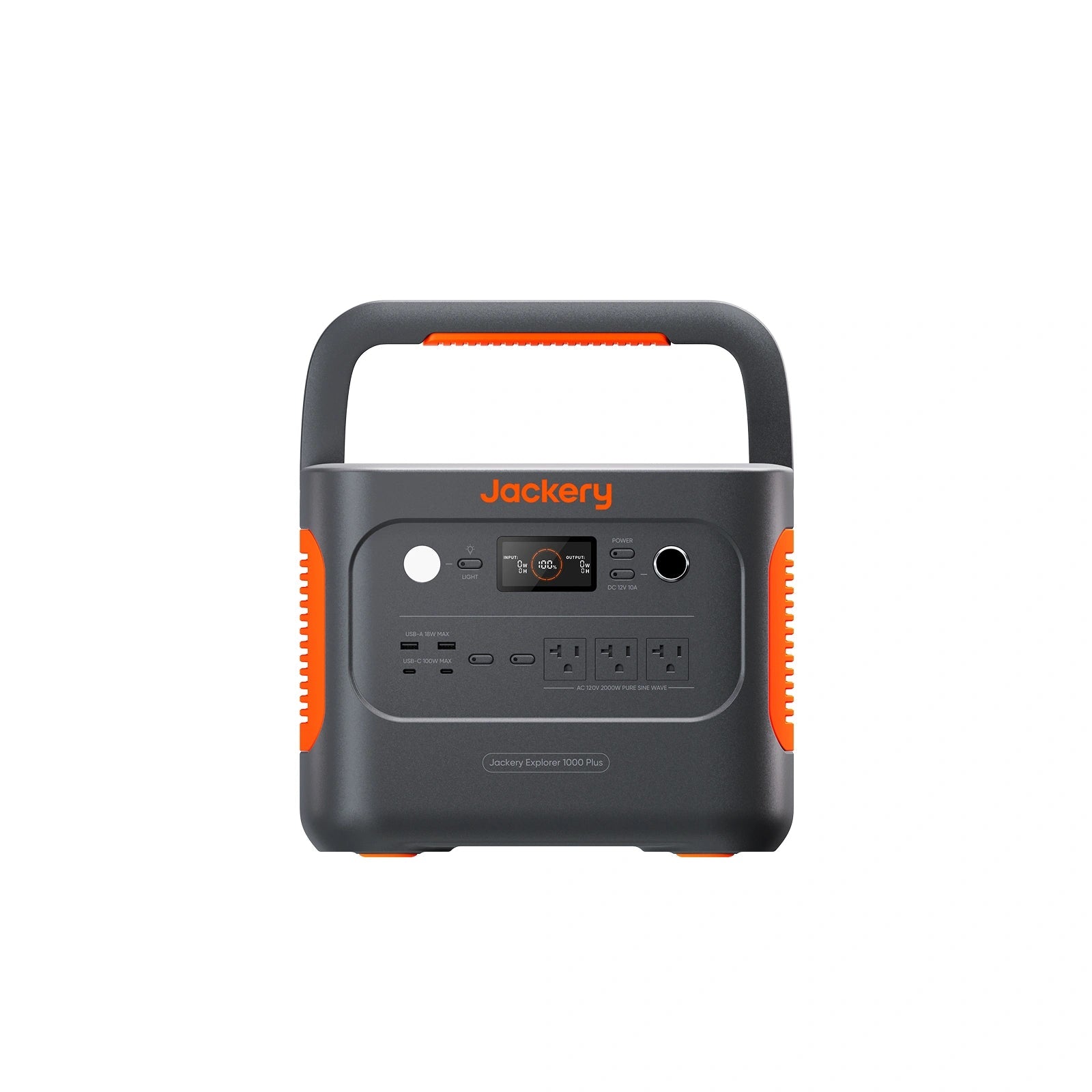
Jackery lists 1,264.64 Wh of LiFePO4 battery capacity, three 120 V AC receptacles sharing 2,000 W rated output, and 4,000 W as the surge peak. The peak is not a continuous appliance rating; size the plan against the load’s running draw and startup needs, and leave room for devices operating at the same time. Two USB-C ports are rated up to 100 W each, two USB-A ports up to 18 W each, and the car-style 12 V outlet up to 10 A / 120 W. One 120 V inverter is not a whole-house 240 V arrangement.
The 32 lb station is carryable between home, vehicle and campsite, but it is not a featherweight backpack battery. Its 1,264.64 Wh is a nameplate battery figure, not a manufacturer-guaranteed amount of AC energy at a given load. The sources reviewed here do not state an AC-delivered watt-hour test at a named load, so do not promise a refrigerator’s runtime from that number alone. Check the refrigerator’s actual draw and duty cycle, consider compressor startup, and decide how much reserve you need before choosing any station.
Solar input is capable; solar hardware is not in this box
JE-1000C accepts 12–60 V DC through two DC8020 inputs. Jackery’s current U.S. support table gives up to 400 W and 11 A per input, or 800 W and 22 A combined. Those ceilings tell you what the station can accept, not what this standalone SKU supplies: its exact box list has no panel. You will need compatible panels and the correctly rated station connection leads separately. The Explorer manual asks users to observe panel type, count, voltage and connection instructions; a matching plug by itself does not prove that an array is suitable.
If you would rather open a box with panels and their station leads, compare the separate two-SolarSaga 100 Air configuration. It supplies a named 200 W-class pair but does not raise the station’s storage or 2,000 W AC rating. If you already own a compatible array, the standalone offer may be the tidier choice. Solar nameplate watts also do not equal daily harvest: shading, panel angle, temperature and weather all change what reaches the battery.
Expansion and outage transfer need careful interpretation
The JE-1000C manual and Jackery’s U.S. support FAQ document compatibility with up to three Battery Pack 1000 Plus modules. However, the current station product page also says that Battery Pack 1000 Plus has been discontinued. That makes technical compatibility real but a dependable new-pack purchase path uncertain. The shortlist therefore does not treat “expansion essential” as a confirmed current buying plan; verify the exact compatible pack and its condition and availability before relying on later capacity. A separately sourced or used battery is not included in this standalone SKU, and neither packs nor a larger capacity increase this station’s 2,000 W inverter rating.
The manual describes a 20 ms Emergency Power System transfer, explicitly not zero-millisecond UPS operation. It cautions against loads requiring high uninterrupted power, including servers and workstations, and recommends testing device compatibility. Do not use the EPS label as proof that sensitive equipment will ride through an outage without interruption. The manual also restricts use to clean, dry conditions and says not to expose the station to rain or snow. The SolarSaga panel’s IP rating applies to the panel only; it does not make the station weatherproof.
Who should compare something else?
The Explorer 1000 v2 is a useful contrast if low carry weight and fixed capacity matter more than inverter headroom: its reviewed JE-1000D configuration is 1,070 Wh and 1,500 W, and it does not have a documented expansion-battery path. The 1000 Plus adds roughly 195 Wh of nameplate storage, 500 W of rated AC output and the expansion interface, while weighing about 8 lb more. That is a meaningful trade if your loads approach 1,500 W, but not a reason to buy surplus output you will never use. For a lighter unit, compare the v2; for a current expandable plan, first resolve the discontinued-pack issue rather than assuming the Plus name guarantees accessory stock.
The station’s published 4,000-cycle figure is a manufacturer rating to at least 70% capacity, not a promise that every unit will deliver the same service life. Its standard station warranty is listed as three years with two additional years for purchases through Jackery.com; do not assume the direct-site extension transfers to another seller. The exact direct-site offer is marked available in the checked product-option data, but availability can change.
Bottom line
Choose the standalone JE-1000C when you want a 120 V station around 1.26 kWh with a 2,000 W rated inverter, and you are content to source solar hardware separately or operate without it. The package is not a solar generator kit, a 240 V backup system or a guaranteed expansion purchase. If the panel pair, bag, current battery availability, warranty channel, or a tight appliance runtime is essential, answer those as separate requirements instead of reading them into the station name.
Sources: Jackery’s U.S. Explorer 1000 Plus offer page, the JE-1000C U.S. manual, Explorer 1000 Plus Basic Information and Jackery’s battery-pack compatibility FAQ.
Key details at a glance
| Nameplate battery capacity | 1264.64 Wh |
|---|---|
| Rated AC output | 2000 W |
| Manufacturer surge rating | 4000 W |
| Maximum solar input | 800 W |
| Included panels, combined nameplate | 0 W |
| Maximum USB-C output per port | 100 W |
| Listed weight | 32 lb |
| 12 V DC output | 120 W |
| Maximum AC recharge input | 1200 W |
| Manufacturer UPS transfer figure | 20 ms |
| Base warranty term | 3 years |
| AC outlet output | Yes |
| USB-C ports | 2 |
| USB-A ports | 2 |
| Solar input ports | 2 |
| 12 V car-style output | 120 W |
| Battery chemistry | LiFePO4 |
| Home Power Panel in this package | No |
| Separate station units in offer | 1 |
| Solar panels in exact offer | 0 |
Use the exact model’s instructions for operating limits, supplied equipment and version differences.
Sources for this assessment
- Jackery U.S. portable power station collection
- Jackery U.S. Explorer 1000 Plus product and exact-option page
- Jackery U.S. Explorer 1000 Plus variant JSON
- Jackery Explorer 1000 Plus U.S. User Manual, model JE-1000C, version JAK-UM-V4.0
- Jackery Explorer 1000 Plus Basic Information
- Jackery FAQ: maximum Battery Pack 1000 Plus count
- CPSC recall search for Jackery Explorer 1000 Plus
- Jackery exact JE-1000C station rendering

A useful match starts with the loads that matter.
Use the finder for hard electrical requirements, then check appliance starting behavior, actual run time and the exact package in the full assessment.