
Your needs, this model
Does it fit your priorities?
Is 120 V AC at up to 1,500 W continuous and a 1,070 Wh battery enough for the essential load list?
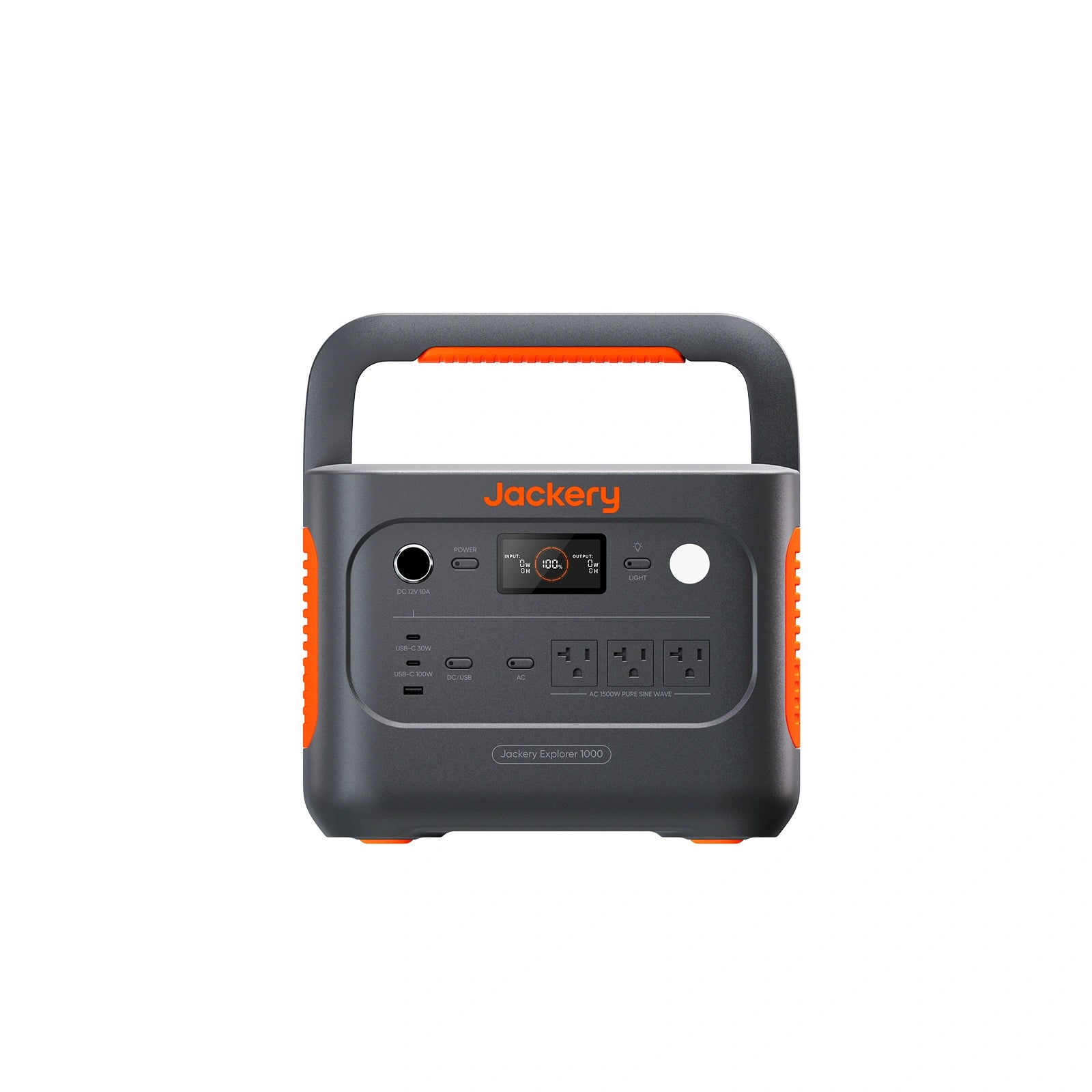
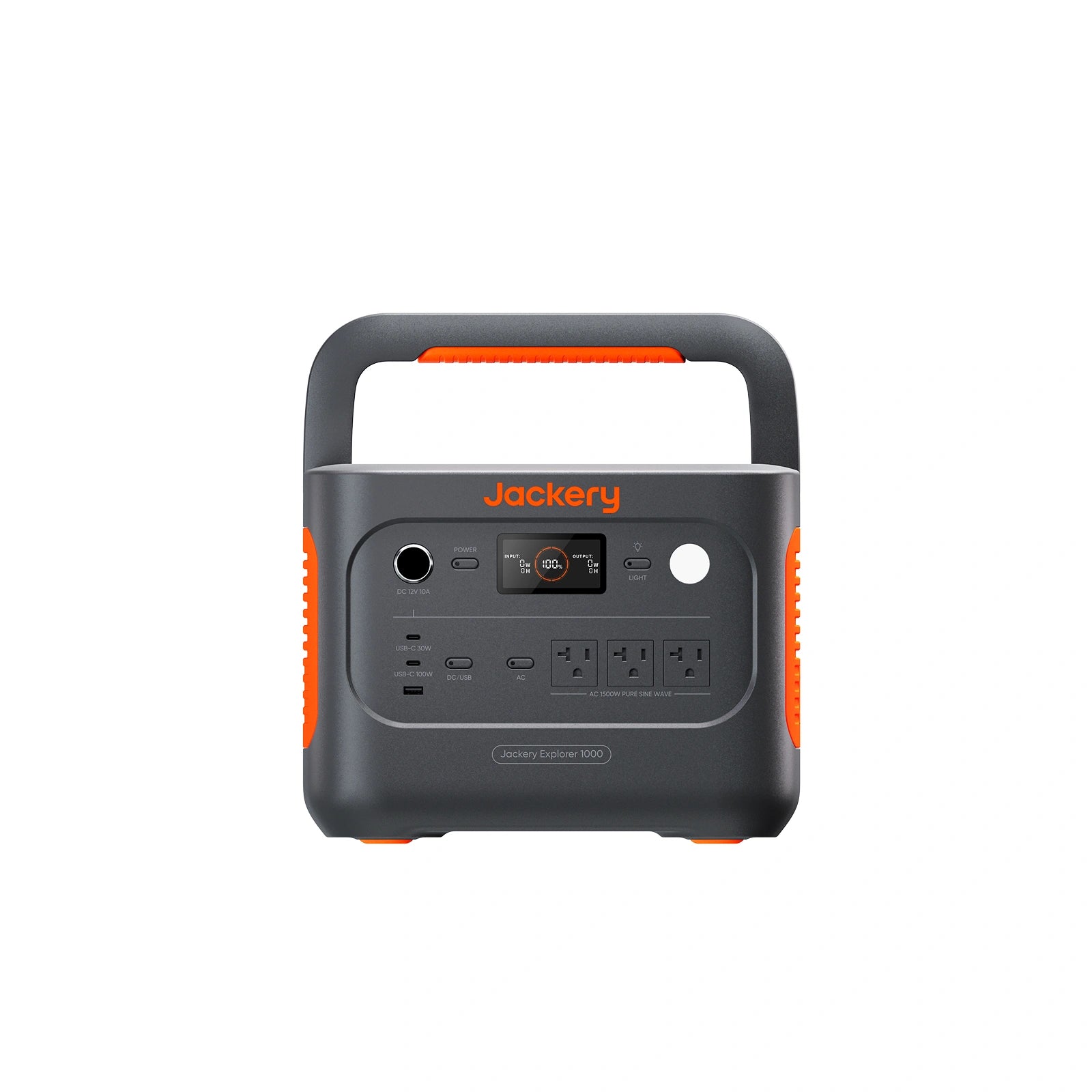
The black standalone JE-1000D has three 120 V AC receptacles sharing 1,500 W continuous output and 1,070 Wh nameplate storage. A 3,000 W peak figure is not a continuous load rating, and delivered AC energy/runtime is not promised.
Explore this need in the finder →Do you want solar input but not an included panel, and can you use the station’s parallel 400 W input plan?
The station accepts up to 400 W on two parallel DC8020 inputs at 16–60 V; the standalone SKU contains no panel or solar lead. Match the panel arrangement and cabling to Jackery’s limits rather than treating the ports as independent.
Explore this need in the finder →Is a 23.8 lb 12 V car-socket plan acceptable without later battery expansion?
Its 12 V/10 A car-style outlet is rated up to 120 W. The JE-1000D does not support expansion batteries; a required expansion option should reject it.
Explore this need in the finder →The Jackery Explorer 1000 v2 is a fixed-capacity, hand-carried station for people who need several ordinary 120 V outlets and a real solar-input path without stepping up to a heavier expandable system. The exact US model is JE-1000D. The black standalone offer reviewed here is listed as SKU 21-0001-000220; the same product page also exposes a white finish and distinct solar and multi-station packages. Check that selection carefully: a solar-panel bundle is not the same box as this standalone station.
A useful 1 kWh middle ground, with a defined ceiling
Its LiFePO4 battery is rated at 1,070 Wh, and the three household receptacles share 1,500 W of continuous pure-sine AC output. The 3,000 W peak does not mean it can run a 3,000 W load continuously. It can suit lights, communications gear, small kitchen appliances and selected tools whose running and startup requirements stay within the limits. It is not a 240 V source, and the standalone package has no transfer-switch or home-panel hardware.
A 1,070 Wh nameplate battery does not promise that 1,070 Wh will reach AC appliances; conversion losses, load, temperature and shutdown behavior matter. Use a load list and actual device draw instead of a blanket refrigerator runtime. A refrigerator, pump or compressor may start above its normal running wattage, so do not treat the 3,000 W peak as a general motor-start guarantee.
Carrying it is possible, but not weightless
At about 23.8 lb and 12.9 by 8.8 by 9.7 inches, the Explorer 1000 v2 is easier to lift into a vehicle than a multi-kWh wheeled backup unit, but repeated stairs or long carries remain work. It has a handle, not an integrated trolley. This suits camp, van, garage or room-to-room use when the owner can lift it comfortably.
Jackery rates the LiFePO4 cells for 4,000 cycles to at least 70% capacity. That is a manufacturer rating, not a promise about every unit's calendar life. The case is not described as weatherproof; keep it dry and within its stated temperature range.
Fast charging and solar need careful planning
Jackery lists around 1.6–1.7 hours for AC charging. The app-enabled emergency mode is advertised as roughly one hour, but the manual says to use it only when necessary, not routinely. Vehicle charging is supported but takes about 12 hours by the ordinary 12 V route, so it is slow recovery rather than a quick turnaround.
Solar acceptance is up to 400 W through two DC8020 inputs, with a stated 16–60 V range and 21 A combined ceiling. The inputs are parallel, not independent trackers. Jackery says not to mix panel wattages across them; supported multi-panel arrangements use matching models and quantities. The 400 W ceiling is not a weather-dependent harvest promise. The standalone box includes the station and AC cable, not a panel. A separate SolarSaga 200 W package adds a panel and solar cable; confirm that exact offer and lead before relying on it.
Ports, controls and the limits that matter
It has a 12 V/10 A car-style outlet (120 W maximum), one USB-A port rated up to 18 W, and two USB-C ports rated up to 100 W and 30 W. The stronger USB-C port suits a compatible laptop; the second is for lighter devices. Port ratings do not promise every port can draw its maximum simultaneously.
The unit can act as a short-transfer backup when connected to wall power and a device is connected to its AC output. Jackery states an approximately 20 ms switch to battery; it is not a zero-interruption UPS. The manual specifically warns against using it for data servers, workstations or other critical equipment. It also has no supported add-on battery, so the capacity you buy is the capacity plan you keep; do not mistake another Explorer 1000-series model's expansion feature for this one's.
Where it sits among Jackery's 1000-class choices
Jackery's comparison distinguishes the Explorer 1000 v2 from the older Explorer 1000 and 1000 Pro (listed as 1,002 Wh/1,000 W with NCM cells) and the Explorer 1000 Plus (1,264 Wh, 2,000 W and expansion support). The v2 balances 1,070 Wh, 1,500 W and a 23.8 lb carry weight; it is not the highest-output or expandable choice. If a future battery pack or a higher continuous load is essential, compare the Plus rather than expecting the v2 to grow.
The separately listed refurbished JE-1000D is the same named station platform, but its product page gives it a six-month warranty and showed the refurbished offer sold out when checked. That is a materially different purchase proposition from the main standalone listing; it should not inherit the newer-offer warranty assumptions. Buyers should inspect the exact offer and warranty terms at purchase time.
Choose this model when a roughly 24 lb lift, 120 V loads up to 1,500 W continuous, a finite 1 kWh-class battery and app monitoring meet the plan. Look elsewhere if you need split-phase power, a battery-expansion path, a supplied solar panel in the standalone box, weather-rated use, or truly uninterrupted critical backup. Before buying, compare each appliance's normal and startup draw, decide whether the AC or solar recharge route fits your outage or travel pattern, and verify the current color/package SKU rather than shopping from the shared “1000” name alone.
Key details at a glance
| Nameplate battery capacity | 1070 Wh |
|---|---|
| Rated AC output | 1500 W |
| Manufacturer surge rating | 3000 W |
| Maximum solar input | 400 W |
| Included panels, combined nameplate | 0 W |
| Maximum USB-C output per port | 100 W |
| Listed weight | 23.8 lb |
| Compatible extra-battery expansion | No |
| 12 V DC output | 120 W |
| Maximum AC recharge input | 1000 W |
| Manufacturer UPS transfer figure | 20 ms |
| Base warranty term | 3 years |
| AC outlet output | Yes |
| USB-C ports | 2 |
| USB-A ports | 1 |
| Solar input ports | 2 |
| 12 V car-style output | 120 W |
| Battery chemistry | LiFePO4 |
| Home Power Panel in this package | No |
| Separate station units in offer | 1 |
Use the exact model’s instructions for operating limits, supplied equipment and version differences.
Sources for this assessment
- Jackery U.S. Explorer 1000 v2 product page
- Jackery U.S. product option JSON
- Jackery Explorer 1000 User Manual, U.S. English; model JE-1000D
- Jackery U.S. Explorer 1000 V2 Basic Information
- Jackery U.S. comparison: Explorer 1000, Pro, Plus and V2
- Jackery U.S. refurbished Explorer 1000 v2 offer
- Jackery refurbished product option JSON
- Jackery product-page image: black Explorer 1000 v2 standalone rendering
- U.S. CPSC Recalls & Product Safety Warnings index
A useful match starts with the loads that matter.
Use the finder for hard electrical requirements, then check appliance starting behavior, actual run time and the exact package in the full assessment.