
Your needs, this model
Does it fit your priorities?
Does the package include two SolarSaga 100 Prime panels and their named hardware?
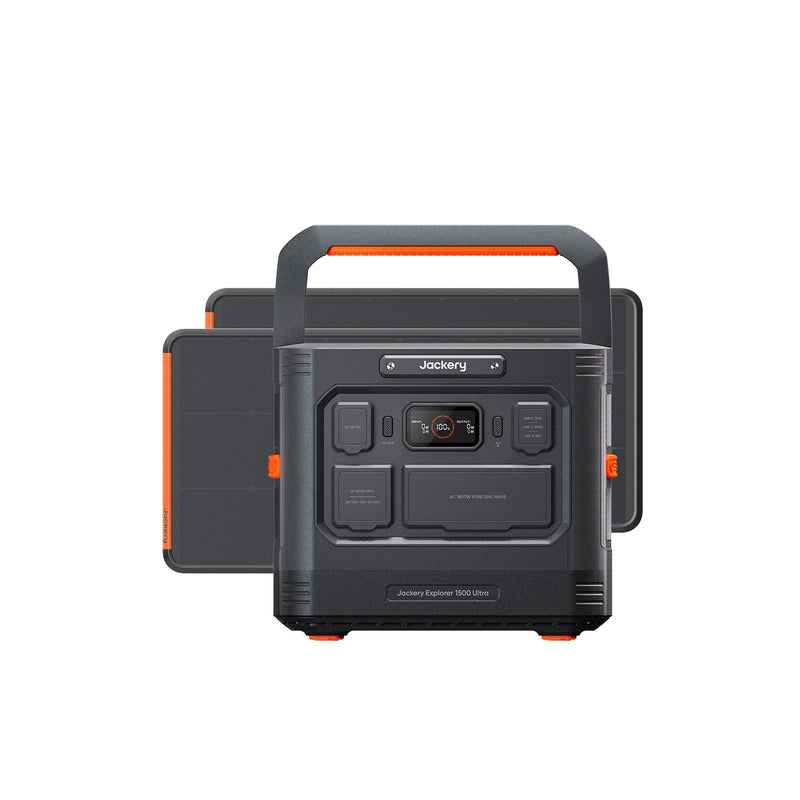
Yes. The exact U.S. package lists one station, an AC cable, two SolarSaga 100 Prime panels, two Anderson-to-DC8020 adapters and two Z-bracket kits. Jackery’s panel manual identifies SolarSaga 100 Prime as model JS-100E; the bundle page itself does not print that suffix.
Explore this need in the finder →Does a 200 W included array mean only 200 W of station input is possible?
No. The package's panels total 200 W nameplate, while the station's published input ceiling is 800 W. Additional capacity is not included in this SKU.
Explore this need in the finder →Does this kit support 240 V loads or battery expansion?
No. It remains one fixed-capacity, 120 V Explorer 1500 Ultra. Included panels do not alter AC voltage, capacity or expandability.
Explore this need in the finder →Is the listed base warranty at least three years?
Yes. Jackery describes a three-year standard warranty and an additional two years on Jackery.com, subject to its stated terms; the exact offer page advertises a 3+2 year warranty.
Explore this need in the finder →Jackery Explorer 1500 Ultra with two SolarSaga 100 Prime panels review
Jackery's two-panel SolarSaga 100 Prime configuration is a different way to buy the Explorer 1500 Ultra, not a different-capacity station. The exact U.S. SKU 60-1510-USC1E2 lists one JE-1500C, one AC charging cable, two SolarSaga 100 Prime panels, two Anderson-to-DC8020 adapters and two Z-bracket kits. That package totals 200 W of panel nameplate. The same station-only model remains 1,536 Wh with one 120 V inverter rated for 1,800 W continuous.
A package oriented toward mounted panels
Jackery's option copy calls the panels a fixed-mount pairing and includes two bracket kits plus the adapters to connect them to the station. This can suit a cabin, RV or work setup where a pair of panels is meant to be installed or positioned more permanently than a foldable travel kit. The listing does not establish the bracket's compatibility with every roof or surface, local installation requirements, wind rating, roof penetrations or a complete wiring plan, so treat the bracket as a supplied accessory rather than a promise that installation is universally simple. The package image is a rendering, not a diagram of a tested rooftop installation.
The two panels provide 200 W combined nameplate, which is half the 400 W panel rating in Jackery's separate pair of SolarSaga 200W panels. The difference affects the solar equipment supplied and the amount of rated panel capacity available, not the station's maximum solar-input capability. Jackery lists up to 800 W solar input across its two DC8020 ports, but neither package includes that much panel. The exact FAQ says the inputs are parallel and simultaneous connection requires matching panels in model and count. Two are supported; three are not. Four are supported only as a matching set with specified additional adapters. This kit's two same-model panels form a manufacturer-listed package, but the 800 W station ceiling should not be read as a 200 W array that is magically capable of 800 W.
Choose for your load, not the bundle label
Three AC outlets share 1,800 W rated continuous output at 120 V/60 Hz. The manual's 2,000 W figure is limited to 15 minutes, while 3,600 W is surge peak. Do not plan an appliance around a peak rating without checking that appliance's starting requirements, nor assume multiple outlets multiply the total. Cold-weather operation also changes the decision: from -15°C to -10°C, the manual limits output to 1,000 W. The model has a 1,536 Wh LiFePO4 battery and a manufacturer-stated cycle life of 4,000 cycles to at least 70% capacity; nameplate Wh alone cannot determine real AC runtime.
For smaller devices, it provides one 100 W USB-C, one 30 W USB-C, USB-A up to 18 W and a 12 V/10 A port. App monitoring over Wi-Fi and Bluetooth and pass-through charging are supported. It weighs 38.6 lb before the panels and mounting items, and the selected package does not publish their combined mass. The station is not battery-expandable and does not offer 240 V or parallel-station output. If your requirement is longer runtime, adding panel wattage can help recharge between uses but cannot add the stored energy available overnight.
Do not confuse a protection rating with outdoor permission
The name Ultra and product imagery can suggest unrestricted rugged use. Jackery's manual gives a narrower rule: intended for indoor use, not waterproof or dustproof, keep away from rain and humid environments. The same manual's specification table identifies IP65 when all lids are closed, while the support FAQ says covered ports tolerate ordinary splashes or light rain; it also says the solar input cover must be open to plug in the array and is then not waterproof. Charging in rain or direct water exposure is not recommended. For this panel package, the practical plan is to place the station in a dry, sheltered area with the input connection protected and keep the panel arrangement consistent with its own manual. Do not leave the connected station exposed because a promotional page mentions a downpour.
Backup use and alternatives
A UPS-style transfer is listed at 20 ms, and Jackery says this is not a 0 ms switching supply; its FAQ warns against servers and workstations that require uninterrupted transfer. It may be useful for less timing-sensitive equipment if the load is compatible and has been tested, but it is not a substitute for a dedicated no-break UPS. Follow the manual's 0–45°C charge and -15–45°C discharge ranges as well as its cold-output limitation.
Compare the 100 Prime package with the 2×200 W foldable-panel package when you are choosing between a mounted setup and a higher panel nameplate. Compare with the station-only offer if you already have suitable panels, or a model with supported extra batteries if fixed 1,536 Wh capacity is insufficient. The visible exact option is sold as one package, yet its panels do not increase AC power, capacity, expansion or 240 V capability. Use the station's exact load limits and your own equipment labels to decide whether it fits; no independent field measurements or appliance runtime tests are claimed here.
Review the Jackery U.S. package option, the official model FAQ and the JE-1500C user manual before installation. Check both electrical compatibility and the actual mounting surface for your use.
Key details at a glance
| Nameplate battery capacity | 1536 Wh |
|---|---|
| Rated AC output | 1800 W |
| Manufacturer surge rating | 3600 W |
| Maximum solar input | 800 W |
| Included panels, combined nameplate | 200 W |
| Maximum USB-C output per port | 100 W |
| Listed weight | 38.6 lb |
| Compatible extra-battery expansion | No |
| 12 V DC output | 120 W |
| Maximum AC recharge input | 1600 W |
| Manufacturer UPS transfer figure | 20 ms |
| Base warranty term | 3 years |
| AC outlet output | Yes |
| USB-C ports | 2 |
| USB-A ports | 1 |
| Solar input ports | 2 |
| 12 V car-style output | 120 W |
| Battery chemistry | LiFePO4 |
| Ingress rating | IP65 (all port lids closed, per manual) |
| Expansion battery in this package | No |
| Home Power Panel in this package | No |
| Separate station units in offer | 1 |
| Solar panels in exact offer | 2 |
Use the exact model’s instructions for operating limits, supplied equipment and version differences.
Sources for this assessment
- Jackery U.S. portable power station collection, observed card position 17
- Jackery Explorer 1500 Ultra U.S. exact product page
- Jackery Explorer 1500 Ultra U.S. Shopify option data
- Jackery Solar Generator 1500 Ultra package options
- Jackery Solar Generator 1500 Ultra exact U.S. variants
- Jackery Explorer 1500 Ultra Basic Information FAQ
- Jackery Explorer 1500 Ultra User Manual, model JE-1500C (hosted by B&H Photo Video)
- U.S. CPSC recall API name search for JE-1500C
- Jackery U.S. SolarSaga 100 Prime exact panel page
- Jackery SolarSaga 100 Prime User Guide, U.S. Model JS-100E
- Jackery Solar Generator Connection Guide
A useful match starts with the loads that matter.
Use the finder for hard electrical requirements, then check appliance starting behavior, actual run time and the exact package in the full assessment.