
Your needs, this model
Does it fit your priorities?
Does the selected package include two SolarSaga 200W panels?
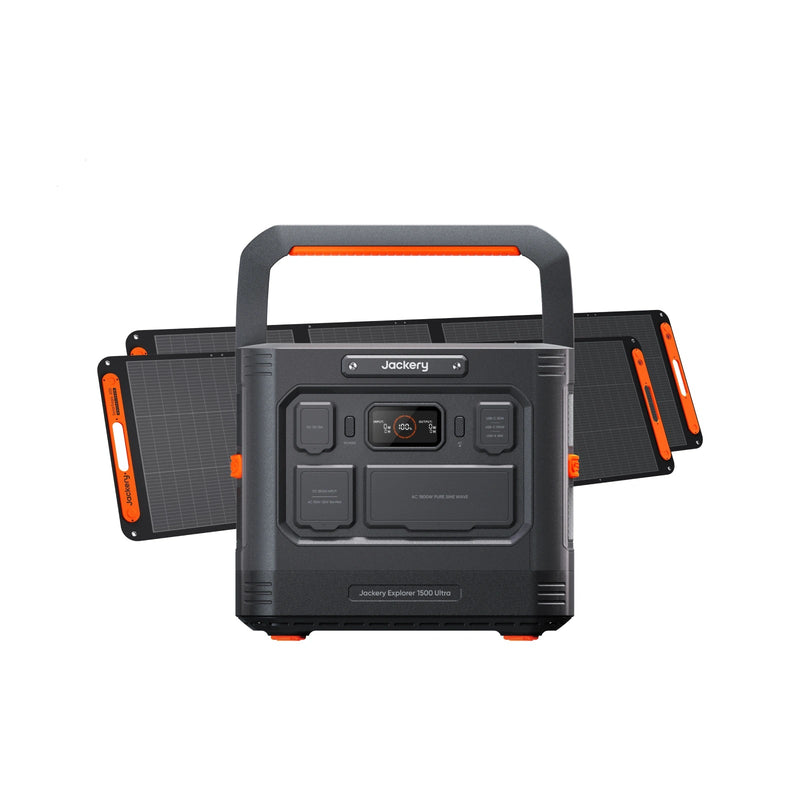
Yes. The exact U.S. option lists two SolarSaga 200W panels and two multifunctional solar charging cables with one Explorer 1500 Ultra and AC cable.
Explore this need in the finder →Is this a 400 W or 800 W station input?
The matched 200 W panel pair totals 400 W nameplate, while the station's published maximum input is 800 W across two inputs. A larger input rating does not change what is in this package.
Explore this need in the finder →Does the package provide 240 V or more than one station?
No. It contains one station with 120 V output; the solar panels recharge it but do not create split-phase output.
Explore this need in the finder →Is the listed base warranty at least three years?
Yes. Jackery describes a three-year standard warranty and an additional two years on Jackery.com, subject to its stated terms; the exact offer page advertises a 3+2 year warranty.
Explore this need in the finder →Jackery Explorer 1500 Ultra with two SolarSaga 200W panels review
This is the solar-equipped version of Jackery's Explorer 1500 Ultra, not a larger power station. The exact U.S. package SKU 60-1520-USC1D2 combines one JE-1500C station with two SolarSaga 200W panels and two multifunctional solar charging cables. Together, the panels carry 400 W of nameplate rating. The station itself remains 1,536 Wh and 1,800 W rated AC, so this bundle suits someone who wants solar equipment in the first purchase without confusing panel capacity with battery storage or inverter power.
What the exact kit changes
The standalone Explorer 1500 Ultra lists a station and AC charging cable. This package adds two named 200 W panels and their solar charging cables; the panels are visibly shown beside the same station in Jackery's exact-option image. That is useful if you want a pair of foldable panels to set out when charging and pack away afterward. It also avoids one compatibility decision: the manufacturer sells this panel-and-station pair as a specific kit. The listing does not state a panel revision suffix or individual panel mass, so do not assume a precise total carry weight. The station alone is 38.6 lb.
Solar equipment does not increase the 1,536 Wh battery. A 400 W panel nameplate is not 400 W of guaranteed charging at every moment, nor a direct runtime number. Shade, direction, cloud, temperature and panel placement can all change harvest. Jackery labels figures as estimates. A buyer needing stable overnight backup should plan energy use around the station capacity and recharge opportunities, not treat the panels as an automatic perpetual-power system.
One station, one output limit
The exact station uses one 120 V/60 Hz AC inverter with three receptacles sharing 1,800 W rated output. The manual allows 2,000 W for 15 minutes and lists 3,600 W surge peak; short-term or surge language is not continuous capacity. In the manual's -15°C to -10°C band, AC output is limited to 1,000 W. Add up concurrent equipment, compare motor starting demand with the actual instructions for the appliance, and leave margin rather than trying to run several loads at their individual maximum ratings.
The station also has one 100 W USB-C, one 30 W USB-C, USB-A up to 18 W and a 12 V 10 A output. Its two DC8020 solar inputs accept 16–60 V and support up to 400 W on one port or 800 W total, according to the manual and FAQ. The included panels sum to 400 W nameplate, below that maximum. Jackery says the inputs are parallel; panels connected to the two ports must match in both model and count. Its FAQ supports two panels, rules out three, and describes four matching panels with additional adapters. That extra capability is not additional equipment in this package.
Important siting and weather caution
Jackery advertises an IP65 design with protective port covers. The manual specifies IP65 only when all lids are closed, but its safety text says indoor use, says the station is not waterproof or dustproof, and tells users to keep it away from rain and humidity. The FAQ describes splash or light-rain resistance when covers are closed, yet cautions that the solar input lid must be open during charging and that the exposed port is not waterproof; rain or direct water while charging is not recommended. Because this solar bundle requires an open input for the panels, a conservative plan is to put the station itself in a dry sheltered place and route the panels outside as their own setup allows. Do not rely on the marketing image to imply that an open-port station can sit in a downpour. Follow panel instructions separately and secure them appropriately.
Fixed capacity and backup behavior
At 38.6 lb for the station, this is not the lightest way to add solar to a campsite. The two panels and leads add more pieces to carry, and the exact offer does not publish total kit mass. If the panel array will remain mounted at a cabin, bracketed or portable panel choices may matter more than pack weight; if you hike from a vehicle, consider whether folding and carrying this station-and-panel set fits your route. This station cannot add an expansion battery and does not support parallel station operation, so the capacity is fixed. A 240 V plan is not supported.
App features provide status monitoring and controls over Wi-Fi/Bluetooth. Pass-through is supported. In UPS use, the transfer is 20 ms, not zero; Jackery says not to attach servers or workstations needing no-break transfer. The manual specifies 0–45°C charging and -15–45°C discharging, with the lower-temperature output restriction noted above.
Who this package suits
Pick the 2×200 W configuration over the standalone unit if you value the matching foldable panel pair and its 400 W total nameplate in the box. Pick the 2×100 Prime option if a fixed-mount-oriented panel arrangement makes more sense, while acknowledging its lower 200 W combined rating. Pick the standalone offer if you already own compatible panels or want to select a different array later. None of these changes raise battery capacity, AC rating, support for expansion or the requirement to keep the station protected from weather. For appliances, calculate your own runtime and starting needs; no lab-tested runtime is claimed here.
Check the exact U.S. Solar Generator package listing, the JE-1500C FAQ and the Explorer 1500 Ultra manual before connecting an array. Respect its voltage/current limits and the matching-panel rules.
Key details at a glance
| Nameplate battery capacity | 1536 Wh |
|---|---|
| Rated AC output | 1800 W |
| Manufacturer surge rating | 3600 W |
| Maximum solar input | 800 W |
| Included panels, combined nameplate | 400 W |
| Maximum USB-C output per port | 100 W |
| Listed weight | 38.6 lb |
| Compatible extra-battery expansion | No |
| 12 V DC output | 120 W |
| Maximum AC recharge input | 1600 W |
| Manufacturer UPS transfer figure | 20 ms |
| Base warranty term | 3 years |
| AC outlet output | Yes |
| USB-C ports | 2 |
| USB-A ports | 1 |
| Solar input ports | 2 |
| 12 V car-style output | 120 W |
| Battery chemistry | LiFePO4 |
| Ingress rating | IP65 (all port lids closed, per manual) |
| Expansion battery in this package | No |
| Home Power Panel in this package | No |
| Separate station units in offer | 1 |
| Solar panels in exact offer | 2 |
Use the exact model’s instructions for operating limits, supplied equipment and version differences.
Sources for this assessment
- Jackery U.S. portable power station collection, observed card position 17
- Jackery Explorer 1500 Ultra U.S. exact product page
- Jackery Explorer 1500 Ultra U.S. Shopify option data
- Jackery Solar Generator 1500 Ultra package options
- Jackery Solar Generator 1500 Ultra exact U.S. variants
- Jackery Explorer 1500 Ultra Basic Information FAQ
- Jackery Explorer 1500 Ultra User Manual, model JE-1500C (hosted by B&H Photo Video)
- U.S. CPSC recall API name search for JE-1500C
A useful match starts with the loads that matter.
Use the finder for hard electrical requirements, then check appliance starting behavior, actual run time and the exact package in the full assessment.