
Your needs, this model
Does it fit your priorities?
Can this standalone configuration run a 120 V load within the continuous AC ceiling?
Yes, up to a shared 1,800 W rated total. The manual lists 2,000 W for 15 minutes and a 3,600 W surge peak; the colder -15°C to -10°C band limits output to 1,000 W.
Explore this need in the finder →Does the standalone SKU include a panel?
No. The exact option lists one Explorer 1500 Ultra and one AC charging cable. The 800 W input ceiling is a charging capability, not included solar hardware.
Explore this need in the finder →Can a 240 V or split-phase appliance use the single station?
No. This one-station U.S. configuration is 120 V only and does not provide 240 V or parallel operation.
Explore this need in the finder →Is the listed base warranty at least three years?
Yes. Jackery describes a three-year standard warranty and an additional two years on Jackery.com, subject to its stated terms; the exact offer page advertises a 3+2 year warranty.
Explore this need in the finder →Jackery Explorer 1500 Ultra review
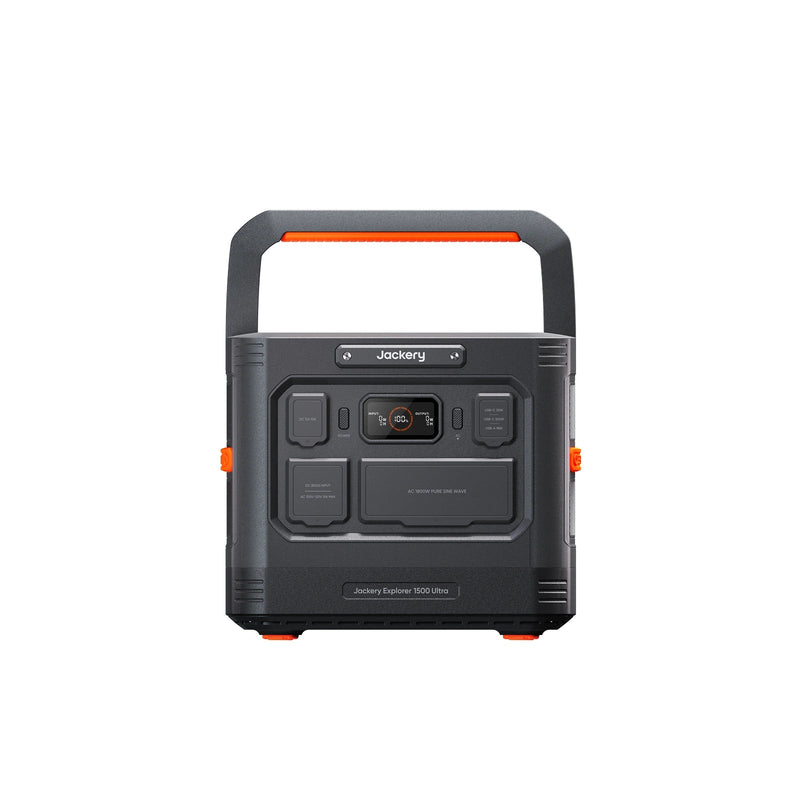
The Explorer 1500 Ultra is a fixed-capacity, 1,536 Wh portable power station with one U.S. 120 V inverter rated for 1,800 W continuous. Its design emphasizes a reinforced enclosure and covered ports, but its own manual tells owners to use it indoors or in a comparable sheltered environment. That makes it interesting for a dry RV bay, workshop or protected outage setup—not a reason to leave a live power station in a storm.
Where the stand-alone offer fits
The exact station-only option (JE-1500C, SKU 21-0001-000301) includes the Explorer 1500 Ultra and AC charging cable. It does not include a SolarSaga panel or a solar charging lead. Jackery lists two separate Solar Generator packages, including a two-panel 200 W kit and a two-panel 100 Prime option; those are materially different ways of starting a solar setup and have their own assessments. The station is not expandable with a battery pack, and Jackery says it does not support parallel station operation. If your plan needs a later capacity upgrade or household split-phase output, this is the wrong architecture rather than a starter that can grow into it.
At 38.6 lb, it is carryable by one person in the broad sense, but not a featherweight grab bag. Consider where it will sit, whether lifting it into a vehicle is comfortable, and whether your solar panels will travel with it. The published station dimensions are 13.2 by 10.4 by 11.6 inches. Its battery is 1,536 Wh LiFePO4, with a manufacturer rating of 4,000 cycles to at least 70% capacity. That is a published cycle-life endpoint, not a promise about how long a particular owner will get from one charge or a forecast of AC energy delivered to each appliance.
Power limits that change the decision
The three AC outlets share 1,800 W rated output. The manual also describes 2,000 W for up to 15 minutes and 3,600 W surge peak; neither figure should be treated as a second continuous rating. Check an appliance's running and starting requirements individually, then account for every other device on the station. The manual also reduces output to 1,000 W from -15°C to -10°C, so a winter plan that depends on a high-wattage heater or kitchen appliance loses headroom in that temperature band.
USB output consists of one 100 W USB-C port, one 30 W USB-C port and one USB-A port rated up to 18 W. There is one 12 V, 10 A output. Jackery lists two DC8020 input ports and a solar input range of 16–60 V. Its manual and FAQ describe a maximum of 400 W on one input and 800 W across both. The FAQ says the input ports are parallel: connected panel groups must match in model and count, two panels are supported, three are not, and a four-panel connection is allowed only with identical panels and the required adapters. Solar and vehicle charging cannot be combined at the same time. AC and solar charging can be used together. A charger capability describes what the station can accept; it does not put panels, cables or an ideal patch of sunlight in the standalone box.
Rugged construction, with a conservative weather rule
Jackery markets an IP65-rated design and says the closed enclosure is resistant to dust and water. The exact manual's specifications qualify the rating as applying with all lids closed. More importantly, the manual's safety section calls the device intended for indoor use and says it is not waterproof or dustproof, directing users to keep it away from rain and humid environments. The official FAQ takes a conditional position: caps closed, it describes resistance to everyday splashes or light rain, but says the solar input cover must be opened to charge and that exposed input is not waterproof; it does not recommend charging in rain or direct water. I would follow the stricter manual wording and keep the station dry and sheltered, especially while any port is open. Do not choose it for unattended outdoor rain exposure or a dusty open construction site on the strength of marketing language.
Backup and everyday use
The station has app control over Wi-Fi and Bluetooth, pass-through charging and a 20 ms UPS transfer. Jackery explicitly says the transfer is not 0 ms and warns against devices such as servers or workstations that require true uninterrupted switching. For a sensitive computer, use a suitable dedicated UPS and test the complete setup; for less timing-sensitive loads, this can provide a brief transition when utility power drops, within its remaining battery capacity and output limits. The manual gives a broad charge range of 0–45°C and discharge range of -15–45°C; these are operating boundaries, not an invitation to store it in any temperature extreme.
Who should compare another configuration
Choose the standalone offer when you already own compatible panels, expect to buy them separately, or mainly want AC charging without paying for a solar package. Compare it with the 2×200 W kit if a portable panel pair is useful, and the 2×100 Prime option if you prefer the named fixed-mount-oriented package with its brackets and adapters. Both bundle options retain the same 1,536 Wh battery, 1,800 W AC rating and weather cautions; panels change charging equipment, not output voltage or storage. Compare other expandable stations if you need to add capacity later, and smaller units if 38.6 lb is too much. A match is only a fit for stated specifications: actual runtime depends on load, inverter losses, temperature, charge state and operating behavior, none of which this review measures.
For exact controls and limits, consult the Jackery U.S. product page, its model FAQ, and the JE-1500C manual. The manual is hosted by B&H Photo Video; its more cautious weather instruction is worth reading before outdoor use.
Key details at a glance
| Nameplate battery capacity | 1536 Wh |
|---|---|
| Rated AC output | 1800 W |
| Manufacturer surge rating | 3600 W |
| Maximum solar input | 800 W |
| Included panels, combined nameplate | 0 W |
| Maximum USB-C output per port | 100 W |
| Listed weight | 38.6 lb |
| Compatible extra-battery expansion | No |
| 12 V DC output | 120 W |
| Maximum AC recharge input | 1600 W |
| Manufacturer UPS transfer figure | 20 ms |
| Base warranty term | 3 years |
| AC outlet output | Yes |
| USB-C ports | 2 |
| USB-A ports | 1 |
| Solar input ports | 2 |
| 12 V car-style output | 120 W |
| Battery chemistry | LiFePO4 |
| Ingress rating | IP65 (all port lids closed, per manual) |
| Expansion battery in this package | No |
| Home Power Panel in this package | No |
| Separate station units in offer | 1 |
| Solar panels in exact offer | 0 |
Use the exact model’s instructions for operating limits, supplied equipment and version differences.
Sources for this assessment
- Jackery U.S. portable power station collection, observed card position 17
- Jackery Explorer 1500 Ultra U.S. exact product page
- Jackery Explorer 1500 Ultra U.S. Shopify option data
- Jackery Solar Generator 1500 Ultra package options
- Jackery Solar Generator 1500 Ultra exact U.S. variants
- Jackery Explorer 1500 Ultra Basic Information FAQ
- Jackery Explorer 1500 Ultra User Manual, model JE-1500C (hosted by B&H Photo Video)
- U.S. CPSC recall API name search for JE-1500C
A useful match starts with the loads that matter.
Use the finder for hard electrical requirements, then check appliance starting behavior, actual run time and the exact package in the full assessment.