
Your needs, this model
Does it fit your priorities?
Does the 6 kWh option provide more than 6,000 Wh nameplate?
One 2,042.8 Wh station plus two 2,042.8 Wh Battery Packs totals 6,128.4 Wh nameplate, not measured usable output.
Explore this need in the finder →Is a SolarSaga 500 X supplied?
The exact selected U.S. option lists one SolarSaga 500 X; its manual identifies JS-500A.
Explore this need in the finder →Do you need new condition and at least one year of offer warranty?
No. This selected option is refurbished and the manufacturer lists a six-month warranty.
Explore this need in the finder →Must all supplied panels fit the station’s input limits at their own published ratings?
The JS-500A short-circuit-current rating is higher than the station’s 12 A per-port maximum, so the strict full-rating condition is not confirmed.
Explore this need in the finder →Is an accessories bag listed in this 500 X package?
No bag appears in the exact 500 X refurbished option contents; compare the two-200 W refurbished option if a bag matters.
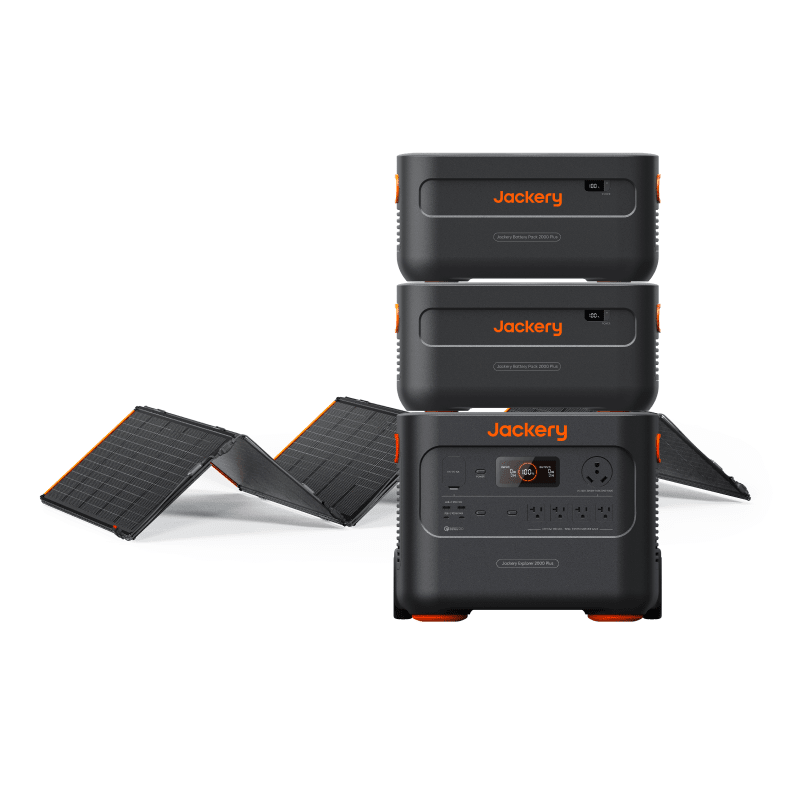
Explore this need in the finder →This review is for Jackery’s exact U.S. Explorer 2000 Plus Kit (6 kWh) + SolarSaga 500 X (Refurbished) selection, SKU 60-202050-US00708. The option record identifies the Explorer 2000 Plus host as model JE-2000C and includes two Battery Pack 2000 Plus units plus one SolarSaga 500 X. That is a materially different offer from the refurbished station-only SKU 21-0001-000036-R. The page marks the station offer refurbished and lists a six-month warranty; it does not provide a per-unit battery-health value.
Three batteries make a bigger plan, not a bigger inverter
Jackery’s kit name says 6 kWh. The station manual gives 2,042.8 Wh for one JE-2000C, and the Battery Pack 2000 Plus manual gives the same 2,042.8 Wh nameplate for each expansion unit. Adding the three published nameplates produces 6,128.4 Wh. That arithmetic is useful for comparing storage, but it is not an independently measured usable-energy or runtime promise, and the refurb page does not disclose the condition of the specific station or the two packs in a delivered set. The one-station operating plan remains 120 V with a 3,000 W AC maximum and 6,000 W surge peak. Two expansion batteries add storage; they do not create another inverter, a 240 V split-phase output, or a transfer-switch installation.
One base station plus two Battery Pack 2000 Plus units is a substantial, heavy combination. Jackery’s manual lists the station at about 61.5 lb and each expansion pack at about 41.9 lb. The included SolarSaga 500 X weighs about 23 lb. The main pieces together are therefore roughly 168 lb before cables and packaging, and they are separate objects to position and connect, not one carryable power station. The exact box list includes two expansion cables, one car charge cable and one AC charge cable. It does not list the accessory bag that appears in the other refurbished kit option.
One large panel sits inside the solar power ceiling
The SolarSaga 500 X manual identifies panel model JS-500A, 500 W ±5% STC, 41.7 V power voltage, 12 A operating current and 48.5 V open-circuit voltage. Jackery’s Explorer 2000 Plus manual gives the station’s two DC8020 inputs a 17.5–60 V working range, 700 W / 12 A per input, and 1,400 W / 24 A combined. On its published maximum-power point, one panel is below the per-input wattage ceiling and at the station’s 12 A operating-current limit; the voltage figures are inside the station’s range. The panel’s short-circuit current is higher than 12 A, however, so do not read nameplate wattage as a guarantee that the station will accept every possible panel output at every condition. The exact kit is a manufacturer-listed combination, but actual charging varies with sunlight and the station’s input controller.
The package includes one 500 W panel, not two or six. That matters if your requirement is a panel-in-box threshold or a particular cable arrangement. The panel’s own cable is documented in its manual; the exact offer list separately names the SolarSaga 500 X, the AC and car cables, and two expansion cables. The station’s input ceiling remains 1,400 W whether or not you later buy additional panels, and its instructions call for consistent panel types and counts across both solar inputs when both are used. Do not assume that the one included panel is a full 1,400 W array or that a second panel is included.
Refurbishment is the qualification, not a footnote
A buyer may value the two packs and the large folding panel in one offer and accept a refurbished host. Still, the manufacturer labels the station refurbished and states six months of warranty, while publishing no unit-level remaining capacity, cycle history or separate battery-condition grade on the reviewed offer. The package page does not separately state the condition or warranty of the two expansion batteries. That gap is not proof that the packs are used, damaged or incompatible; it is a reason not to make up their individual condition. A new-only filter should reject this package, and a one-year warranty floor should reject it unless the seller gives a different written term for the exact SKU.
The other 6 kWh refurb option lists two SolarSaga 200 W panels, two packs and an accessory bag; its solar panel model revision is not named in the selected option. The new Explorer 2000 Plus + two SolarSaga 100 W Mini choice has smaller panels, no expansion packs and a different offer condition. Both alternatives remain one JE-2000C host, so neither should be treated as a second station or as a 240 V setup.
Bottom line
Choose this kit only if a refurbished JE-2000C, two model-specific expansion packs and one SolarSaga 500 X match the actual contents you want. It offers a larger nameplate storage system and one panel without changing the station’s 120 V / 3,000 W output plan. Keep the six-month warranty and undisclosed individual battery conditions visible, and verify the panel connection and array plan rather than promising a 500 W harvest from a bundle photograph.
Compare this larger single-panel bundle with the station-only and two-200 W refurb options in the Explorer 2000 Plus package guide.
Sources: Jackery U.S. Explorer 2000 Plus selected-option page, JE-2000C specifications, the Explorer 2000 Plus manual, the Battery Pack 2000 Plus manual, and the SolarSaga 500 X JS-500A manual.
Key details at a glance
| Nameplate battery capacity | 6128.4 Wh |
|---|---|
| Rated AC output | 3000 W |
| Manufacturer surge rating | 6000 W |
| Maximum solar input | 1400 W |
| Included panels, combined nameplate | 500 W |
| Maximum USB-C output per port | 100 W |
| Listed weight | 61.5 lb |
| Compatible extra-battery expansion | Yes |
| 12 V DC output | 120 W |
| Maximum AC recharge input | 1750 W |
| Manufacturer UPS transfer figure | 20 ms |
| Base warranty term | 0.5 years |
| AC outlet output | Yes |
| USB-C ports | 2 |
| USB-A ports | 2 |
| Solar input ports | 2 |
| 12 V car-style output | 120 W |
| Battery chemistry | LiFePO4 |
| Expansion battery in this package | Yes |
| Home Power Panel in this package | No |
| Separate station units in offer | 1 |
| Solar panels in exact offer | 1 |
Use the exact model’s instructions for operating limits, supplied equipment and version differences.
Sources for this assessment
- Jackery U.S. portable-station collection snapshot
- Jackery U.S. Explorer 2000 Plus offer page
- Jackery U.S. Explorer 2000 Plus option JSON
- Jackery Explorer 2000 Plus User Manual, model JE-2000C
- Jackery Explorer 2000 Plus Basic Information
- Jackery FAQ: maximum Battery Pack count
- Jackery Battery Pack 2000 Plus User Manual, model JBP-2000A
- Explorer 2000 Plus solar connection information on the selected manufacturer product route
- CPSC recall search query for Jackery Explorer 2000 Plus
- Jackery SolarSaga 500 X User Manual, model JS-500A
A useful match starts with the loads that matter.
Use the finder for hard electrical requirements, then check appliance starting behavior, actual run time and the exact package in the full assessment.