
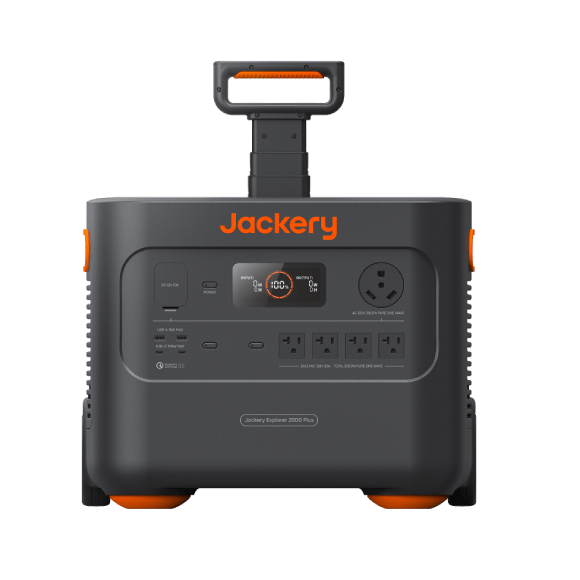
Your needs, this model
Does it fit your priorities?
Does this exact station meet a 120 V, 3,000 W requirement?
The JE-2000C is a single-station 120 V plan rated 3,000 W AC; 6,000 W is the listed surge peak, not continuous output.
Explore this need in the finder →Is a panel included in this station-only refurbished SKU?
No. The option contents list the station and charging accessories, but no solar panel.
Explore this need in the finder →Do you need one compatible extra battery included?
This offer includes no Battery Pack 2000 Plus, although the station supports compatible batteries bought separately.
Explore this need in the finder →Do you require a new unit?
This exact U.S. SKU is listed as refurbished; unit-level health is not disclosed.
Explore this need in the finder →What warranty floor applies to this exact offer?
The manufacturer refurb listing states six months; it does not promise individual battery health.
Explore this need in the finder →This review covers the exact U.S. refurbished station offer, SKU 21-0001-000036-R, not one of the 6 kWh refurbished bundles shown on Jackery’s related Explorer 2000 Plus page. The listing identifies the unit as an Explorer 2000 Plus; the U.S. manual identifies the station model as JE-2000C. Jackery’s refurbished page states a six-month warranty. It does not give a unit-specific battery-health grade, cycle count or remaining-energy figure, so the model’s 2,042.8 Wh nameplate is not a measurement of this particular refurbished battery.
A high-output 120 V host, but no batteries in this box
The JE-2000C is a much heavier, expandable home-and-RV-oriented station than a small camping pack: its manual lists 2,042.8 Wh of LiFePO4 storage, 3,000 W maximum AC output and a 6,000 W surge peak. Those values describe different things. The surge figure is not a continuous rating, and the model’s 120 V single-station plan does not become 240 V simply because extra batteries can be attached. The body is about 61.5 lb and 27.9 kg; moving it is a two-hand task even before adding any expansion units. Its published cycle-life figure is 4,000 cycles to at least 70% capacity, but that factory specification does not certify the history or present state of a refurbished unit.
The exact refurbished box is narrower than the expandable platform’s capabilities. Jackery’s U.S. offer lists one station, an AC charging cable, a car charging cable and two DC7909-to-DC8020 adapters. It does not list an expansion battery, solar panel or accessory bag. The adapter pieces may help connect supported equipment, but they are not evidence that a panel is included. Buyers can add the model-specific Battery Pack 2000 Plus later; the manufacturer says up to five packs can be used with an Explorer 2000 Plus. The refurbished station offer itself includes none, so the questionnaire must distinguish expansion support from an expansion battery actually in the box.
Solar inputs are a system limit, not a panel promise
The JE-2000C supports two DC solar inputs. Jackery’s U.S. specifications give a 17.5–60 V working range, up to 700 W and 12 A on one port, and up to 1,400 W and 24 A when the two inputs are used. Those limits help narrow a panel plan, but this station-only offer supplies no panel. Confirm connector, voltage, current and parallel-array instructions for any panel you already own; the station’s 1,400 W ceiling is not a forecast of actual daily harvest. Nameplate watts are a laboratory rating, not an all-weather charging result. The manual also says the two input branches must use consistent panel type and quantities when both are used together.
The station has USB-C and USB-A charging as well as a 12 V car-style outlet. It is useful for a chosen mix of 120 V appliances and smaller direct-DC loads, provided the total draw and startup demand stay inside the station’s own limits. If you are looking for an automatic mains-failure handoff, Jackery calls this an Emergency Power System: the manual gives a 20 ms transfer and warns that it is not a professional zero-millisecond UPS. It specifically advises against relying on it for high-uninterruptibility equipment such as servers and workstations. Treat that distinction as essential rather than extrapolating from the word “backup.”
Condition and warranty change the buying decision
This offer can suit a buyer who wants the JE-2000C’s expansion path and high single-unit output, has a plan to inspect the refurbished condition, and knowingly accepts six months of stated coverage. It is a poor fit for a household that needs a fresh capacity guarantee, a long warranty floor, an included solar kit, or a reserve whose battery history cannot be checked. The page does not disclose per-unit remaining Wh, state of health, cycle count, cosmetic grade or a unit-specific performance test. If those facts matter, ask the seller before purchase and keep the uncertainty in the decision; do not translate “2,042.8 Wh” into a promise about current usable energy.
For a refurbished station plus more stored energy, compare the separate 6 kWh configurations: one includes a SolarSaga 500 X, while another lists two SolarSaga 200 W panels and an accessory bag. Those packages add two Battery Pack 2000 Plus units and therefore change both the contents and the capacity plan. If buying new matters more than including a solar panel, the current Explorer 2000 Plus option with two SolarSaga 100 W Mini panels is the new-offer alternative. None of these package differences should be guessed from the station’s model name or from a shared product image.
Bottom line
The refurbished Explorer 2000 Plus is best considered as a specific JE-2000C station with a short stated warranty and unknown unit-level battery condition. Its 120 V / 3,000 W station plan, 2,042.8 Wh model capacity and five-pack expansion capability are useful facts; they do not make the six-month refurb offer equivalent to a new station or to a multi-battery kit. Choose it only when the included station and cables meet your plan, and when you can live with what Jackery does not disclose about the individual battery.
For the exact contents and tradeoffs of the larger solar bundles, see the Explorer 2000 Plus package comparison.
Sources: Jackery U.S. refurbished Explorer 2000 Plus listing, Jackery U.S. model specifications, and the Explorer 2000 Plus JE-2000C manual.
Key details at a glance
| Nameplate battery capacity | 2042.8 Wh |
|---|---|
| Rated AC output | 3000 W |
| Manufacturer surge rating | 6000 W |
| Maximum solar input | 1400 W |
| Included panels, combined nameplate | 0 W |
| Maximum USB-C output per port | 100 W |
| Listed weight | 61.5 lb |
| Compatible extra-battery expansion | Yes |
| 12 V DC output | 120 W |
| Maximum AC recharge input | 1750 W |
| Manufacturer UPS transfer figure | 20 ms |
| Base warranty term | 0.5 years |
| AC outlet output | Yes |
| USB-C ports | 2 |
| USB-A ports | 2 |
| Solar input ports | 2 |
| 12 V car-style output | 120 W |
| Battery chemistry | LiFePO4 |
| Expansion battery in this package | No |
| Home Power Panel in this package | No |
| Separate station units in offer | 1 |
| Solar panels in exact offer | 0 |
Use the exact model’s instructions for operating limits, supplied equipment and version differences.
Sources for this assessment
- Jackery U.S. refurbished Explorer 2000 Plus page
- Jackery U.S. refurbished Explorer 2000 Plus option JSON
- Jackery Explorer 2000 Plus User Manual, model JE-2000C
- Jackery Explorer 2000 Plus Basic Information
- Jackery FAQ: maximum Battery Pack count
- Jackery Battery Pack 2000 Plus User Manual, model JBP-2000A
- Explorer 2000 Plus solar connection information on the selected manufacturer product route
- CPSC recall search query for Jackery Explorer 2000 Plus
A useful match starts with the loads that matter.
Use the finder for hard electrical requirements, then check appliance starting behavior, actual run time and the exact package in the full assessment.