
Your needs, this model
Does it fit your priorities?
Does this exact package meet a 120 V, 2,200 W continuous station requirement?
The JE-2000D is documented for 120 V AC, 2,200 W rated total output and 4,400 W peak. Peak is not continuous; startup and simultaneous loads need their own margin.
Explore this need in the finder →Must the package include solar panels, and what total panel nameplate is needed?
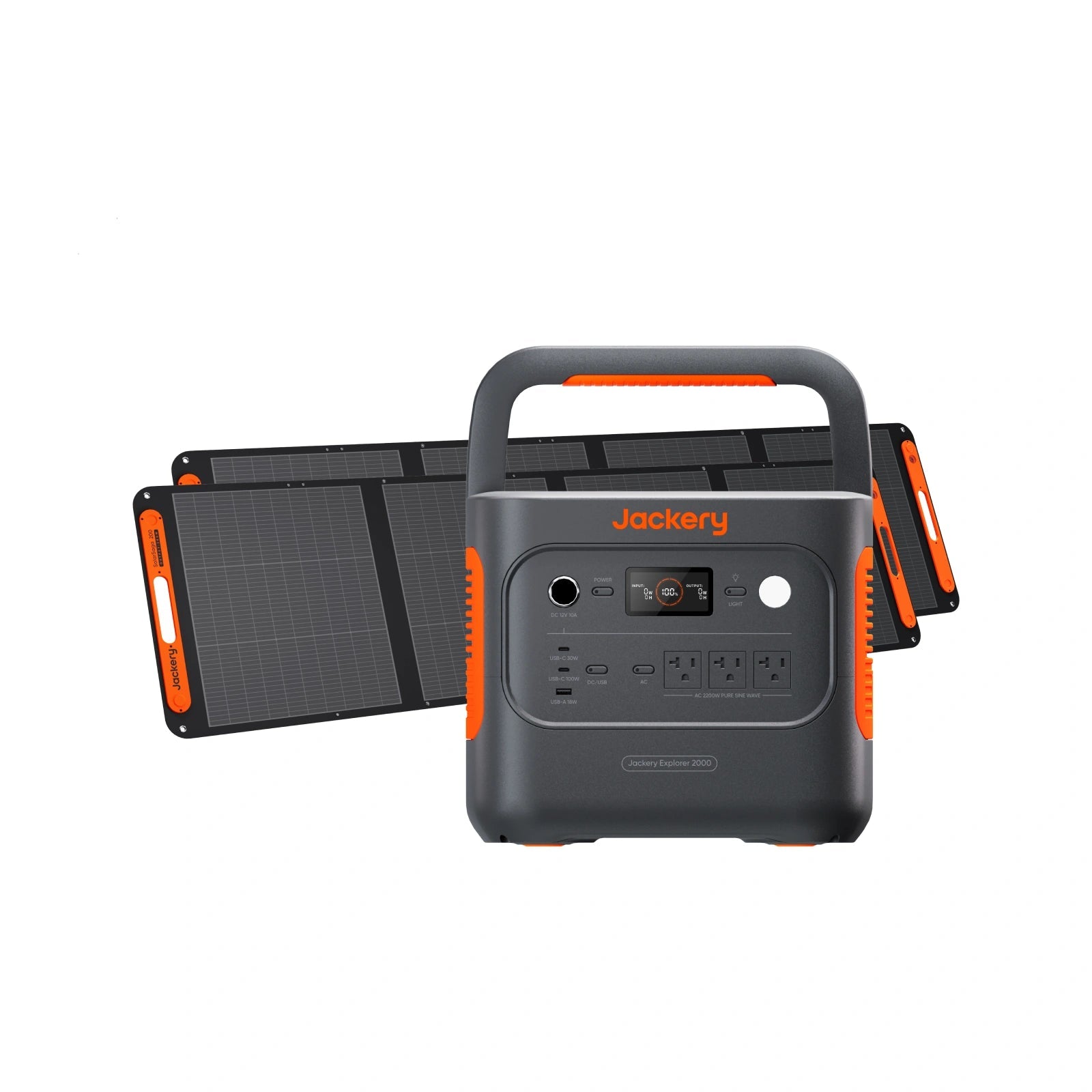
This exact offer includes 2 panel(s) with 400 W nominal total.
Explore this need in the finder →Must all supplied panels work together within the station’s published ratings at nameplate power?
The exact nominal panel array is within the JE-2000D’s 400 W combined ceiling.
Explore this need in the finder →Is the exact package warranty and accessory set suitable for your need?
The exact offer does not include a carry bag; new-package warranty is shown as 3+2 years on Jackery.com.
Explore this need in the finder →Do you require a new, non-refurbished unit?
The exact page variant is a new retail offer, not the separately listed refurbished SKU.
Explore this need in the finder →The Jackery Explorer 2000 v2 + SolarSaga 200 W ×2 configuration is a station-plus-panels offer, not the station’s standalone SKU. The official U.S. option record identifies bundle SKU 60-2020-USD1D2, with two SolarSaga 200 W panels, the Explorer 2000 v2, AC cable and solar leads in the offer. Each panel is rated 200 W, which gives this pair a 400 W combined nameplate—exactly the JE-2000D’s listed maximum total solar input, not an extra margin above it.
Two panels are useful only as one compatible plan
Jackery’s station documentation describes 16–60 V solar input, two parallel station inputs and up to 400 W combined. The 200 W bundle is attractive on paper because its two-panel nameplate sum reaches 400 W. That arithmetic is not enough to verify a real array: voltage, current, connector, adapter and how each panel is assigned to the inputs all matter. The official SolarSaga 200 W product page and the JS-200D manual disagree on some published voltage, current and weight values. Both sets of stated electrical values fit inside the Explorer’s published 60 V and per-port/combined current limits when arranged as the manufacturer’s two-panel kit, but the differences remain real; don’t substitute a third-party panel or rewire the set based only on nominal watts.
A 400 W combined panel rating is measured under standard conditions. A hot panel, imperfect angle, shade, cloud or cable loss reduces actual production, and the station can limit input according to its own ceiling. No exact refill time in a particular campsite or weather condition is guaranteed. If you need an array that is independently inspected and electrically specified against the station, use the exact Jackery-supplied package and leads or obtain direct confirmation for the alternate wiring you intend to use.
The station remains a fixed 2,042 Wh, 2,200 W unit
The bundle’s station has 2,042 Wh LiFePO4 nameplate capacity and 2,200 W rated 120 V AC output, with 4,400 W listed as surge. Do not use that short peak figure as a continuous appliance rating; check operating and startup loads. Its three AC outlets share the inverter, while two USB-C ports carry 100 W and 30 W ratings, USB-A is rated up to 18 W, and the 12 V/10 A car-style socket is for compatible low-draw equipment. The manufacturer’s documents do not publish AC-delivered Wh for a specified load, so a household runtime estimate needs conservative load assumptions rather than dividing every nominal Wh by the appliance label.
The JE-2000D does not support a separately purchased expansion battery. The bundle’s extra solar equipment changes how the station can be replenished, not how much stored energy or AC output it has. It also remains one portable station, not a hard-wired household panel. The published automatic transfer interval is 20 ms rather than zero; Jackery says not to rely on that transfer for critical electronic equipment.
When this package is worth choosing
Consider this option if you want about 400 W of nominal Jackery-branded panel capacity in the same exact order as the 2 kWh-class station, and you have room to set up and orient two panels. It saves the separate compatibility and cable research required by the bare JE-2000D, but it is still a real outdoor setup task. The station weighs about 39.5 lb before the panels and AC cable, and the panels require their own handling and storage. If the system will be moved often or deployed by someone who cannot manage multiple panels, the two 100 W Air kit may be more manageable despite its lower nameplate input.
For solar power to be an essential match, select the included-panel question and a maximum input need that makes sense, then separately require that all panels in the offered kit can operate together. The 500 X option should not pass an all-panels-at-rated-output condition because its single 500 W nameplate exceeds the station’s 400 W total limit. If solar input is not important, the standalone SKU is simpler and does not justify paying for panels you will leave stored. If a bag or cold-weather accessory is more useful, the Extreme Kit is a different package; its heater uses energy and does not expand the station’s published temperature limits.
Bottom line
This exact two-panel configuration is the most direct way in this family to buy a 400 W-nameplate array with the JE-2000D. Its advantage is a clearly listed kit, not an unqualified 400 W field charging rate. The remaining source conflict in the SolarSaga panel specifications is material to anyone planning custom wiring or fitting the panels into tight electrical margins. Keep the official cables, verify exact labels and avoid assuming the panel pair can add storage, exceed 400 W input or make the station weatherproof. For the core station without that solar package, use the separately reviewed standalone profile.
Key details at a glance
| Nameplate battery capacity | 2042 Wh |
|---|---|
| Rated AC output | 2200 W |
| Manufacturer surge rating | 4400 W |
| Maximum solar input | 400 W |
| Included panels, combined nameplate | 400 W |
| Maximum USB-C output per port | 100 W |
| Listed weight | 39.5 lb |
| Compatible extra-battery expansion | No |
| 12 V DC output | 120 W |
| Maximum AC recharge input | 1800 W |
| Manufacturer UPS transfer figure | 20 ms |
| Base warranty term | 5 years |
| AC outlet output | Yes |
| USB-C ports | 2 |
| USB-A ports | 1 |
| Solar input ports | 2 |
| 12 V car-style output | 120 W |
| Battery chemistry | LiFePO4 |
| Home Power Panel in this package | No |
| Separate station units in offer | 1 |
| Solar panels in exact offer | 2 |
Use the exact model’s instructions for operating limits, supplied equipment and version differences.
Sources for this assessment
- Jackery U.S. exact Explorer 2000 v2 product/package page
- Jackery U.S. selected option JSON
- Jackery U.S. alternate Explorer 2000 v2 route
- Jackery U.S. alternate route option JSON
- Jackery Explorer 2000 v2 User Manual, model JE-2000D
- Jackery Explorer 2000 V2 Basic Information
- CPSC search snapshot
- Exact U.S. selected-option manufacturer image
- Jackery U.S. SolarSaga 200 W product page
- SolarSaga 200 W manual, model JS-200D

A useful match starts with the loads that matter.
Use the finder for hard electrical requirements, then check appliance starting behavior, actual run time and the exact package in the full assessment.