
Your needs, this model
Does it fit your priorities?
Can this exact small station run a 120 V AC device rated at 300 W or less?
The matching U.S. manual identifies one 120 V/60 Hz, 300 W-rated AC outlet with a 600 W peak. The support table's 100 V/3 A notation conflicts, so confirm the unit voltage for a voltage-critical load.
Explore this need in the finder →Will the station fit a light carry plan under eight pounds?
Jackery support lists the JE-240A at about 3.6 kg (7.94 lb); the refurbished offer is station-only and does not include a panel.
Explore this need in the finder →Can I accept the exact refurbished offer and its six-month warranty rather than requiring a new unit or longer warranty?
Yes, with the caveat that the listed refurb option was unavailable on October 24, 2026 and unit-specific remaining battery capacity is unpublished. It fails a new-only condition or a one-year warranty minimum.
Explore this need in the finder →Does it include a panel and adapter for a complete solar kit?
No. The exact refurb box list contains no panel or solar adapter. Its single USB-C solar input is limited to 100 W; standalone panel charging requires a separately purchased DC8020-to-USB-C adapter.
Explore this need in the finder →The refurbished Explorer 240 v2 is a compact, AC-equipped station for someone who has a modest, clearly defined load and is comfortable with the shorter protection attached to this particular offer. The important distinction is not just “240 v2”: this U.S. product page names a refurbished configuration, and its selected SKU is 21-0001-000212-R. The same station platform is also offered as a new unit under a different SKU. Do not assume the new-unit warranty, package or condition applies to the refurbished listing.
A small battery with a real, but limited, AC outlet
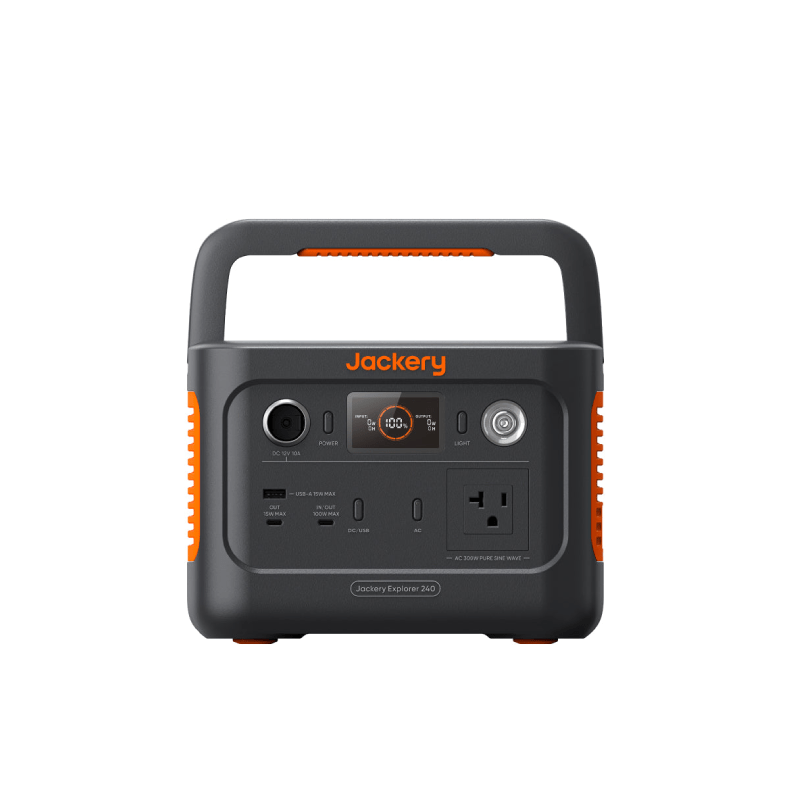
The matching U.S. manual identifies the station as model JE-240A. It lists a 256 Wh LiFePO4 battery and one 120 V, 60 Hz AC outlet rated at 300 W continuous, with 600 W peak surge. This gives it a useful role for charging small electronics and operating low-draw plug-in equipment, but it is not a substitute for a high-output home-backup unit. A device must meet both the station’s watt limit and the practical energy budget. The 256 Wh figure is battery nameplate capacity, not a promise that 256 Wh reaches an AC load; inverter use, device draw, temperature and other conditions affect delivered energy. No exact runtime is promised here.
For direct devices, the manual lists one USB-A port up to 15 W, one USB-C output up to 15 W, and a USB-C input/output port up to 100 W. A 12 V, 10 A car-style output is also listed. These are useful for a small mix of compatible electronics without needing the AC inverter. Do not add every individual port maximum and treat the sum as an extra station-wide budget: the manual and support material describe port ratings, not a guarantee that every port can deliver its maximum simultaneously. The unit has an integrated LED light and app connection; it does not support battery expansion.
The word “refurbished” changes the purchase decision
The selected refurbished page states a six-month warranty and its official option data showed the sole SKU as unavailable on October 24, 2026. That is a dated status, not a promise that it will remain sold out or return. More importantly, Jackery does not publish an individual refurbished battery’s cycle count, measured remaining capacity or unit-specific condition. A 256 Wh label identifies the model’s nameplate design, not a tested value for a particular used battery. The new-unit support table separately lists a three-year standard warranty with a possible extension, but that is not the warranty stated for this refurbished offer. If a longer warranty, known battery history, or reliable current stock is essential, do not treat this offer as a match; choose a current new product with a warranty that meets your own threshold.
There is also a small documentation difference worth keeping in view rather than smoothing over. The U.S. manual rates the AC output at 120 V, while Jackery’s current support table for JE-240A writes “100 V/3 A, Max. 300 W.” Both identify a 300 W ceiling, but the voltage labels do not agree. For a load where exact voltage is critical, confirm the rating on the unit and current manufacturer instructions before relying on the refurbished listing. The manual also describes the battery as reaching 3,000 cycles to 80% or better; the current support table gives a different cycle-life statement of at least 4,000 cycles to 70%. Those are distinct endpoints, not a reason to infer a refurbished unit’s present condition.
Plan the recharge before counting on it
The standard refurbished box list names the station, an AC charging cable and a user manual. It does not list a solar panel or a panel adapter. Solar input uses the USB-C port, has a 100 W maximum in the support table and is limited to one panel by voltage. Jackery says a separately purchased DC8020-to-USB-C adapter is required for a standalone solar panel; the SolarSaga 40 Mini is an exception because Jackery says that set includes the adapter. Do not assume a panel or adapter is bundled with this SKU. Vehicle charging is limited to a 12 V source—the manual warns against using 24 V—and the support table lists up to 100 W; the refurbished box list does not include a car charging lead. A solar panel, cable and the station’s input rating are three separate parts of the plan.
Where it fits, and where to look instead
This is a reasonable configuration to consider when low weight matters (the manufacturer lists about 7.94 lb), a single 300 W AC outlet is enough, 256 Wh nameplate storage fits the intended short session, and refurbished condition is acceptable. Its size can simplify carrying from a vehicle to a campsite or around a home during a brief interruption. It is not an all-day appliance source: first check the appliance’s running and startup requirements, then estimate the time you need and leave room for conversion losses. The manual calls for dry, ventilated use and lists charging at 0–45°C and discharge at -10–45°C; it is not a weatherproof outdoor enclosure.
For a need limited to USB and 12 V loads, compare the Explorer 300D: it has a similar small-station role, but no AC inverter, so an AC-only device rules it out. If you need more than 300 W AC or substantially more storage, move up to an inverter-equipped station such as the Explorer 1000 v2 and check its own weight, warranty and exact package. If you are interested in this exact refurbished SKU, use the finder’s condition and warranty choices rather than letting its model name stand in for a new unit. The six-month warranty, unavailable snapshot, and unknown individual battery history are real tradeoffs; no promotional image or nameplate figure can settle them for you.
Key details at a glance
| Nameplate battery capacity | 256 Wh |
|---|---|
| Rated AC output | 300 W |
| Manufacturer surge rating | 600 W |
| Maximum solar input | 100 W |
| Included panels, combined nameplate | 0 W |
| Maximum USB-C output per port | 100 W |
| Listed weight | 7.94 lb |
| Compatible extra-battery expansion | No |
| 12 V DC output | 120 W |
| Manufacturer UPS transfer figure | 20 ms |
| Base warranty term | 0.5 years |
| AC outlet output | Yes |
| USB-C ports | 2 |
| USB-A ports | 1 |
| Solar input ports | 1 |
| 12 V car-style output | 120 W |
| Vehicle charge input | 100 W |
| Battery chemistry | LiFePO4 |
| Expansion battery in this package | No |
| Home Power Panel in this package | No |
| Separate station units in offer | 1 |
| Solar panels in exact offer | 0 |
Use the exact model’s instructions for operating limits, supplied equipment and version differences.
Sources for this assessment
- Jackery U.S. portable power station collection, observed card position 16
- Jackery U.S. Explorer 240 v2 refurbished product page
- Jackery U.S. Shopify option data for the refurbished Explorer 240 v2
- Jackery Explorer 240 v2 U.S.-English user manual, model JE-240A
- Jackery U.S. Explorer 240 v2 Basic Information, model JE-240A
- Jackery U.S. Explorer 240 v2 refurbished product-page image
- CPSC SaferProducts Explorer 240 v2 recall-name query
- Jackery U.S. new Explorer 240 v2 product page
- Jackery U.S. option data for new Explorer 240 v2

A useful match starts with the loads that matter.
Use the finder for hard electrical requirements, then check appliance starting behavior, actual run time and the exact package in the full assessment.