
Your needs, this model
Does it fit your priorities?
Can a refurbished offer with a six-month warranty and no unit-level remaining-capacity grade suit your plan?
This exact U.S. SKU is refurbished; Jackery states a six-month warranty and general function testing, but no per-unit remaining-Wh or battery-health grade is published.
Explore this need in the finder →Does the 110 V outlet and 300 W detailed-model rating—with a conflicting 200 W collection-card label—fit your exact loads?
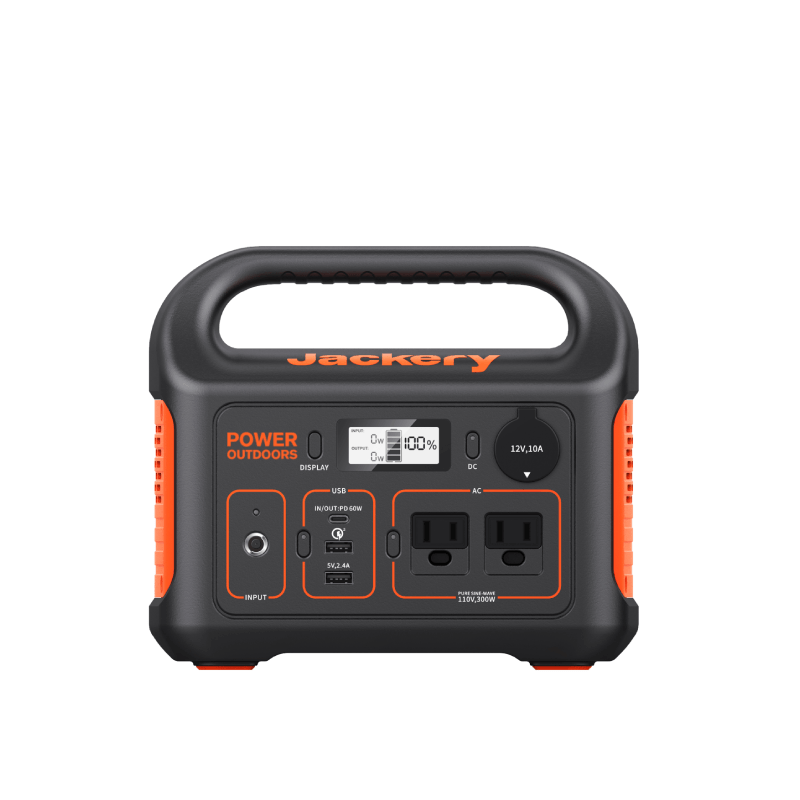
The product-page image and model-labelled manual copy state 110 V and 300 W continuous; the old collection card says 200 W, so confirm near-limit loads with Jackery and do not treat 500 W surge as continuous.
Explore this need in the finder →Are a small 290 Wh station, manually switched outputs, no UPS, and an optional separately sourced 100 W panel acceptable?
The offer page rounds capacity to 290 Wh, lists no solar panel, and the model manual copy says outputs are manually enabled rather than functioning as a UPS.
Explore this need in the finder →The Explorer 290 Plus is a small, fixed-capacity Jackery station sold here as a refurbished U.S. offer, not a new Explorer 300 or the AC-free Explorer 300D. The exact refurb option is SKU 70-0300-USOR04-R. In the checked manufacturer option data it was marked unavailable, so this review is useful for comparing the model and its refurb terms, not a promise that this particular offer can be ordered.
A small battery for modest loads, not a miniature home backup system
Jackery rounds this offer's capacity to 290 Wh. A manual copy labelled Explorer 290 Plus gives 293.76 Wh nominal, which is consistent with a rounded product label; neither number is a measurement of AC energy that a particular appliance will receive. For a rough planning exercise, total the nameplate watts of each load and the hours you need it to run, then leave room for conversion losses, startup draw, and battery condition. The unit-level remaining capacity of this refurbished station is not published. That makes an exact battery-health minimum an unsuitable match unless Jackery provides a test result for the particular unit.
There is an important rating inconsistency. The observed U.S. collection card calls the station a 200 W model. The detailed Explorer 290 Plus artwork on the exact product page marks the two 110 V receptacles at 300 W, and the model-labelled manual copy states 300 W continuous with 500 W surge. I use the detailed 300 W model rating, but a buyer whose load sits near that ceiling should confirm the actual returned unit's label with Jackery. Until clarified, planning below 200 W is the conservative choice; 500 W is a brief surge figure, not another continuous-load allowance. The outlets share the same inverter, so plugging into both does not double the rating. This is a 110 V design, not a confirmed 120 V or 240 V supply.
Useful port mix, with manual switching
The inspected exact-model image shows two household AC outlets, a 12 V/10 A car-style output, one USB-C PD port marked 60 W in/out, and two USB-A ports: one 5 V/2.4 A port and one Quick Charge 3.0 port. The 12 V socket is a device output, not evidence of a 12 V battery-charging input. Two AC receptacles are convenient for a light and a small electronic load, but a freezer compressor, kettle, heater, or other high-start/high-draw appliance is not a reason to trust either the capacity label or the surge number without checking the appliance's own rating and startup needs.
The model manual copy says the AC, USB, and DC outputs have to be switched on manually and that the Explorer 290 Plus is not a UPS. That distinction matters for outage planning: it may supply a device after you turn the relevant output on, but it is not an automatic switchover for a router or computer. Do not connect household wiring or expect continuous, unattended backup. The manual copy also says pass-through charging is supported but not recommended because it may affect battery life; simultaneous-input charging claims should not be mistaken for permission to use it as a permanently installed backup system.
Recharge routes are flexible; a solar panel is not in this box
The product page describes wall, car, and one optional SolarSaga 100 charging route. The exact refurbished box list names the station, a car-charging cable, a two-part AC charger, and a 12 V automotive-battery charging cable; it does not include a solar panel. A model manual copy recommends one optional 100 W SolarSaga and describes a shared DC input, but its stated solar recharge time differs from the marketing page's examples. Treat any advertised recharge duration as conditional, not a field-tested guarantee. If solar is essential, confirm the panel, correct lead, and exact refurb-package contents before purchase rather than assuming that a station compatible with a 100 W panel comes with one.
Refurbishment and use conditions deserve a close read
Jackery's support definition says refurbished units are tested for proper function and cleaned, may have minor cosmetic marks, and carry a six-month warranty. That is useful protection, but it does not publish this station's remaining watt-hours, battery-health grade, or cycle count. The model is described as lithium-ion, but the English U.S. offer does not establish a more specific cell chemistry. If new-only condition, a longer warranty, or a minimum measured battery capacity is essential, use a different offer or ask for written unit-specific confirmation.
At a listed 7.1 lb and roughly 9.1 × 5.2 × 7.8 inches in the model manual copy, the body is much easier to carry than larger home-backup stations. Still, its use instructions conflict: Jackery's product marketing names hikes and camping, while the manual copy labelled for this model says indoor use only and warns against outdoor exposure. No IP rating is published. Do not use it in rain, damp areas, or exposed campsite conditions on the strength of a general outdoor marketing line; if actual outdoor use is essential, ask Jackery to reconcile the instructions first.
Who should keep it on the shortlist?
It may fit someone who wants a light, AC-equipped source for small electronics, values a 60 W bidirectional USB-C port, accepts a refurbished unit with a six-month warranty, and can live with no panel, no expansion, and no UPS. It is a poor fit for 120 V or 240 V requirements, automatic outage transfer, a documented water-resistance need, high-draw appliances, a guaranteed battery-health floor, or an in-box solar kit. Compare the separately reviewed Explorer 300 if you want to weigh another Jackery station near this capacity; check that model's exact offer and warranty rather than assuming the same refurbished terms apply.
Sources: the exact Jackery Explorer 290 Plus refurbished option, Jackery's refurbished-product policy, the product-page Explorer 290 Plus detail image, and a model-labelled manual copy hosted by Manuals+ (the exact refurbished product page does not expose a manual download in its captured manual section).

Key details at a glance
| Nameplate battery capacity | 293.76 Wh |
|---|---|
| Rated AC output | 300 W |
| Manufacturer surge rating | 500 W |
| Maximum solar input | 100 W |
| Included panels, combined nameplate | 0 W |
| Maximum USB-C output per port | 60 W |
| Listed weight | 7.1 lb |
| Compatible extra-battery expansion | No |
| 12 V DC output | 120 W |
| Base warranty term | 0.5 years |
| AC outlet output | Yes |
| USB-C ports | 1 |
| USB-A ports | 2 |
| Solar input ports | 1 |
| 12 V car-style output | 120 W |
| Battery chemistry | Lithium-ion; finer cell chemistry not confirmed by the English U.S. offer |
| Expansion battery in this package | No |
| Home Power Panel in this package | No |
| Separate station units in offer | 1 |
| Smart Transfer Switch in this package | No |
| Solar panels in exact offer | 0 |
Use the exact model’s instructions for operating limits, supplied equipment and version differences.
Sources for this assessment
- Jackery U.S. Explorer 290 Plus refurbished selected option
- Jackery exact U.S. refurbished option JSON
- Previously archived Jackery U.S. portable-power-station collection, card 22
- Selected-option Jackery Explorer 290 Plus refurbished product rendering
- Jackery Explorer 290 Plus product-detail image
- Manuals+ hosted copy labelled Jackery Explorer 290 Plus User Manual
- Jackery Support, refurbished-product definition and warranty
- Jackery U.S. user-guides page

A useful match starts with the loads that matter.
Use the finder for hard electrical requirements, then check appliance starting behavior, actual run time and the exact package in the full assessment.