
Your needs, this model
Does it fit your priorities?
Will one U.S. 120 V station plan with 3,000 W total rated AC output and 3,024 Wh nameplate suit the combined load?
The JE-3000A U.S. manual describes a 120 V plan and a shared 3,000 W rating, but the support-table AC row conflicts and the used unit has no published remaining-energy grade.
Explore this need in the finder →Is a six-month warranty acceptable, or does the exact offer need to cover at least a year?
The exact refurbished option lists six months; there is no per-unit battery-health result.
Explore this need in the finder →Can you supply compatible solar panels and leads yourself instead of requiring an included panel?
The station has two 17.5–60 V DC solar inputs with a combined 1,400 W ceiling; the exact refurbished option includes no panel and does not establish a complete multi-panel cable set.
Explore this need in the finder →Must a solar panel be included in this exact package?
No panel appears in this selected refurbished offer’s box list.
Explore this need in the finder →Must this exact offer be new rather than refurbished?
This is explicitly the refurbished station-only option, SKU 70-3000-USOR01-R.
Explore this need in the finder →Is a verified RV-style TT-30 receptacle essential?
The manual rates a fifth outlet at 25 A, while the separate FAQ lists a 30 A/100 V output. Neither source names the exact connector subtype; an unknown does not meet a TT-30 requirement.
Explore this need in the finder →Does a sensitive device require zero-millisecond changeover?
The manual describes EPS changeover within 20 ms and explicitly says it is not a zero-ms professional UPS.
Explore this need in the finder →This is the refurbished U.S. Explorer 3000 Pro offer, model JE-3000A, not a new unit or a different Explorer 3000-family product. Its exact U.S. option is SKU 70-3000-USOR01-R and the listing states a six-month warranty. The offer does not publish this station's remaining capacity, cycle count, health grade, or a unit-level output test.
Three kilowatts is the ceiling, not a runtime promise
The model-specific U.S. manual describes a 3,024 Wh NCM lithium-ion battery, five AC receptacles, 3,000 W total rated output, and a 6,000 W surge peak. Four AC outputs are listed at 120 V/20 A maximum each; the fifth is listed at 120 V/25 A maximum. Those figures do not stack into a 5,000 W station: all five outlets share the 3,000 W total, and the surge figure is not a continuous load rating. Check both the combined running watts and the startup demands of your appliances before treating the capacity label as a fit. Nameplate watt-hours are not measured AC energy or a promise of how long a specific refrigerator, heater, or medical device will run.
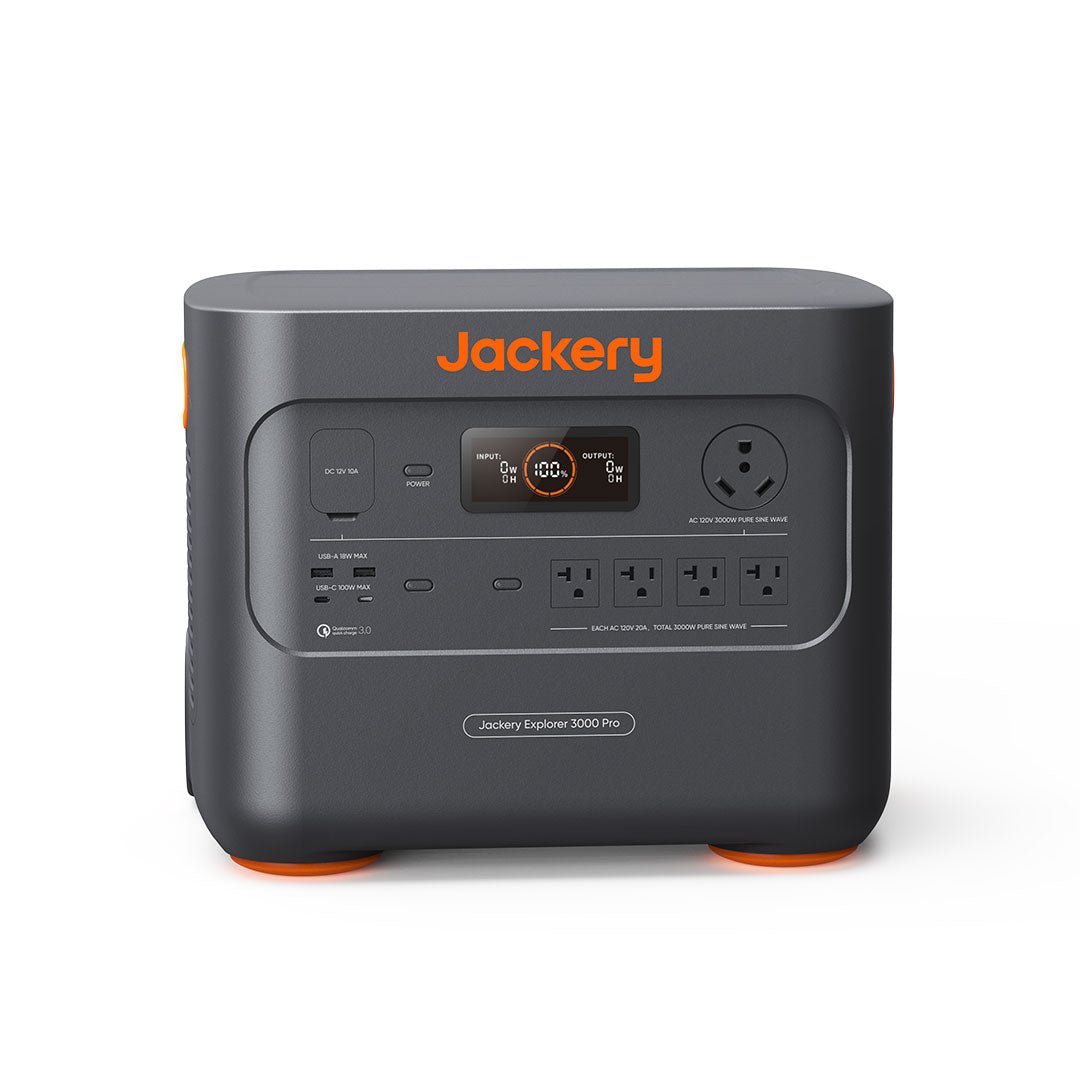
There is a documentation conflict worth resolving before a voltage- or outlet-sensitive purchase. The U.S. manual and the product image show 120 V, with 25 A maximum on the fifth output; Jackery's support table instead lists its four ordinary outputs at 100 V/20 A and one output at 100 V/30 A. I use the model-specific U.S. manual for the 120 V plan, but the pages do not reconcile the fifth-port current or name its exact receptacle subtype. Do not treat this review as confirmation of a TT-30 connector or assume a 30 A RV load. Check the label on the actual station and ask Jackery about the intended outlet before building a critical setup around that port.
The layout is useful for mixed loads: two USB-C ports are rated up to 100 W apiece, two USB-A ports up to 18 W apiece, and the 12 V car-style output is rated 10 A (120 W). That 12 V outlet serves compatible DC devices; it is not a 12 V battery-charging input.
Solar is capable; the refurbished box is not a solar kit
The manual specifies two DC input ports. Each solar input accepts 17.5–60 V, up to 12 A and 700 W; the dual-input ceiling is 24 A and 1,400 W. These are electrical limits rather than an expected harvest figure. The manual's connection instructions require matched panel types and equal panel counts on the two inputs when both are used; larger arrangements may need a separately purchased SolarSaga series connector. The exact refurbished offer page lists no solar panel. Its contents section names one DC7909-to-DC8020 adapter, but does not identify that as the complete charging-lead arrangement for every panel or multi-panel configuration. If a ready-to-connect array or a particular in-box cable is essential, this station-only SKU does not establish it.
The included car-charging cable is useful for a drive between stops, but the manual limits vehicle charging to 12 V vehicles and explicitly says not to use a 24 V vehicle system. It is not a substitute for the higher solar-input ceiling. For a regular solar routine, decide which exact panels, adapters, and array layout you will use before purchasing; a compatible power-input rating alone does not supply those parts.
Refurbished condition and placement matter as much as the headline spec
At about 63.93 lb and 18.6 × 14.1 × 14.7 inches, this is a substantial station, though its retractable handle and wheels ease movement on suitable level surfaces. Stairs still require planning. Jackery's six-month refurbished warranty is shorter than coverage described for a qualifying new purchase. Its 2,000-cycle-to-70%-capacity figure is a model rating, not this unit's remaining capacity. If a minimum usable-energy value or longer warranty is essential, do not infer it from 3,024 Wh or another offer's condition language.
In the exact refurbished option's “What's in the Box” list, Jackery names the station, car-charge cable, AC-charge cable, and one DC7909-to-DC8020 adapter. No solar panel appears in that list. The manual's generic new-product package illustration shows additional accessories, but that is not evidence that this refurbished SKU ships with the same accessories. The listing also does not promise an expansion battery or a transfer switch, and the JE-3000A is not described as supporting battery expansion.
Placement is a real constraint: the manual calls the device for indoor use and says not to use it outdoors where it can be exposed to rain or snow or in wet locations. Its marketing pages discuss camping and outdoor appliances, but do not give the station an ingress-protection rating; use a dry, ventilated protected location and follow the more specific safety instructions. Its EPS changeover is specified within 20 ms, not zero milliseconds. Jackery warns that it is not a professional UPS and should not back up equipment such as servers or workstations that cannot tolerate a momentary interruption. Test ordinary equipment for compatibility rather than treating pass-through charging as whole-home backup.
Who should compare it—and what else to consider
This refurbished Explorer can suit someone who wants a single 120 V station with a 3 kW rated ceiling, substantial nameplate storage, app access, and a high solar-input limit, and who accepts a short warranty and unknown unit-level battery condition. It is not a match for new-only, a verified battery-health minimum, 240 V, expansion, an included panel, a documented TT-30 outlet, or zero-millisecond UPS needs.
Compare the new Jackery HomePower 3000 if you want a distinct 3,072 Wh, 3,600 W LiFePO4 model rather than this refurbished 3,024 Wh, 3,000 W NCM station. For a materially higher-output setup, the Explorer 5000 Plus is another platform, not an accessory for this model. No refurbished sample was examined or tested.
Sources: Jackery's Explorer 3000 Pro refurbished offer, its JE-3000A U.S. manual, and the separate Explorer 3000 Pro support table whose AC-output values conflict with the manual.
Key details at a glance
| Nameplate battery capacity | 3024 Wh |
|---|---|
| Rated AC output | 3000 W |
| Manufacturer surge rating | 6000 W |
| Maximum solar input | 1400 W |
| Included panels, combined nameplate | 0 W |
| Maximum USB-C output per port | 100 W |
| Listed weight | 63.93 lb |
| Compatible extra-battery expansion | No |
| 12 V DC output | 120 W |
| Manufacturer UPS transfer figure | 20 ms |
| Base warranty term | 0.5 years |
| AC outlet output | Yes |
| USB-C ports | 2 |
| USB-A ports | 2 |
| Solar input ports | 2 |
| 12 V car-style output | 120 W |
| Battery chemistry | NCM lithium-ion |
| Expansion battery in this package | No |
| Home Power Panel in this package | No |
| Separate station units in offer | 1 |
| Smart Transfer Switch in this package | No |
| Solar panels in exact offer | 0 |
Use the exact model’s instructions for operating limits, supplied equipment and version differences.
Sources for this assessment
- Jackery Explorer 3000 Pro Portable Power Station (Refurbished), exact selected U.S. option
- Jackery selected refurbished product option data
- Jackery Explorer 3000 Pro U.S. User Manual, JE-3000A, version JAK-UM-V1.0
- Jackery Explorer 3000 Pro Basic Information support article
- Exact selected JE-3000A refurbished-offer product image
- U.S. CPSC exact product-name query

A useful match starts with the loads that matter.
Use the finder for hard electrical requirements, then check appliance starting behavior, actual run time and the exact package in the full assessment.