
Your needs, this model
Does it fit your priorities?
Must the exact package include an AC extension cable?
Yes: SKU 60-100000-US00654 lists an extension cable in addition to the normal station charging cable.
Explore this need in the finder →Does it keep the JHP-1000B 120 V / 1,800 W operating plan?
The extra cord does not alter the station’s rated output or voltage.
Explore this need in the finder →Does it include an expansion battery as well as the cord?
No. The product option does not list a battery pack.
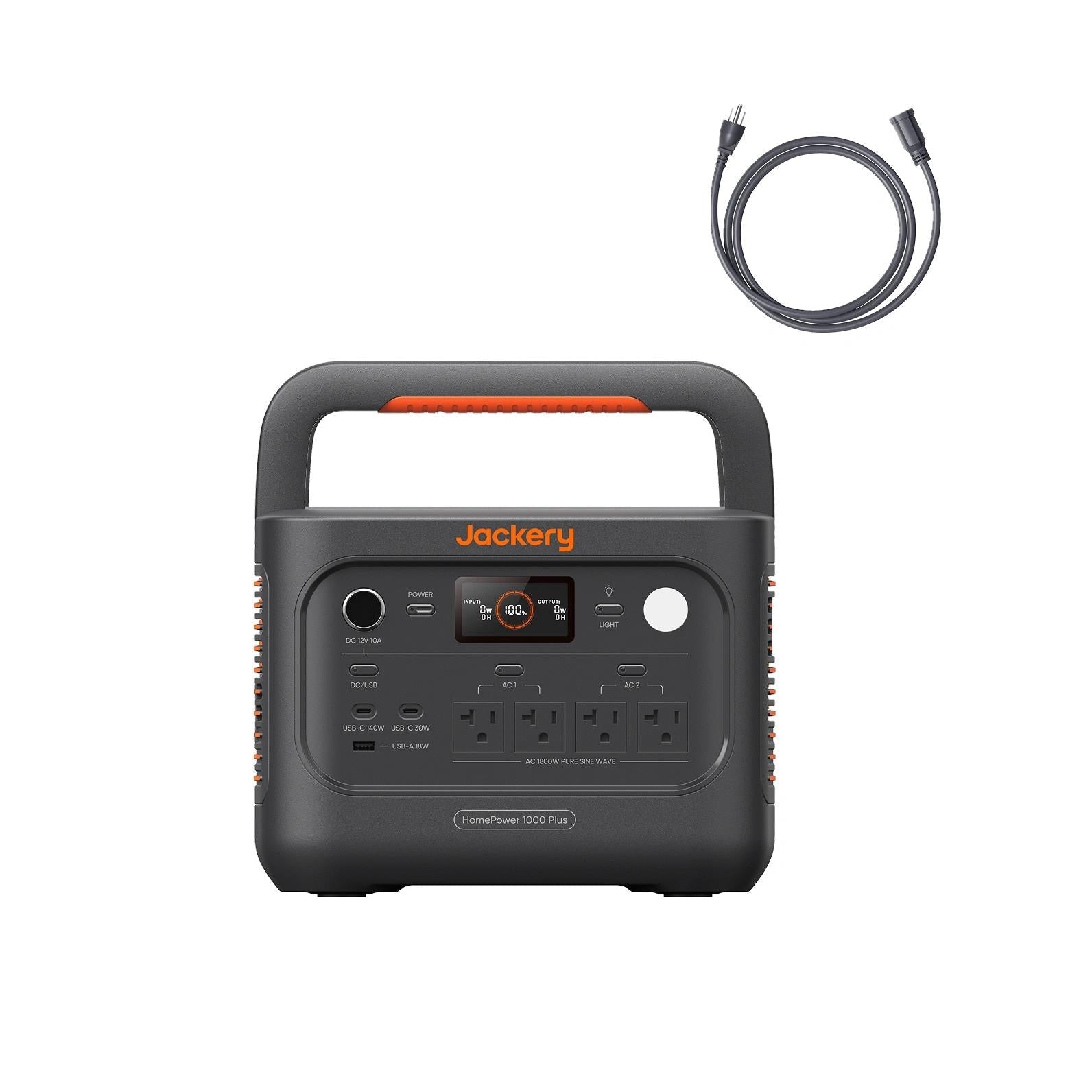
Explore this need in the finder →This is the HomePower 1000 Plus v2 JHP-1000B paired with an AC extension cable, not a different inverter or a higher-capacity model. Jackery’s U.S. selected-option list identifies SKU 60-100000-US00654 and lists one station, one AC extension cable, and the ordinary AC charging cable. Keeping those two cords distinct matters: the extension cord is an included accessory, while the AC charging cable is for charging the station from a wall outlet. The photo is a manufacturer rendering of the station and a coiled cable; it does not establish a cord length or electrical rating.
The station’s power plan stays the same
JHP-1000B has 1,024 Wh of LiFePO4 nameplate storage and four 120 V receptacles sharing 1,800 W rated AC output. The 3,600 W figure is peak output, not continuous. The extension cable does not raise that limit, add receptacles, or turn the station into a 240 V supply. Before plugging in several loads, use appliance labels and starting requirements to make sure their simultaneous demand fits the 1,800 W ceiling. A tool that draws below that ceiling while running can still exceed a startup or surge limit.
The station is rated for 6,000 cycles to at least 70% capacity, a manufacturer specification rather than an independent life test. Nameplate watt-hours do not translate directly into appliance runtime: the official material checked for this review does not give AC-usable energy under a stated test load. Account for inverter losses and leave a margin, rather than assigning hours from 1,024 Wh alone. The listed dimensions are 12.4 by 7.9 by 9.2 inches and the unit weighs 23.8 lb before cables or other accessories.
What the cord can and cannot solve
An extension cord can make the station easier to position in a work area or room when the charging or load setup needs separation, but it is not a substitute for a properly rated cable selected for the connected appliance. Jackery’s page does not state the extension’s length, conductor size, or separate maximum current in the selected option list. Do not infer those details from a rendering. Check the package sheet and cable marking before using a high-draw appliance or routing a cord where people may trip over it.
The box option includes one extension cable and one charging cable; it does not list a SolarSaga panel, station solar lead, or Battery Pack 2000 Plus v2. Solar input remains a station capability: 16–60 V across two parallel DC8020 inputs, 12 A per input, 21 A combined, and 400 W maximum. The supported panel counts are one, two, or four matching units, not three. A solar-capable station without the panel and station-side connector is not a solar-ready package. If that is essential, use the separate SolarSaga offer, whose included panel and cable details are reviewed on its own assessment.
Capacity growth and sensitive electronics
JHP-1000B can accept up to five compatible Battery Pack 2000 Plus v2 units, but none comes with SKU 60-100000-US00654. The available expansion path is not the same as an included pack, and it changes storage capacity rather than the main 1,800 W inverter rating. The linked standalone plan remains 120 V only.
Jackery documents a 10 ms UPS transfer, not 0 ms. The manual expressly warns that equipment requiring 0 ms—such as data servers or workstations—should not be connected as though this were uninterrupted power. Bypass output is limited to 12 A after three hours. The station also has a 12 V/10 A car outlet, an 18 W USB-A outlet, and two USB-C ports rated 30 W and 140 W. Verify the device protocol and cable rather than assuming the 140 W port charges every laptop at that rate.
At 23.8 lb the station is a one-person short carry, while the cable adds kit contents rather than battery mass. Charging and discharging are specified from -10°C to 45°C; water and dust protection are not supported. This package is for someone who specifically wants the included extension cord with the JHP-1000B’s 1 kWh / 1.8 kW plan. If the cable is not useful, the less-accessorized standalone can be simpler; if you need an included panel or battery, select the package that actually lists it. Do not buy this cord bundle for a 240 V load, waterproofing, an included battery, or a promise of longer runtime.
Key details at a glance
| Nameplate battery capacity | 1024 Wh |
|---|---|
| Rated AC output | 1800 W |
| Manufacturer surge rating | 3600 W |
| Maximum solar input | 400 W |
| Included panels, combined nameplate | 0 W |
| Maximum USB-C output per port | 140 W |
| Listed weight | 23.8 lb |
| Compatible extra-battery expansion | Yes |
| 12 V DC output | 120 W |
| Maximum AC recharge input | 1200 W |
| Manufacturer UPS transfer figure | 10 ms |
| Base warranty term | 3 years |
| Total rated DC output | 120 W |
| AC outlet output | Yes |
| USB-C ports | 2 |
| USB-A ports | 1 |
| Solar input ports | 2 |
| 12 V car-style output | 120 W |
| Battery chemistry | LiFePO4 |
| Expansion battery in this package | No |
| Home Power Panel in this package | No |
| Separate station units in offer | 1 |
| Expansion packs in exact offer | 0 |
| Solar panels in exact offer | 0 |
Use the exact model’s instructions for operating limits, supplied equipment and version differences.
Sources for this assessment
- Jackery U.S. portable power station collection, position 18
- Jackery U.S. HomePower 1000 Plus v2 selected option page
- Jackery U.S. HomePower 1000 Plus v2 product variant JSON
- Jackery HomePower 1000 Plus v2 User Manual, JHP-1000B/B-WH
- Jackery HomePower 1000 Plus V2 Basic Information
- U.S. CPSC recall index; exact name/model search
- Exact selected-option manufacturer product rendering

A useful match starts with the loads that matter.
Use the finder for hard electrical requirements, then check appliance starting behavior, actual run time and the exact package in the full assessment.