
Your needs, this model
Does it fit your priorities?
Must one 200 W SolarSaga panel be in the box?
Yes. This exact offer is SKU 60-100020-US00652, one JS-200C panel.
Explore this need in the finder →Can every supplied panel work together within the station’s published limits?
The single included JS-200C is within 16–60 V and below 12 A per port at its published current.
Explore this need in the finder →Do you need both an expansion pack and a 200 W panel in the same offer?
This one-panel package does not include a Battery Pack 2000 Plus v2.
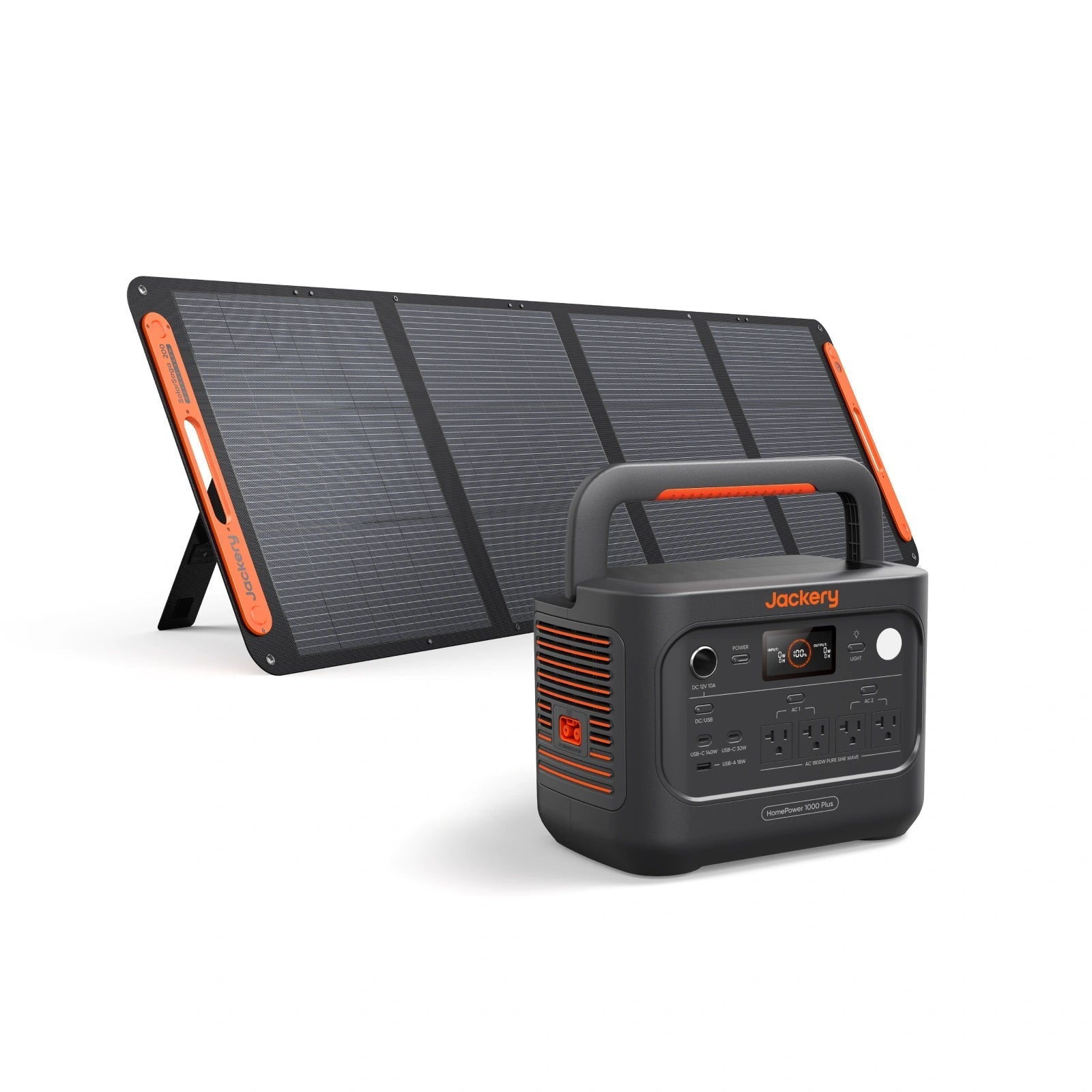
Explore this need in the finder →The U.S. option in this assessment is SKU 60-100020-US00652: one HomePower 1000 Plus v2 station and one SolarSaga 200 W panel. The linked Jackery panel material identifies the panel revision as JS-200C. It is a one-panel package, not a 400 W array and not a battery-expansion kit. The selected-option rendering shows a single folding panel beside the station; the image is promotional CGI, not a photograph of measured solar output.
One panel, one 1,024 Wh station
The HomePower 1000 Plus v2 is model JHP-1000B, rated at 1,024 Wh of LiFePO4 storage and 1,800 W continuous AC at 120 V. Four household outlets share that output, while 3,600 W is the short peak figure. Adding a panel does not raise inverter output or battery capacity. If your essential appliance exceeds 1,800 W while running, or has a startup surge above the supported peak, this bundle is not a workaround.
The station has a 12 V/10 A car socket, one USB-A port rated up to 18 W, and two USB-C ports at 30 W and 140 W. The 140 W USB-C output may be useful for a compatible laptop, but a negotiated device rate depends on the cable and device. The station weighs 23.8 lb, so it remains a carryable base station; the panel and its carrying bag add separate bulk and weight. Jackery rates the battery for 6,000 cycles to at least 70%, which is a published cell-life specification, not an independent test result.
Why this one-panel connection is a good electrical fit
The JS-200C is rated 200 W, with 20 V optimum operating voltage and 10 A optimum current, each published with ±5% tolerance. Its 24.8 V open-circuit voltage is within the station’s 16–60 V solar input range. The panel current remains below the station’s 12 A limit for an individual DC input even at the stated tolerance. The panel’s included DC7909 cable and DC7909-to-DC8020 adapter provide the connection path named in the panel materials; the selected U.S. box still lists the station and panel separately from the AC charging cable.
This one panel uses only one of two parallel inputs and is well below the station’s 400 W combined ceiling. That does not guarantee 200 W harvest: shade, angle, clouds, panel temperature, and battery state all matter. The official support page gives charging-time estimates for a 200 W panel, but those should be treated as ideal reference values, not promised recharge times. The panel’s own IP rating applies to the panel, not the power station. Jackery does not support water or dust protection for the station, so set up the electronics under suitable dry shelter.
Package detail that changes the shortlist
Compared with the station-only SKU, this offer supplies one solar panel, but it does not include a Battery Pack 2000 Plus v2. The station can later expand with up to five compatible packs; that upgrade is a separate purchase and raises nameplate storage, not the 1,800 W AC ceiling. It also supports up to four panels under Jackery’s stated arrangement, but three panels are not supported. The inputs are parallel, so they do not act like independent MPPT channels. Jackery says not to combine different panel wattages at the same time and requires equal model and quantity across the two inputs. For one panel, those multi-panel rules do not create an issue; for later additions, follow the exact manual rather than improvising mixed arrays.
AC wall charging is listed at up to 1,200 W with a manufacturer estimate around 75 minutes in the cited mode; emergency fast charge is listed around 50 minutes. The station supports wall and solar charging together. Vehicle input and solar cannot run at the same time, and the product page’s selected-option contents do not include a separate vehicle cable. Charging and discharging are specified from -10°C to 45°C.
Who should choose it?
Choose this configuration if an included 200 W panel is a real part of your first-day plan and your loads fit one 120 V / 1,800 W station. A buyer with compatible solar already on hand may prefer the standalone SKU and verify the necessary lead. A buyer who wants more energy in the box should compare the Battery Pack bundle; its 3,072 Wh nameplate total changes the storage plan but not AC output. The similarly named JHP-1000A HomePower 1000 v2 is a different, fixed-capacity model with a 1,500 W inverter and no supported expansion. This bundle is not a 240 V, whole-home panel, weatherproof, or zero-transfer UPS solution. Do not select it because a 200 W label promises a fixed charging time; the useful difference is the included panel and verified electrical match.
Key details at a glance
| Nameplate battery capacity | 1024 Wh |
|---|---|
| Rated AC output | 1800 W |
| Manufacturer surge rating | 3600 W |
| Maximum solar input | 400 W |
| Included panels, combined nameplate | 200 W |
| Maximum USB-C output per port | 140 W |
| Listed weight | 23.8 lb |
| Compatible extra-battery expansion | Yes |
| 12 V DC output | 120 W |
| Maximum AC recharge input | 1200 W |
| Manufacturer UPS transfer figure | 10 ms |
| Base warranty term | 3 years |
| Total rated DC output | 120 W |
| AC outlet output | Yes |
| USB-C ports | 2 |
| USB-A ports | 1 |
| Solar input ports | 2 |
| 12 V car-style output | 120 W |
| Battery chemistry | LiFePO4 |
| Expansion battery in this package | No |
| Home Power Panel in this package | No |
| Separate station units in offer | 1 |
| Expansion packs in exact offer | 0 |
| Solar panels in exact offer | 1 |
Use the exact model’s instructions for operating limits, supplied equipment and version differences.
Sources for this assessment
- Jackery U.S. portable power station collection, position 18
- Jackery U.S. HomePower 1000 Plus v2 selected option page
- Jackery U.S. HomePower 1000 Plus v2 product variant JSON
- Jackery HomePower 1000 Plus v2 User Manual, JHP-1000B/B-WH
- Jackery HomePower 1000 Plus V2 Basic Information
- U.S. CPSC recall index; exact name/model search
- Exact selected-option manufacturer product rendering
- Jackery SolarSaga 200W manual, JS-200C
- Jackery Solar Generator Connection Guide

A useful match starts with the loads that matter.
Use the finder for hard electrical requirements, then check appliance starting behavior, actual run time and the exact package in the full assessment.