
Your needs, this model
Does it fit your priorities?
Does one station meet a 120 V / 1,800 W / 1,024 Wh nameplate floor?
One JHP-1000B provides 120 V, 1,800 W rated output and 1,024 Wh; outlet demand and surge still need checking.
Explore this need in the finder →Must a compatible expansion battery already be included?
No. The black/white standalone SKUs do not include a Battery Pack 2000 Plus v2.
Explore this need in the finder →Does this exact offer arrive with a 200 W panel?
No panel is in the standalone box; a different SKU includes one SolarSaga 200 W.
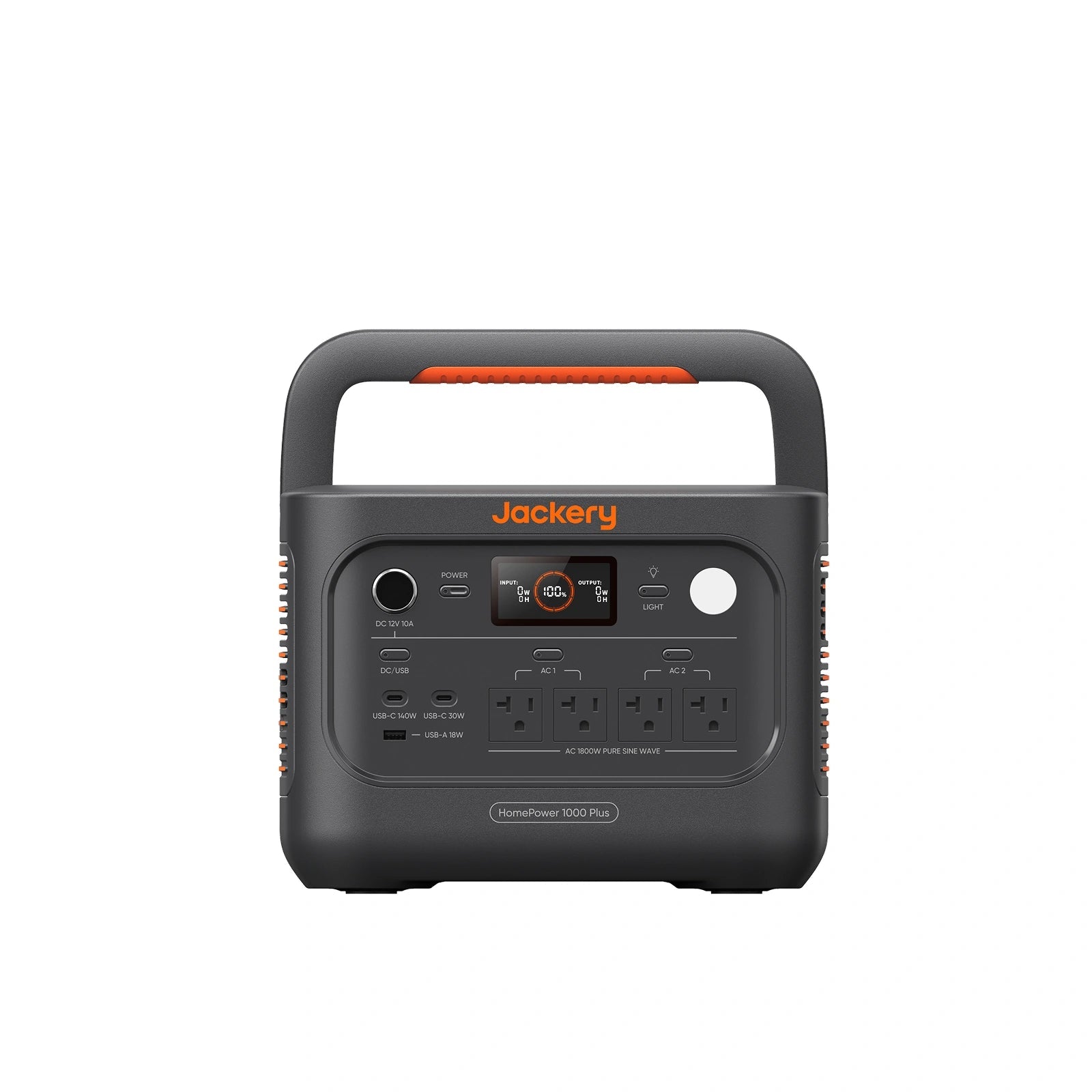
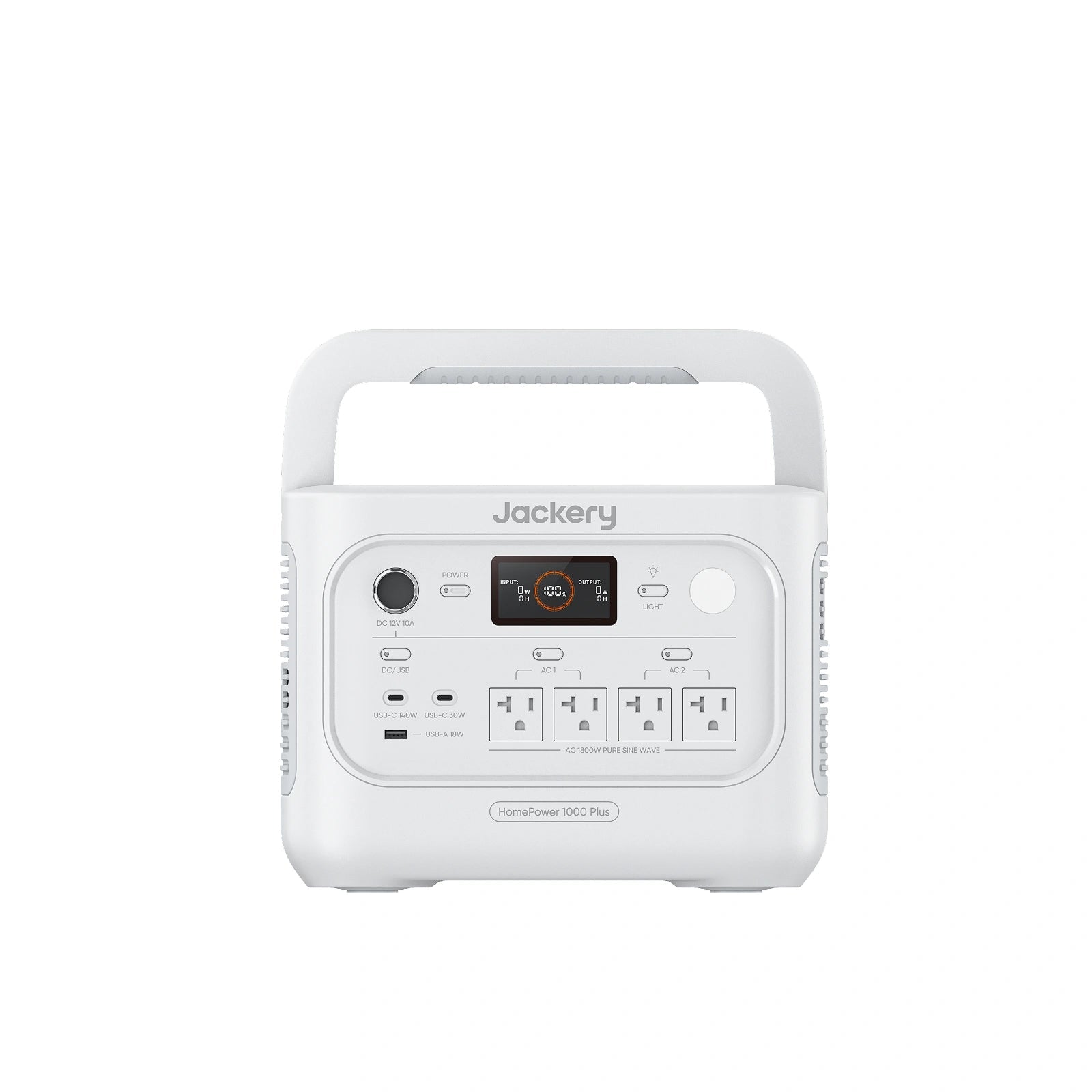
Explore this need in the finder →Jackery’s HomePower 1000 Plus v2 is not just a higher-output trim of the HomePower 1000 v2. The exact U.S. manual identifies this family as JHP-1000B and JHP-1000B-WH: 1,024 Wh of LiFePO4 storage, 1,800 W of rated 120 V AC output, four AC receptacles, and a supported battery-expansion port. This standalone assessment covers the black SKU 21-0001-000449 and white-finish SKU 21-0001-000450. It does not include a panel, expansion pack, or AC extension cable.
More inverter headroom than a fixed 1 kWh station
The station’s four outlets share 1,800 W continuous output; 3,600 W is the instantaneous peak, not a load it can sustain. That is a meaningful distinction from the separately sold HomePower 1000 v2 (JHP-1000A), which is rated at 1,500 W and does not accept an expansion pack. The Plus v2 is a 120 V station, not a 240 V or split-phase source. A 1,800 W nameplate rating makes it relevant to some corded tools and household equipment, but check startup demand, duty cycle, and every other active output before treating a load as suitable.
The LiFePO4 battery is rated at 1,024 Wh. That is stored nameplate energy, not a promise of 1,024 Wh delivered through the inverter. The manufacturer does not publish an AC-usable-energy number tied to a stated load for this review, so a runtime calculation based on nameplate capacity alone would be misleading. Add the actual wattage of each essential appliance, then leave room for inverter losses, temperature, and compressor or motor startup. The 6,000-cycle-to-at-least-70% specification is a manufacturer battery-life claim, not an independent cycle test or calendar-life guarantee.
Useful ports, with specific limits
Alongside the four AC receptacles, the station has a 12 V/10 A car-style outlet (120 W), one USB-A port up to 18 W, and two USB-C outputs rated 30 W and 140 W. A compatible laptop can use the 140 W port, but cable and device negotiation still matter; the two port maxima are not a promise that all ports deliver their rated output simultaneously. The case measures 12.4 by 7.9 by 9.2 inches and weighs 23.8 lb. That is manageable for a short carry, but it is not a tiny power bank, especially when repeated stairs are part of the plan.
For wall charging, Jackery lists a 1,200 W input and estimates about 75 minutes under its stated charging mode; emergency fast charging is listed at about 50 minutes. Those are manufacturer estimates rather than guaranteed times for every outlet, state of charge, temperature, or selected app mode. Charging and discharging are specified from -10°C to 45°C. The station is not specified as water- or dust-protected, so a weather-exposed patio, wet tent floor, or dusty worksite is not an appropriate place to assume it can sit unprotected.
Solar is supported, but this exact box is not a solar kit
The two DC8020 inputs accept solar within 16–60 V; each input is listed at 12 A, with 21 A combined and a 400 W station ceiling. Jackery says the inputs are parallel, not independent trackers. It supports one, two, or four matching panels, not three; when both inputs are used, keep the model and number of panels consistent. Wall charging and solar charging may run together, while a vehicle charger and solar are not a supported simultaneous pair.
Those limits describe the station, not the standalone package. The exact black and white standalone box lists the station and AC charging cable only; it does not supply a SolarSaga panel, battery, or station-side solar connection lead. A separate SKU includes a SolarSaga 200 W, and other selected options include battery combinations. Do not let “400 W solar input” stand in for equipment in the box. If you already own compatible panels and the correct lead, the base offer may suit a fixed-capacity plan; if solar-ready contents matter, choose and assess the exact kit instead.
Expansion and backup boundaries
The Plus v2 supports up to five compatible Battery Pack 2000 Plus v2 units, but this standalone SKU includes none. Capacity expansion is a later purchase and does not make the station’s inverter a 240 V or higher-wattage system. Jackery specifies a 10 ms UPS transfer; that is not zero-time switching. Its manual warns against equipment that requires 0 ms, including data servers and workstations, and states bypass output is limited to 12 A after three hours. Treat UPS operation as a documented transfer mode, not a tested continuity guarantee for sensitive equipment.
Choose this offer if you want one portable 1,024 Wh/1,800 W station and expect to supply your own charging accessories. Choose the JHP-1000A if its lower 1,500 W rating is enough and you do not need expansion; choose a separately reviewed battery bundle if greater nameplate storage must be included now. For a strict solar-included requirement, select the one-panel or two-panel package and check the panel count and cables. For 240 V appliances, a home-panel transfer switch, waterproofing, or 0 ms backup, this standalone configuration is the wrong fit.
Key details at a glance
| Nameplate battery capacity | 1024 Wh |
|---|---|
| Rated AC output | 1800 W |
| Manufacturer surge rating | 3600 W |
| Maximum solar input | 400 W |
| Included panels, combined nameplate | 0 W |
| Maximum USB-C output per port | 140 W |
| Listed weight | 23.8 lb |
| Compatible extra-battery expansion | Yes |
| 12 V DC output | 120 W |
| Maximum AC recharge input | 1200 W |
| Manufacturer UPS transfer figure | 10 ms |
| Base warranty term | 3 years |
| Total rated DC output | 120 W |
| AC outlet output | Yes |
| USB-C ports | 2 |
| USB-A ports | 1 |
| Solar input ports | 2 |
| 12 V car-style output | 120 W |
| Battery chemistry | LiFePO4 |
| Expansion battery in this package | No |
| Home Power Panel in this package | No |
| Separate station units in offer | 1 |
| Expansion packs in exact offer | 0 |
| Solar panels in exact offer | 0 |
Use the exact model’s instructions for operating limits, supplied equipment and version differences.
Sources for this assessment
- Jackery U.S. portable power station collection, position 18
- Jackery U.S. HomePower 1000 Plus v2 selected option page
- Jackery U.S. HomePower 1000 Plus v2 product variant JSON
- Jackery HomePower 1000 Plus v2 User Manual, JHP-1000B/B-WH
- Jackery HomePower 1000 Plus V2 Basic Information
- U.S. CPSC recall index; exact name/model search
- Exact selected-option manufacturer product rendering
- Exact white JHP-1000B-WH manufacturer rendering


A useful match starts with the loads that matter.
Use the finder for hard electrical requirements, then check appliance starting behavior, actual run time and the exact package in the full assessment.