
Your needs, this model
Does it fit your priorities?
Must this package supply at least one SolarSaga 200W panel?
Both listed finish options include one HomePower 1000 v2 and one SolarSaga 200W panel; panel nameplate is not a daily harvest promise.
Explore this need in the finder →Must the solar panel package include a station-compatible charging cable?
The SolarSaga 200W product manual lists its multifunctional charging cable and DC8020 adapter; the HomePower package page itself lists the panel but not each internal panel-carton cable separately.
Explore this need in the finder →Will one fixed 120 V / 1,500 W station meet your essential loads?
The panel does not raise output: the single station remains rated 1,500 W at 120 V with 1,024 Wh nameplate storage, and the 3,000 W figure is surge.
Explore this need in the finder →Is the station input rating of at least 400 W useful for a later compatible panel setup?
The station supports up to 400 W solar input, but this exact offer supplies one panel labeled 200 W; input rating and included-panel wattage are separate.
Explore this need in the finder →Do you require two separate panels in the box?
No: the selected offer includes one panel. A two-panel minimum excludes this profile even though other JHP-1000A/Jackery configurations may offer separate kits.
Explore this need in the finder →This assessment covers the Jackery HomePower 1000 v2 JHP-1000A with one SolarSaga 200W panel, rather than the same station sold on its own. The U.S. product page lists black package SKU 60-100020-US00511 and white SKU 60-100020-US00516. Both are the same station-and-panel plan in different case colors; the package is still a single, fixed-capacity 1,024 Wh power station.
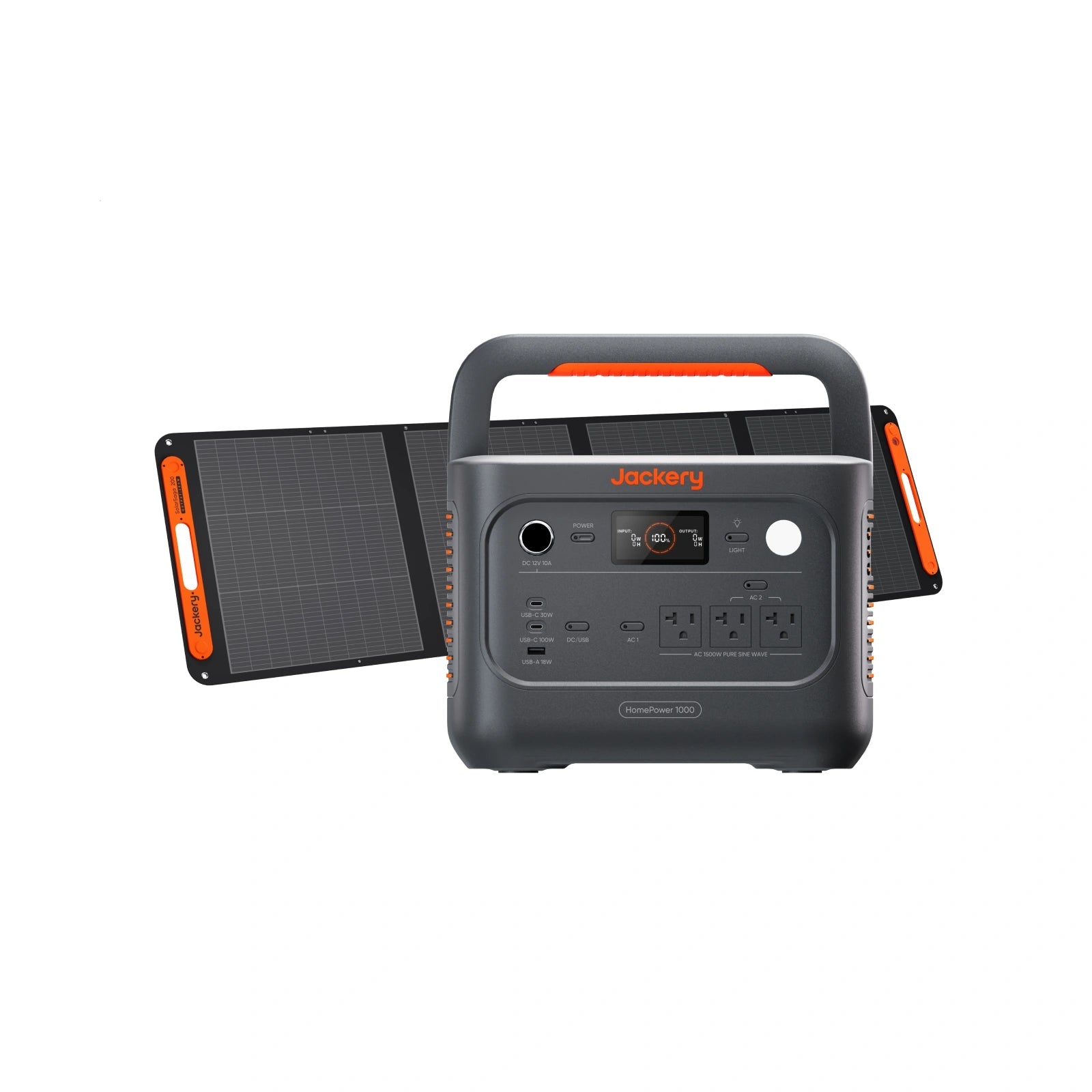
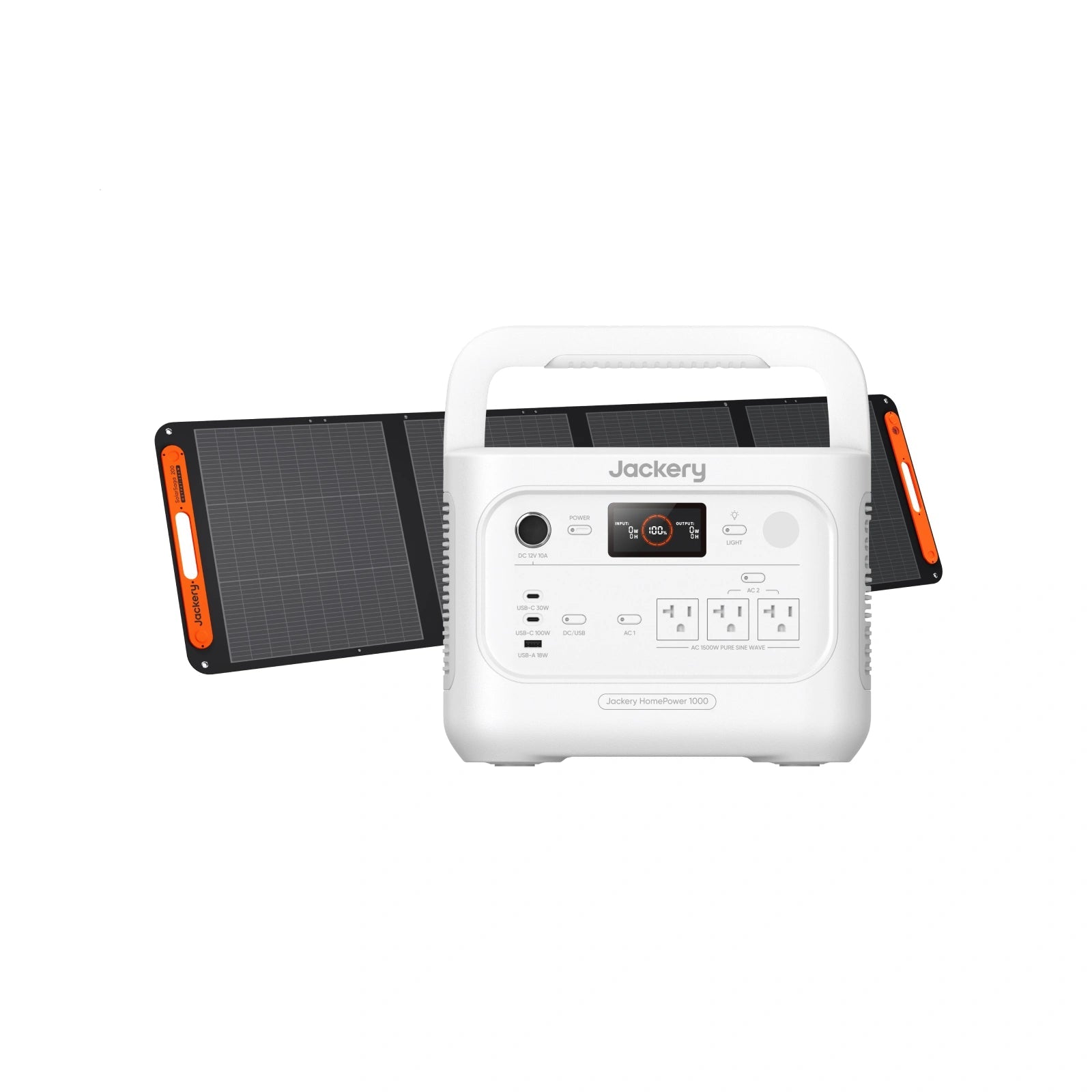
The bundle adds one panel, not a larger station
The HomePower 1000 v2 supplies 1,024 Wh of LiFePO4 nameplate storage and three 120 V receptacles sharing a 1,500 W rated AC ceiling. Its 3,000 W surge figure is not a continuous load rating. The panel does not increase inverter output or battery size; it gives the owner one way to put energy back into that same battery when sunlight and setup conditions allow.
The box list for the selected option names one HomePower 1000 v2, one SolarSaga 200W, and an AC charging cable. The panel’s own U.S. product materials describe its retail package with a multifunctional solar cable and adapter, and its user manual shows the DC8020 connector used at a Jackery station input. That is a meaningful difference from the station-only offer, whose box list has no panel and whose station manual says its solar connector is sold separately. The kit page does not print a separate panel submodel code, so I keep the public SolarSaga 200W name rather than silently turning it into a more specific SKU.
Use the panel as a replenishment source, not a runtime promise
Jackery rates the HomePower 1000 v2 for up to 400 W of solar input at 16–60 V and 21 A maximum across its two DC8020 inputs. This package supplies one panel labeled 200 W, not a 400 W array. The panel’s nameplate is a laboratory rating; shade, clouds, season, angle, temperature and cable placement change the power that reaches the station. It may help top up energy during an outage or outdoor stay, but neither the package title nor the 1,024 Wh battery rating predicts how long an appliance will run or how quickly the sun will refill it.
For a more exact equipment check, compare the open-circuit voltage and connector instructions on the panel you receive with the station’s input window, and follow the manual’s guidance for any second panel. The station’s two inputs do not create two independent inverters or double the solar ceiling. A buyer who needs two separate panels, at least 400 W of included panel nameplate, or a documented guaranteed daily harvest should not infer those requirements from this one-panel kit. The matching selector treats included panel wattage and the station’s maximum solar-input rating as separate questions for that reason.
Carry the station and the panel separately
The station weighs about 23.4 lb. The SolarSaga 200W manual lists a panel weight of 6.5 kg, about 14.3 lb, so the pair represents roughly 37.7 lb of equipment before any extra packing. The panel unfolds to almost 7.5 feet long and folds into a broad case roughly 2 feet square; it takes real ground space and needs a clear position in the sun. The panel’s IP68 rating applies to the panel, not to the power station. Keep the battery unit dry and within its published operating-temperature range.
This setup suits a buyer who can place a panel outdoors while keeping the station nearby, and who values receiving one compatible-looking solar panel with the station instead of sourcing parts separately. It is less attractive for someone whose top priority is low carry weight, a compact panel footprint, the fewest items to store, or a simple single-box guarantee that every cable for a custom extension arrangement is present.
Know the station’s limits before choosing a kit
The power station remains fixed at 1,024 Wh and does not support an expansion battery. It is a 120 V source, not a 240 V or split-phase backup system. Jackery specifies a 10 ms UPS transfer, but the manual expressly says 0 ms switching is unsupported; sensitive equipment that cannot ride through a short transfer needs another plan. Nameplate capacity also is not AC energy delivered at a chosen load, and the manufacturer does not publish a load-specific AC-usable-energy figure in the reviewed material.
Choose this SolarSaga bundle if your essentials fit one 120 V/1,500 W station, one 200 W panel is enough for your charging plan, and you want the panel and its standard charging lead supplied as part of the offer. Choose the standalone HomePower 1000 v2 if you already own compatible solar equipment and do not need a panel in the box. If you need more storage, more inverter output, or future battery expansion, compare the distinct HomePower 1000 Plus v2 family rather than assuming this JHP-1000A can grow. In the questionnaire, asking for one 200 W panel and a supplied station-side lead can admit this package; increasing the panel minimum to 201 W, requiring two panels, or asking for 240 V should remove it.
Use the exact model’s instructions for operating limits, supplied equipment and version differences.Key details at a glance
Nameplate battery capacity 1024 Wh Rated AC output 1500 W Manufacturer surge rating 3000 W Maximum solar input 400 W Included panels, combined nameplate 200 W Maximum USB-C output per port 100 W Listed weight 23.4 lb Compatible extra-battery expansion No 12 V DC output 120 W Maximum AC recharge input 1200 W Manufacturer UPS transfer figure 10 ms Base warranty term 3 years AC outlet output Yes USB-C ports 2 USB-A ports 1 Solar input ports 2 12 V car-style output 120 W Battery chemistry LiFePO4 Expansion battery in this package No Home Power Panel in this package No Separate station units in offer 1 Solar panels in exact offer 1 Sources for this assessment


A useful match starts with the loads that matter.
Use the finder for hard electrical requirements, then check appliance starting behavior, actual run time and the exact package in the full assessment.