
Your needs, this model
Does it fit your priorities?
Must the exact offer include a named 12V charging cable?
The selected U.S. variant title includes “12V Charging Cable.” The page does not identify the cable part number or establish whether it charges the station from a vehicle or uses the station’s output for another 12V task.
Explore this need in the finder →Will your AC loads fit a single 120 V / 2,400 W JHP-2000A?
The 12V-cable option keeps the JHP-2000A station at 2,048 Wh, 120 V, and 2,400 W continuous (4,800 W surge). It is not a 240 V plan.
Explore this need in the finder →Do you need the station’s 120 W 12 V/10 A car-style output as well as the package accessory?
The JHP-2000A manual lists a 12 V/10 A car-style output rated 120 W. That station output is separate from the offer’s unnamed cable and does not prove that the cable uses this port.
Explore this need in the finder →This is a supplemental U.S. package option for the Jackery HomePower 2000 Plus v2 station. Its selected product-page option is titled “HomePower 2000 Plus v2 + 12V Charging Cable,” with variant 44332507660375 and retailer SKU 60-200000-US00697. The station in this family is the JHP-2000A. The added cable is the meaningful difference from the separately reviewed standalone offer; it does not create another station or change the station’s battery or inverter rating.
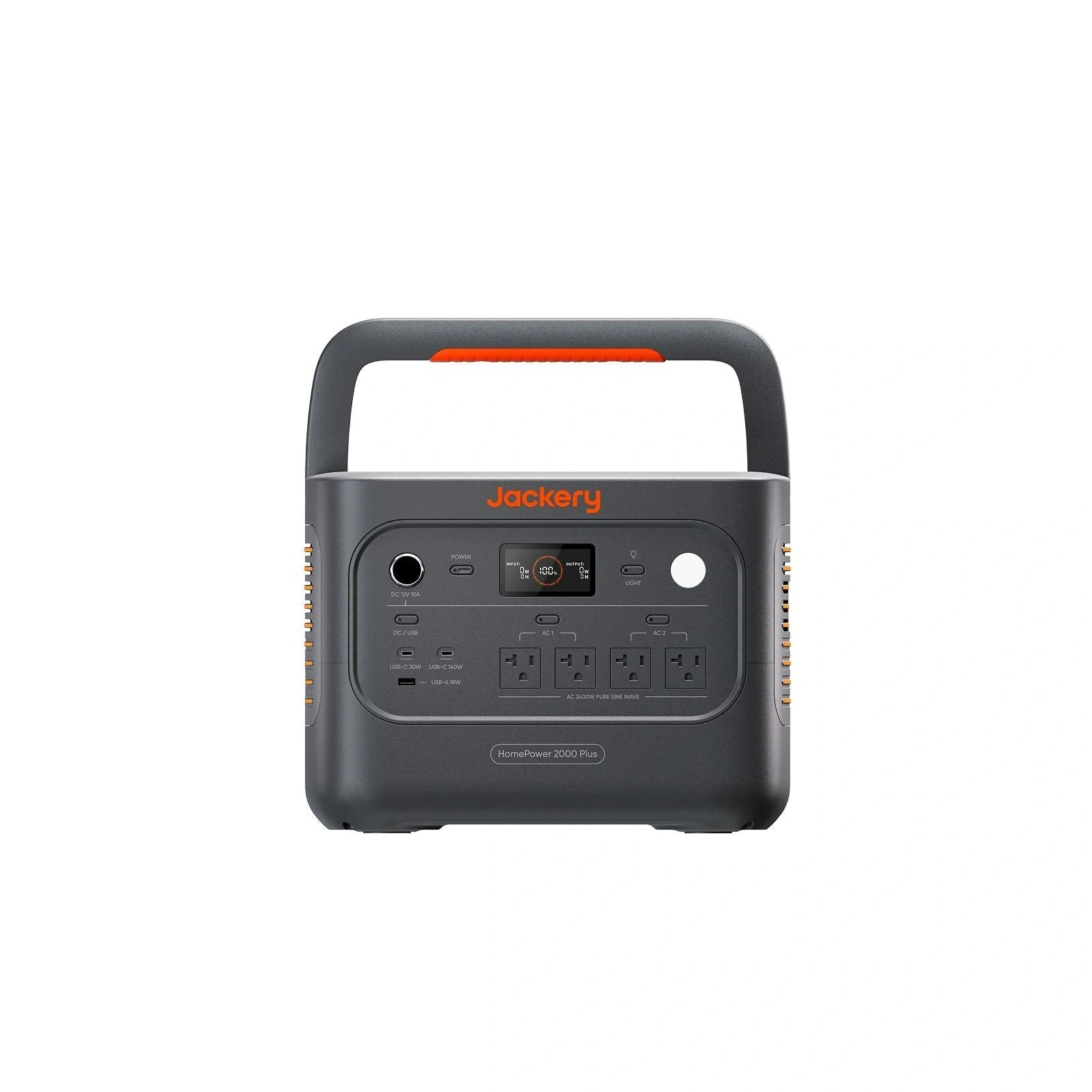
The power station is the same 120 V, 2,400 W platform
Jackery’s JHP-2000A manual specifies 2,048 Wh of LiFePO4 nameplate capacity, four 120 V AC receptacles sharing a 2,400 W continuous rating, and a 4,800 W surge figure. Those values describe one station-wide inverter, not the independent capacity of each outlet. Check the continuous and startup loads of the appliances you plan to run together. The nameplate Wh figure is stored energy, not a promise of that much usable AC energy; the reviewed sources do not publish a load-specific AC-usable-energy result, so this assessment does not turn capacity into a runtime estimate.
The station weighs 41.45 lb and measures 14.4 by 10.0 by 10.7 inches. It is a substantial box even before the extra lead is considered, and the package-level weight is not stated. For small electronics and a light cooler, a smaller unit may be easier to carry. For larger household loads, confirm that the combined plan fits the single 2,400 W ceiling. This is not a 240 V or split-phase system.
What the 12 V cable does—and what the offer does not identify
The exact selected option names a 12 V charging cable, but its archived offer record does not give the cable’s part number, length, connector, rating, or direction of power flow. That distinction matters. In the JHP-2000A manual, vehicle charging means bringing power from a 12 V vehicle source into the station through its car-charging input; Jackery says the car-charging lead is sold separately in the standalone box, permits 12 V vehicles only, warns against 24 V vehicles and rough-road use, and says not to charge from car and solar inputs at the same time. Separately, Jackery lists a 12 V Automobile Battery Charging Cable for sending 12 V/10 A from a Jackery station’s car-style output to a 12 V lead-acid vehicle battery; that listing says it is not for electric cars. Those are different jobs. The bundle title alone does not let me assign either use or either accessory’s detailed rating to the unnamed cable in this package.
The station itself has a 12 V/10 A car-style output rated at 120 W, as well as a separate 11–16 V DC car-charging input with an 8 A limit. The output can matter for modest 12 V devices; the input is a way to replenish the station under the manual’s conditions. Do not infer that the added lead is the input cable just because the offer uses “charging,” or that it is a battery-maintenance lead just because a separate Jackery accessory has that role. If one of those jobs is essential, confirm the exact lead model and compatible port before treating this package as a solution.
Solar and expansion are separate decisions
The JHP-2000A supports up to 800 W of solar input across two DC8020 ports, with a 16–60 V range, 12 A per port and 21 A combined. Those are station limits, not an included solar kit. The exact 12 V-cable offer does not provide a complete box list that establishes a SolarSaga panel or solar lead, so neither should be assumed from the station’s solar capability. The station can also accept up to five compatible Battery Pack 2000 Plus v2 modules, but this selected option does not document an included pack. Adding compatible storage later does not raise the single station’s AC output. Do not substitute the older Battery Pack 2000; Jackery identifies the v2 battery-pack family separately.
Where this package fits
Choose this option over the plain standalone JHP-2000A only if an included 12 V cable is useful and you are willing to verify its exact purpose. It is not the same as the separate JA-AD600A DC-DC Alternator Charger configuration: that is a wired, professionally installed vehicle-recharging device with a defined DC8020 station connection, whereas this product page names only a 12 V cable. The DC-DC package has its own documented input limits and installation cautions; do not treat the two accessories as interchangeable.
For an essential need, the questionnaire can distinguish this exact offer’s stated cable inclusion from an otherwise similar station-only profile. It cannot promise a specific cable direction or connector when the package page does not identify one. If you need a panel, an expansion battery, an AC lead, or a cable for a particular vehicle-battery task in the same box, look for an exact offer that lists that item and its model rather than combining separate offers mentally. The station’s 10 ms UPS transfer is also not zero-time, and the manual cautions against equipment that requires zero-time switching. Keep it dry; no weatherproof rating is established here.
Product references: Jackery HomePower 2000 Plus v2 selected option; JHP-2000A manual; Jackery 12V Automobile Battery Charging Cable (a separate accessory, not an identified component of this exact bundle).
Key details at a glance
| Nameplate battery capacity | 2048 Wh |
|---|---|
| Rated AC output | 2400 W |
| Manufacturer surge rating | 4800 W |
| Maximum solar input | 800 W |
| Maximum USB-C output per port | 140 W |
| Listed weight | 41.45 lb |
| Compatible extra-battery expansion | Yes |
| 12 V DC output | 120 W |
| Maximum AC recharge input | 1800 W |
| Manufacturer UPS transfer figure | 10 ms |
| Base warranty term | 3 years |
| Total rated DC output | 120 W |
| AC outlet output | Yes |
| USB-C ports | 2 |
| USB-A ports | 1 |
| Solar input ports | 2 |
| 12 V car-style output | 120 W |
| Battery chemistry | LiFePO4 |
| Separate station units in offer | 1 |
Use the exact model’s instructions for operating limits, supplied equipment and version differences.
Sources for this assessment
- Jackery HomePower 2000 Plus v2 Series selected U.S. 12V-cable option
- Jackery HomePower 2000 Plus v2 Series U.S. product option JSON
- Jackery HomePower 2000 Plus User Manual, model JHP-2000A
- Jackery 12V Automobile Battery Charging Cable (separate accessory page)
- Jackery 12V Automobile Battery Charging Cable product JSON
A useful match starts with the loads that matter.
Use the finder for hard electrical requirements, then check appliance starting behavior, actual run time and the exact package in the full assessment.