
Your needs, this model
Does it fit your priorities?
Must the selected package include two or more panels with at least 400 W combined nameplate power?
Yes. This exact option lists two SolarSaga 200W panels (400 W combined nameplate); panel nameplate is not guaranteed station input.
Explore this need in the finder →Do my essential loads need the one-station 120 V / 2,400 W plan?
The JHP-2000A remains a single 120 V / 2,400 W station with 2,048 Wh nameplate storage; two panels do not add battery or AC output.
Explore this need in the finder →Is the station’s 800 W solar-input ceiling relevant even though this package has only 400 W of panel nameplate?
The station accepts up to 800 W total solar input, while the two included panels total 400 W STC nameplate. Real output depends on sun, angle, shade and current limits.
Explore this need in the finder →This review covers Jackery's selected U.S. HomePower 2000 Plus v2 + 200W × 2 offer, SKU 60-200020-US00480 and variant 43957143273559. The product page's box list names one HomePower 2000 Plus v2 station, two SolarSaga 200W panels, and one AC Charging Cable. The panel wattage is charging equipment; it does not add to the station's battery capacity or AC inverter rating.
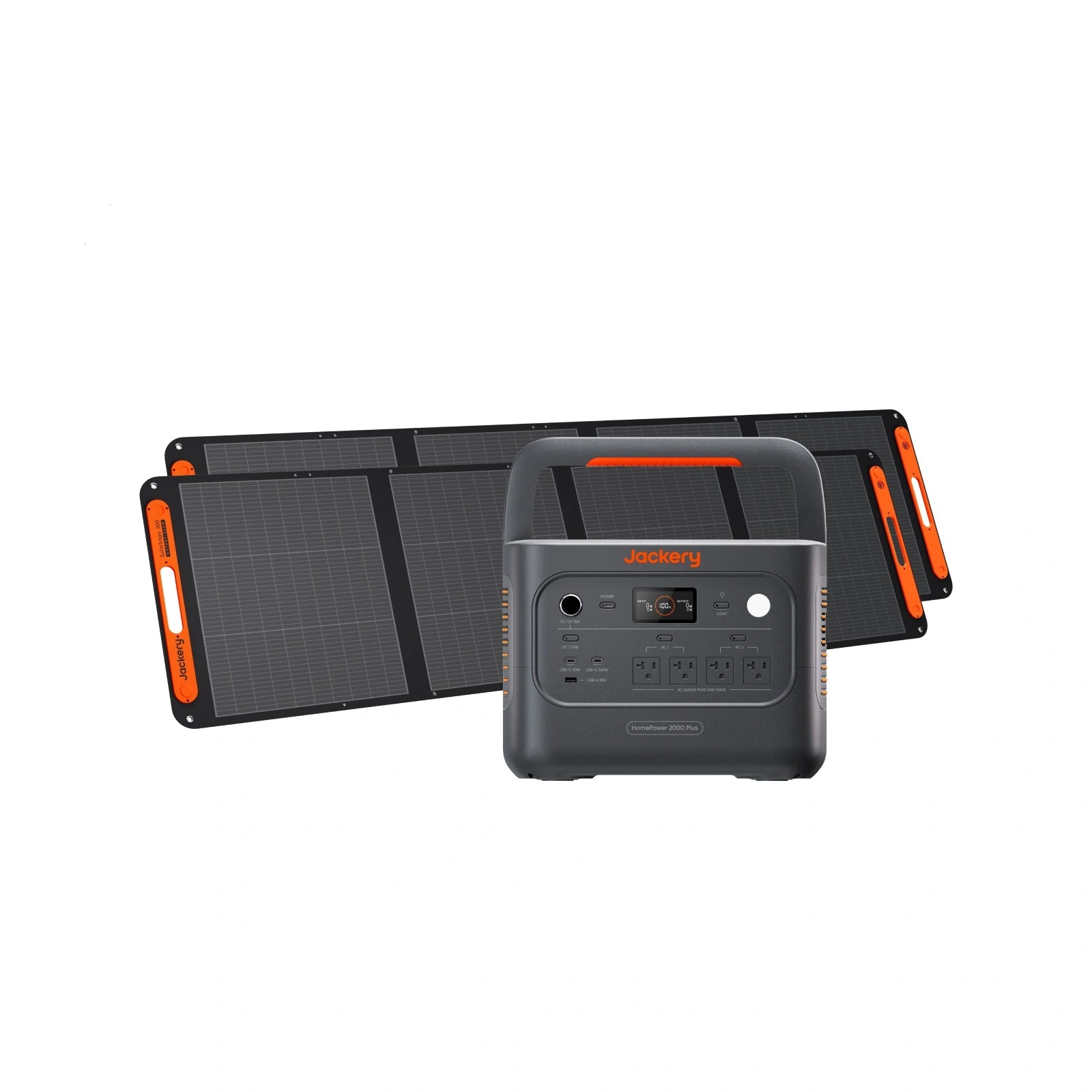
What the two-panel setup changes
The two named panels provide 400 W of combined nameplate power under standard test conditions. Jackery's current panel page describes the SolarSaga 200W as a foldable, bifacial panel and lists about 14.33 lb per panel, so the pair adds roughly 28.7 lb of panel mass before cables and bags. Each panel can be placed and angled separately. That is useful when one clear patch is not available, or when the panels can be set on different sides of a campsite or yard. It is less convenient if the main constraint is setting up and putting away the fewest individual pieces. The separate 500 W SolarSaga 500 X package uses one larger assembly and carries a higher single-panel nameplate rating, but it has its own broad footprint and current-limit caveat.
For the JHP-2000A, Jackery lists two parallel DC8020 solar inputs, a 16–60 V window, a 12 A per-port current limit, 21 A combined and an 800 W maximum. Its support information says one or two panels can use the included connection cable without a series box; if both parallel inputs are used, different panel wattages are not supported. A matched pair of the same SolarSaga 200W panel is therefore a coherent nominal setup, and its 400 W nameplate total is below the station's 800 W ceiling. The station does not have two independent maximum-power trackers, however, so panel placement and shading can affect both inputs together.
There is also a current-rating detail worth keeping in view. The SolarSaga 200W page lists 11.5 A operating current ±5% (and 12.5 A short-circuit current ±5%); the station's per-port limit is 12 A. At the upper end of that panel operating-current tolerance, the listed value can exceed 12 A. Jackery sells the matched panel bundle, but the published limits do not prove an exact 400 W input under every condition or a strict worst-case full-rating pass. Do not treat the panels' combined 400 W label as guaranteed charging power. The bundle can still be considered for a normal solar-charging need where the manufacturer's recommended connection path is followed; it does not pass a requirement that every included panel be proven to deliver its full rating inside the station's current limits.
The station remains a single 2 kWh-class inverter
The base station is the JHP-2000A: 2,048 Wh LFP nameplate capacity, four 120 V AC receptacles, 2,400 W continuous output and 4,800 W surge. The output rating is shared across the outlets, and the 2,048 Wh figure is not an AC-usable-energy guarantee. Jackery has not published a delivered AC-energy figure at a stated load in the reviewed material. Solar may replenish stored energy in usable sunlight; it does not raise the station's instantaneous wattage, add a second 120 V leg, or create 240 V split phase. For loads that need more run time at night, compare the one-pack Battery Pack 2000 Plus v2 offer instead. That package adds compatible storage but retains the same inverter limit.
The station weighs about 41.45 lb by itself. The panels add about 28.7 lb total, with the usual manufacturer weight tolerances, so this is not a one-piece portable set. Each 200 W panel is itself a large open surface even though it folds for transport. The offer page does not separately list a station-side solar extension cable in its box list. Jackery's station FAQ says the one- and two-panel connection can be made with the included cable and no series box, but the exact selected-package listing should still be checked for the particular lead you receive. Do not treat the panel's own ports or standalone-panel accessories as proof that every additional station lead or extension is bundled. The station itself is not rated as weatherproof; the panel's IP rating does not apply to the power station.
Who should choose this version?
This is the more flexible panel-layout option for someone who wants the JHP-2000A station and two same-wattage panels together, can deploy two separate folding panels, and accepts that 400 W is a label rather than a guaranteed daily harvest. It is not the lightest way to get solar with this station: the 500 X option has a higher single-panel nameplate rating and fewer separate panels, while a standalone JHP-2000A makes sense for buyers who already own compatible solar equipment. If your essential load is 240 V, needs over 2,400 W continuous, or cannot tolerate the station's documented 10 ms UPS transfer, look elsewhere. If you require proof of worst-case per-panel current headroom or a fixed solar harvest figure, neither the panel count nor the package title resolves that uncertainty.
Key details at a glance
| Nameplate battery capacity | 2048 Wh |
|---|---|
| Rated AC output | 2400 W |
| Manufacturer surge rating | 4800 W |
| Maximum solar input | 800 W |
| Included panels, combined nameplate | 400 W |
| Maximum USB-C output per port | 140 W |
| Listed weight | 41.45 lb |
| Compatible extra-battery expansion | Yes |
| 12 V DC output | 120 W |
| Maximum AC recharge input | 1800 W |
| Manufacturer UPS transfer figure | 10 ms |
| Base warranty term | 3 years |
| Total rated DC output | 120 W |
| AC outlet output | Yes |
| USB-C ports | 2 |
| USB-A ports | 1 |
| Solar input ports | 2 |
| 12 V car-style output | 120 W |
| Battery chemistry | LiFePO4 |
| Expansion battery in this package | No |
| Home Power Panel in this package | No |
| Separate station units in offer | 1 |
| Expansion packs in exact offer | 0 |
| Solar panels in exact offer | 2 |
Use the exact model’s instructions for operating limits, supplied equipment and version differences.
Sources for this assessment
- Jackery U.S. portable power station collection, observed row 15
- Jackery HomePower 2000 Plus User Manual, model JHP-2000A
- Jackery HomePower 2000 Plus V2 Basic Information
- U.S. CPSC recall index, exact name/model search
- Jackery U.S. HomePower 2000 Plus v2 selected package 60-200020-US00480
- Jackery U.S. HomePower 2000 Plus v2 option JSON
- Jackery HomePower 2000 Plus V2 Basic Information
- Exact SolarSaga 200W selected-option Jackery rendering
- Jackery SolarSaga 200W U.S. product page
- Jackery Solar Generator Connection Guide

A useful match starts with the loads that matter.
Use the finder for hard electrical requirements, then check appliance starting behavior, actual run time and the exact package in the full assessment.