
Your needs, this model
Does it fit your priorities?
Must the exact offer include a panel with at least 500 W nameplate power?
Yes. SKU 60-200050-US00481 includes one named SolarSaga 500 X rated 500 W; the station and panel ratings do not guarantee 500 W of actual charging.
Explore this need in the finder →Do my essential loads need the one-station 120 V / 2,400 W plan?
The JHP-2000A remains a single 120 V / 2,400 W station with 2,048 Wh nameplate storage; the included panel does not add inverter or battery capacity.
Explore this need in the finder →Is an 800 W station-side solar input ceiling important, even though this package includes a 500 W panel?
The station accepts up to 800 W over its solar inputs. The included panel has 500 W nameplate, and the per-port current limit means that is not a guaranteed 500 W harvest.
Explore this need in the finder →This is the selected U.S. HomePower 2000 Plus v2 offer with SKU 60-200050-US00481 (variant 43957143306327): one JHP-2000A station, one SolarSaga 500 X panel, and one AC Charging Cable. It is not a larger battery configuration. The station still stores 2,048 Wh of nameplate energy and has one 120 V inverter rated for 2,400 W continuous and 4,800 W surge; the included panel changes the charging kit, not the output or storage.
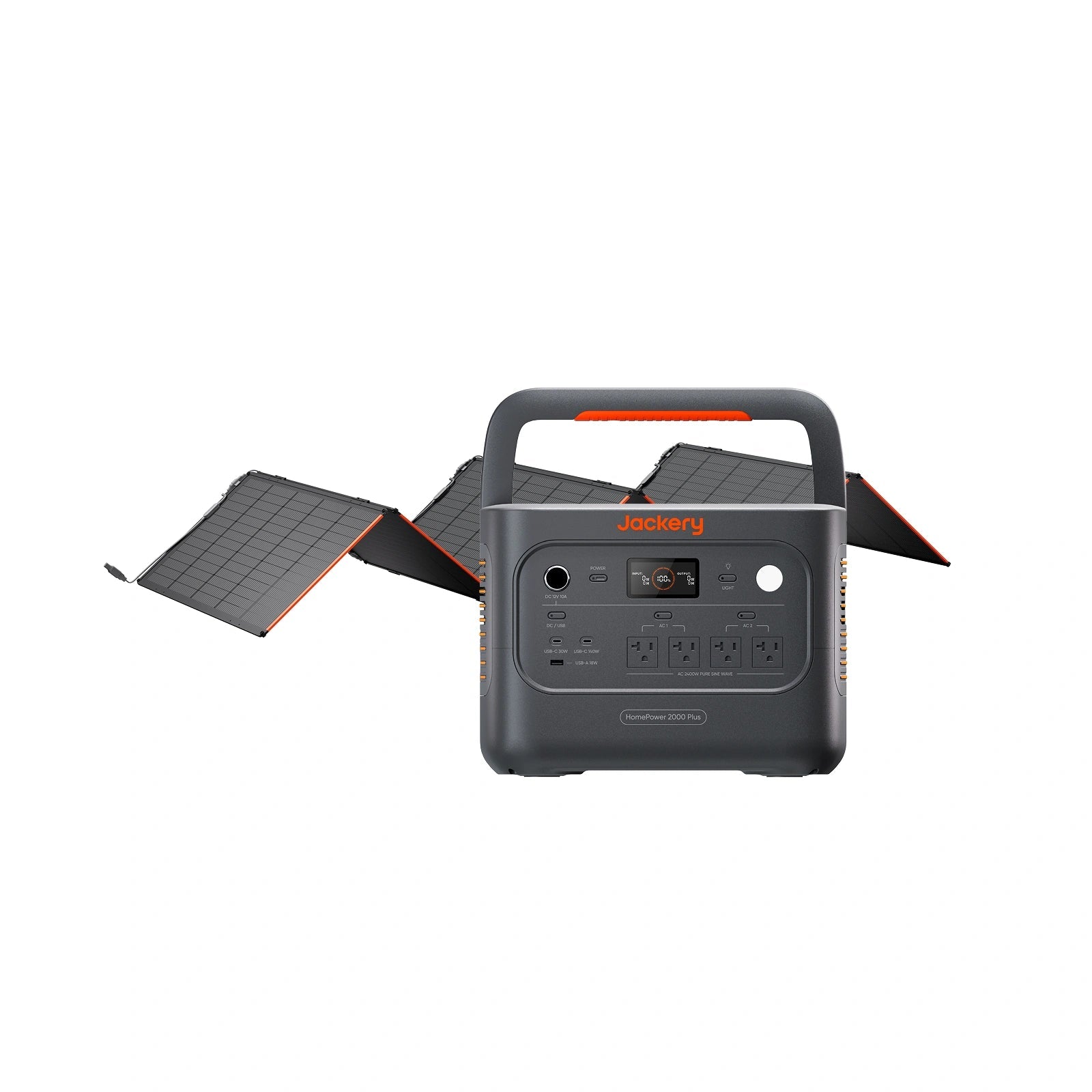
A complete station plus one larger fold-out panel
The practical appeal is a simple one-panel package: the SolarSaga 500 X has a 500 W nameplate rating, while the JHP-2000A accepts up to 800 W of solar input. Jackery lists this panel as a compatible option for the HomePower 2000 Plus v2, so the nominal panel rating sits below the station's total solar ceiling. That is a useful starting point for a buyer who wants the station and a substantial panel together rather than sourcing a panel later. The rating is not a promise of 500 W into the battery in ordinary sun; angle, shading, temperature, and panel placement all affect output.
One large fold-out panel is not a tiny accessory. Jackery lists the 500 X at about 22.05 lb (10.5 kg, with a stated tolerance) and roughly 39 by 21 by 4 inches folded; unfolded it spans about 98 by 39 inches. That is easier to count and stage than several separate panels, but it still needs a broad, sunny patch and a place to bring it inside. Jackery says the panel is not intended for permanent installation and advises retracting or storing it in severe weather. The station alone weighs about 41.45 lb, so the package is two substantial pieces, not a single carryable unit.
Keep the two power limits separate
Four AC outlets share one 2,400 W total continuous ceiling. They are not four independent 2,400 W circuits. The 4,800 W surge rating is for brief startup demand, not a substitute for checking an appliance's running load and motor-start behavior. The battery is 2,048 Wh LFP nameplate capacity; the manufacturer has not given an AC-usable-energy figure at a stated load in the reviewed sources, so a precise runtime promise would be misleading. If longer overnight operation is the goal, an included expansion pack would change the storage plan; a solar panel only helps recharge when usable sun is available.
The 500 X is rated at 500 W under standard test conditions, and the station advertises up to 800 W solar input over two DC8020 ports. The more important detail for a conservative array plan is the port current limit: Jackery lists a 12 A limit per input, while the SolarSaga 500 X manual lists 12.0 A operating current with ±5% tolerance and 13.02 A short-circuit current with ±5% tolerance. Jackery sells this matched panel option and names the panel as compatible; that does not establish a guaranteed 500 W harvest at every condition or convert the package into a strict worst-case current-headroom pass. Treat 500 W as panel nameplate, not guaranteed input power. If an essential requirement is proof that a panel's full rating is delivered at the station input under worst-case tolerance, this package does not establish it.
Jackery's support page says one panel can be connected through the included cable without buying a series box. The selected-option box list itself names the station, SolarSaga 500 X, and AC cable; it does not separately enumerate an extra extension lead or a standalone connector accessory. Follow the model-specific connection guide, keep the panel within the station's 16–60 V input window and the per-port current limit, and do not mix charging from a vehicle with solar on the shared inputs. The two inputs are parallel, not independent trackers. The panel's IP68 rating is not a weatherproof rating for the station; keep the JHP-2000A dry.
Who this selected option suits
Choose this offer if you want the JHP-2000A's single-station 120 V / 2,400 W plan and want one named solar panel in the box from the start. It is easier to reason about than a loose assortment of incompatible panels, and one SolarSaga 500 X can be attractive when there is room for its broad folding footprint. Consider the two-SolarSaga-200W package if independent positioning of two panels matters more than one larger folding assembly; consider a station-plus-battery offer if the problem is stored energy after sunset. If your must-have load requires 240 V, a guaranteed zero-millisecond UPS transfer, more than 2,400 W continuous AC, or a manufacturer-backed AC-runtime figure, this configuration does not answer that need. Do not assume an in-box solar panel changes those limits.
Key details at a glance
| Nameplate battery capacity | 2048 Wh |
|---|---|
| Rated AC output | 2400 W |
| Manufacturer surge rating | 4800 W |
| Maximum solar input | 800 W |
| Included panels, combined nameplate | 500 W |
| Maximum USB-C output per port | 140 W |
| Listed weight | 41.45 lb |
| Compatible extra-battery expansion | Yes |
| 12 V DC output | 120 W |
| Maximum AC recharge input | 1800 W |
| Manufacturer UPS transfer figure | 10 ms |
| Base warranty term | 3 years |
| Total rated DC output | 120 W |
| AC outlet output | Yes |
| USB-C ports | 2 |
| USB-A ports | 1 |
| Solar input ports | 2 |
| 12 V car-style output | 120 W |
| Battery chemistry | LiFePO4 |
| Expansion battery in this package | No |
| Home Power Panel in this package | No |
| Separate station units in offer | 1 |
| Expansion packs in exact offer | 0 |
| Solar panels in exact offer | 1 |
Use the exact model’s instructions for operating limits, supplied equipment and version differences.
Sources for this assessment
- Jackery U.S. portable power station collection, observed row 15
- Jackery HomePower 2000 Plus User Manual, model JHP-2000A
- Jackery HomePower 2000 Plus V2 Basic Information
- U.S. CPSC recall index, exact name/model search
- Jackery U.S. HomePower 2000 Plus v2 selected package 60-200050-US00481
- Jackery U.S. HomePower 2000 Plus v2 option JSON
- Jackery HomePower 2000 Plus V2 Basic Information
- Exact SolarSaga 500 X JS-500A selected-option Jackery rendering
- Jackery SolarSaga 500 X manual, JS-500A specification section
- Jackery SolarSaga 500 X U.S. product page

A useful match starts with the loads that matter.
Use the finder for hard electrical requirements, then check appliance starting behavior, actual run time and the exact package in the full assessment.