
Your needs, this model
Does it fit your priorities?
Must one compatible expansion pack already be included with at least 4,096 Wh nameplate storage?
Yes for this exact bundle: one JHP-2000A station and one JBP-2000B pack provide 4,096 Wh nameplate sum. The inverter remains 2,400 W at 120 V.
Explore this need in the finder →Can I carry the station and pack together under one 75 lb limit?
Their manufacturer-listed component weights sum to about 74.08 lb, but they are two separate pieces; check whether each component can be moved safely.
Explore this need in the finder →Does the bundle solve a 240 V or panel-included requirement?
No. It is still one 120 V station and the selected box list includes no solar panel.
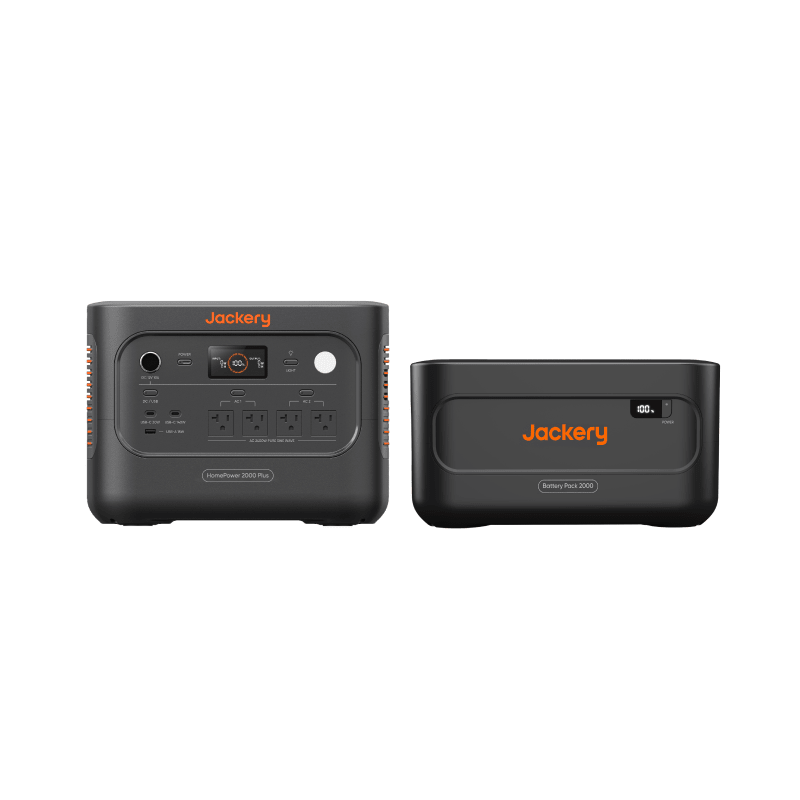
Explore this need in the finder →This exact U.S. selected option bundles one Jackery HomePower 2000 Plus v2 station with one Battery Pack 2000 Plus v2 and an AC charging cable. The station SKU is 21-0001-000402; the complete offer is SKU 60-202000-US00479, variant 44231910391895. The current station support page identifies the host as model JHP-2000A; the pack manual identifies JBP-2000B. This is a two-piece energy system in one retail configuration—not one larger inverter and not a third battery model.
What the bundle changes—and what it does not
The selected bundle contains two 2,048 Wh LFP components, for 4,096 Wh combined nameplate capacity. The station’s single inverter remains rated at 2,400 W total at 120 V, with 4,800 W surge peak. The extra pack provides more stored energy for compatible loads; it does not increase the station’s continuous AC output, add another set of AC outlets, or create 240 V split-phase output. That distinction is useful when comparing a longer low-power backup plan with the high-wattage demand of a heater, pump or cooking appliance. Check both the appliance’s running load and startup behavior before assuming the shared inverter is suitable.
Jackery lists the station at about 41.45 lb (18.8 kg) and the JBP-2000B pack at about 32.63 lb (14.8 kg). Their listed weights sum to roughly 74 lb (33.6 kg) before cables or packaging, but they are separate units to position and carry—not a single 74 lb lift. The pack manual says to turn products off before connecting them, allow ventilation around the equipment, and not place the pack on top of the station. Four or more connected packs need additional anti-tip precautions; this offer includes one pack, not that larger stack.
Read the output limits as one operating plan
The HomePower station supplies four 120 V AC receptacles that share 2,400 W continuous output. Its 12 V/10 A port is rated at 120 W; USB-A is up to 18 W; and the two USB-C ports are rated 30 W and 140 W. Port numbers can make the panel look more capable than the battery’s finite energy budget. For a backup plan, prioritize essential devices and include their approximate running times rather than assuming every device can run indefinitely. The manufacturer does not publish AC-usable energy tied to a stated load, so the 4,096 Wh nameplate sum is not equivalent to delivered AC watt-hours or a guaranteed runtime.
Both components are specified for 6,000 cycles to at least 70% capacity. That is the manufacturer’s stated cell-life threshold, not an independent test. The bundle’s value is therefore easiest to judge against a real load schedule: it is more relevant to extending a modest set of essential loads than to raising instantaneous output. If your main problem is a tool or appliance that exceeds the station’s 2,400 W continuous ceiling, one included expansion pack does not solve it.
Solar and wall charging: check the items, not just the headline
The host accepts up to 800 W of solar input across two DC8020 ports, 16–60 V, 12 A per port and 21 A combined. The pack can be charged through the HomePower station; it is not a separate wall-inverter or standalone solar generator. The selected bundle’s manufacturer box list names the station, one Battery Pack 2000 Plus v2 and one AC charging cable. No solar panel or solar connection lead is listed. If you intend to recharge from panels, verify the right panel arrangement and station-side connection accessories before relying on a kit image or the 800 W capability figure.
Compatibility and backup cautions
Use the exact Battery Pack 2000 Plus v2 identity for this offer. Jackery says the HomePower 2000 Plus v2 is compatible only with the Battery Pack 2000 Plus v2 and warns that the older Battery Pack 2000 is not compatible. The included pack is also listed by Jackery for use with HomePower 1000 Plus v2; that cross-family note does not make other older Jackery packs interchangeable. Before connecting, follow the instructions for the exact v2 hardware and keep air intakes and exhaust paths unobstructed.
UPS transfer is specified at 10 ms, not 0 ms. The station manual cautions against loads requiring zero-time switching and describes a bypass-mode reduction to 1,440 W if current stays above 12 A for more than three hours. Those are meaningful limits for a sensitive computer, workstation or a sustained high-load backup plan. The station is not specified as waterproof or dustproof, so an outdoor use case still needs a protected, dry and ventilated location. Jackery currently presents a 3-year standard station warranty with an additional two years for eligible direct-channel purchases; verify terms for the seller and exact pack before purchase rather than treating promotional coverage as universal.
Who benefits from the included pack?
Choose this exact bundle when the included 4,096 Wh nameplate storage is more useful than a lighter single station and you can manage two separate pieces. It fits buyers who want the extra energy now, have mostly 120 V loads below the shared 2,400 W ceiling, and accept that a solar kit is not part of this option. The standalone JHP-2000A may be easier to carry and costs less in storage mass if 2,048 Wh is enough; the station plus pack option is the more direct comparison when more reserve is essential. Compare other configurations if you need 240 V, a transfer switch, panel-in-box, a measured AC-usable-energy figure, a proven 0 ms UPS, or weather-rated enclosure. The pack changes the length of a plausible energy plan, not the electrical boundaries of the station.
Key details at a glance
| Nameplate battery capacity | 4096 Wh |
|---|---|
| Rated AC output | 2400 W |
| Manufacturer surge rating | 4800 W |
| Maximum solar input | 800 W |
| Included panels, combined nameplate | 0 W |
| Maximum USB-C output per port | 140 W |
| Listed weight | 41.45 lb |
| Compatible extra-battery expansion | Yes |
| 12 V DC output | 120 W |
| Maximum AC recharge input | 1800 W |
| Manufacturer UPS transfer figure | 10 ms |
| Base warranty term | 3 years |
| Total rated DC output | 120 W |
| AC outlet output | Yes |
| USB-C ports | 2 |
| USB-A ports | 1 |
| Solar input ports | 2 |
| 12 V car-style output | 120 W |
| Battery chemistry | LiFePO4 |
| Expansion battery in this package | Yes |
| Home Power Panel in this package | No |
| Separate station units in offer | 1 |
| Expansion packs in exact offer | 1 |
| Solar panels in exact offer | 0 |
Use the exact model’s instructions for operating limits, supplied equipment and version differences.
Sources for this assessment
- Jackery U.S. portable power station collection, observed row 30
- Jackery U.S. HomePower 2000 Plus v2 battery-bundle selected-option page
- Jackery U.S. exact battery-bundle variant JSON
- Jackery Battery Pack 2000 manual, model JBP-2000B
- Jackery Battery Pack 2000 Plus v2 U.S. product page and JSON
- Exact JHP-2000A plus JBP-2000B bundle rendering
- Jackery HomePower 2000 Plus V2 Basic Information
- U.S. CPSC recall index, exact name/model search
- Jackery Battery Pack 2000 Plus v2 exact U.S. product variant JSON

A useful match starts with the loads that matter.
Use the finder for hard electrical requirements, then check appliance starting behavior, actual run time and the exact package in the full assessment.