
Your needs, this model
Does it fit your priorities?
Do my essential loads need standard U.S. 120 V AC, up to 2,400 W continuous?
The single JHP-2000A plan is 120 V / 2,400 W continuous with 4,800 W surge. Check appliance startup and the combined load across all outlets.
Explore this need in the finder →Is solar charging a station requirement, or must a panel be in this offer?
The station supports up to 800 W solar input, but this exact standalone offer lists no panel or solar lead. Solar capability and box contents are separate constraints.
Explore this need in the finder →Can the match promise a minimum number of AC-usable watt-hours at my load?
No. The reviewed manufacturer sources state 2,048 Wh nameplate capacity but do not establish a published AC-usable energy figure at a stated load.
Explore this need in the finder →The U.S. collection lists Jackery’s HomePower 2000 Plus v2 at 2,048 Wh and 2,400 W. The exact selected station option is SKU 21-0001-000402; the manufacturer support page identifies this v2 as model JHP-2000A. Its manual shortens the name to “HomePower 2000 Plus,” so I use the SKU and model code—not that abbreviated manual title alone—to keep it distinct from other Jackery generations. This review covers one station and one AC charging cable, with no panel or expansion battery in this standalone offer.
Start with the inverter and voltage
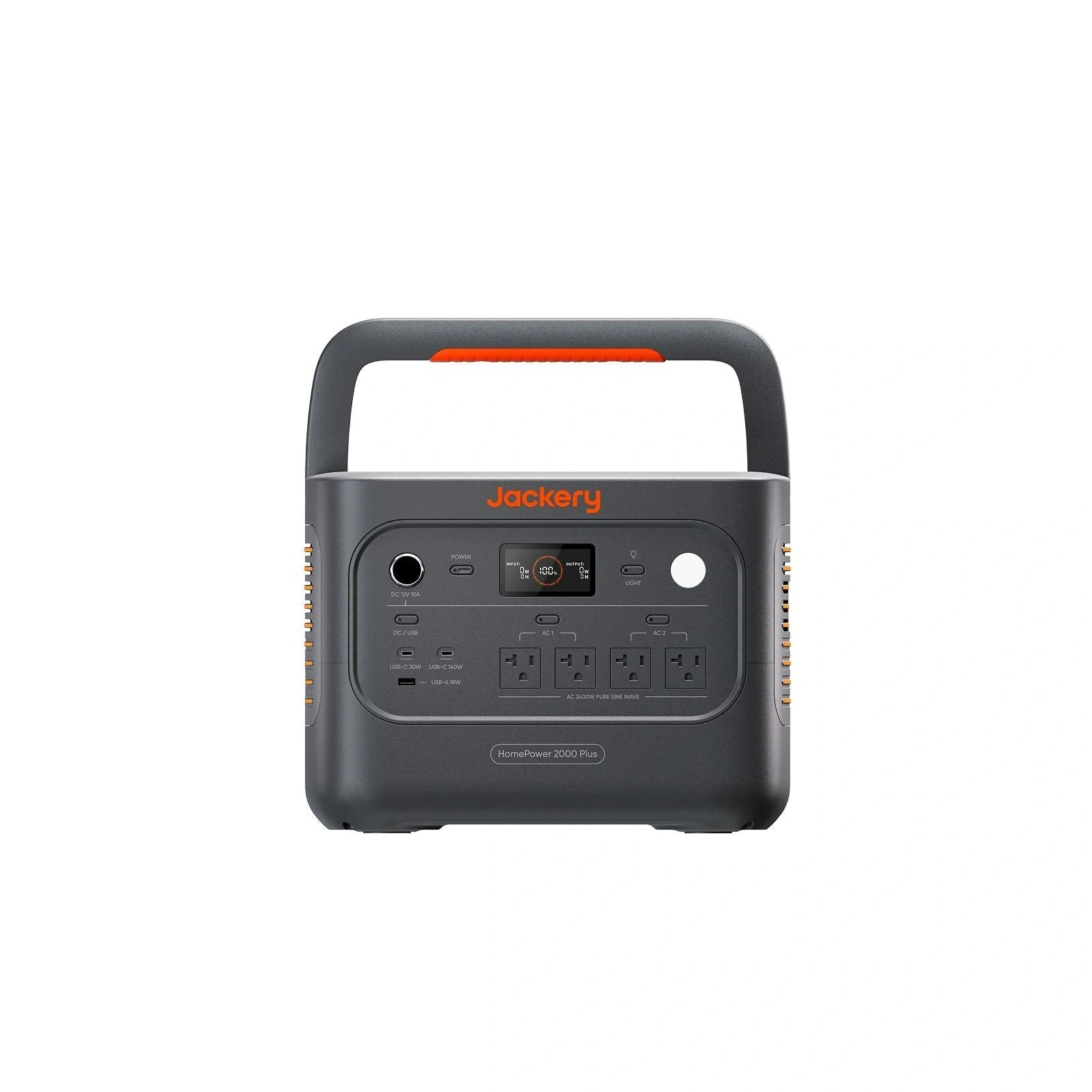
This is a 120 V, pure-sine AC station with four household receptacles. The manual rates the station at 2,400 W total and gives 4,800 W as its surge peak. Those four sockets do not provide four separate 2,400 W circuits: all connected AC loads share one station-wide ceiling. Compare the continuous demand and startup surge of each appliance, and remember that USB and 12 V devices also draw from the same battery. A 240 V appliance or split-phase home connection is outside the single-station plan; more stored energy does not create a second voltage leg.
Capacity is 2,048 Wh of LFP nameplate storage. Jackery specifies 6,000 cycles to at least 70% capacity, but that is a manufacturer battery-life rating, not a third-party cycle test or a calendar-life promise. The reviewed documents do not give a manufacturer-published AC-usable-energy figure at a stated load. So do not turn 2,048 Wh into a precise runtime guarantee. Add up the wattage of the loads you actually need, account for compressor starts and duty cycles, and plan for conversion loss and temperature rather than treating the nameplate as delivered AC energy.
Useful direct ports, but keep the small loads in perspective
The front panel provides four AC receptacles, one 12 V/10 A output rated at 120 W, USB-A up to 18 W, and two USB-C ports rated at 30 W and 140 W. That combination can simplify a mixed setup of a few household devices and modern USB-C electronics. It does not make the unit an unlimited power strip: the AC sockets share the 2,400 W ceiling, the 140 W USB-C maximum depends on a suitable device and cable, and published port maxima should not be added together as if each were an independent battery. The station weighs about 41.45 lb (18.8 kg) and measures 14.4 by 10.0 by 10.7 inches. That is carryable for many users, but still a substantial object for repeated stairs or solo vehicle loading.
Solar capability is not solar equipment in this box
The station accepts up to 800 W of solar input over two DC8020 ports, with a 16–60 V input range, 12 A per port and 21 A combined maximum. These are station limits, not a guarantee that any arbitrary panel wiring will work. Use Jackery’s compatibility and connection instructions, observe the voltage and current limits, and do not assume the port pair acts as two unconstrained independent trackers. The standalone SKU’s box list identifies the station and AC cable only. It does not include SolarSaga panels or a solar charging lead. If you want an out-of-box solar kit, compare the separate selected offer rather than buying from the station’s 800 W headline alone.
Expansion adds energy, not inverter power
One HomePower 2000 Plus v2 can connect up to five compatible Battery Pack 2000 Plus v2 modules. That gives a later expansion route, but the standalone SKU reviewed here includes none. Adding a pack increases the storage plan; the station remains a single 120 V / 2,400 W inverter. The v2 name matters: Jackery specifically warns that the older Battery Pack 2000 is not interchangeable with the Battery Pack 2000 Plus v2. For a buyer who knows more capacity is needed from day one, the separately reviewed station-plus-pack SKU is a more precise comparison than mentally adding a future accessory to the base package.
Backup use has important boundaries
Jackery specifies a 10 ms transfer time for UPS operation, but the manual says this is not 0 ms and warns against devices that require zero-time power, such as data servers or workstations. It also documents a bypass-mode limit: if current stays above 12 A for more than three hours, output is reduced to 12 A/1,440 W, and bypass output may be lower while charging and powering loads together. Treat this as a documented transfer feature, not an independently tested continuity guarantee for sensitive equipment. The station is not specified as weatherproof; keep it dry, ventilated and within its stated operating-temperature range.
Who should choose this exact option?
The standalone JHP-2000A makes sense when a buyer wants 2,048 Wh of stored capacity, a single 2,400 W / 120 V inverter and the option to expand later, but already has a charging plan and does not need a battery pack or panel included today. Compare it with smaller, lighter stations if the real load is only phones, networking gear or a compact cooler; compare a larger fixed or multi-unit setup if a load needs 240 V, a higher continuous AC rating, a transfer switch or whole-home integration. For long outages, assess the actual appliance schedule and charging source before choosing on capacity alone. For sensitive electronics needing 0 ms transfer, wet locations, or any 240 V requirement, this single-station configuration is not the right match.
Key details at a glance
| Nameplate battery capacity | 2048 Wh |
|---|---|
| Rated AC output | 2400 W |
| Manufacturer surge rating | 4800 W |
| Maximum solar input | 800 W |
| Included panels, combined nameplate | 0 W |
| Maximum USB-C output per port | 140 W |
| Listed weight | 41.45 lb |
| Compatible extra-battery expansion | Yes |
| 12 V DC output | 120 W |
| Maximum AC recharge input | 1800 W |
| Manufacturer UPS transfer figure | 10 ms |
| Base warranty term | 3 years |
| Total rated DC output | 120 W |
| AC outlet output | Yes |
| USB-C ports | 2 |
| USB-A ports | 1 |
| Solar input ports | 2 |
| 12 V car-style output | 120 W |
| Battery chemistry | LiFePO4 |
| Expansion battery in this package | No |
| Home Power Panel in this package | No |
| Separate station units in offer | 1 |
| Expansion packs in exact offer | 0 |
| Solar panels in exact offer | 0 |
Use the exact model’s instructions for operating limits, supplied equipment and version differences.
Sources for this assessment
- Jackery U.S. portable power station collection, observed row 15
- Jackery U.S. HomePower 2000 Plus v2 selected-option page
- Jackery U.S. exact option JSON for HomePower 2000 Plus v2
- Jackery HomePower 2000 Plus User Manual, model JHP-2000A
- Jackery HomePower 2000 Plus V2 Basic Information
- Jackery alternate Solar Generator route for same battery-bundle offer
- Exact JHP-2000A standalone selected-option image
- U.S. CPSC recall index, exact name/model search

A useful match starts with the loads that matter.
Use the finder for hard electrical requirements, then check appliance starting behavior, actual run time and the exact package in the full assessment.