
Your needs, this model
Does it fit your priorities?
Do you need two SolarSaga 200 panels supplied with the station?
The exact package lists two 200 W panels and two multifunctional charging cables; combined panel nameplate is 400 W.
Explore this need in the finder →Does each panel have strict current headroom below the station limit?
The linked JS-200E manual rates Imp at 11.5 A ±5%, close to the station’s 12 A per-port maximum; full-rating headroom across tolerance is not confirmed.
Explore this need in the finder →Must three or more panels be supplied in the selected box?
This exact package lists two panels, not three.
Explore this need in the finder →Do you need 240 V or capacity expansion?
The HomePower 3000 supplies 120 V only and has no compatible expansion battery path.
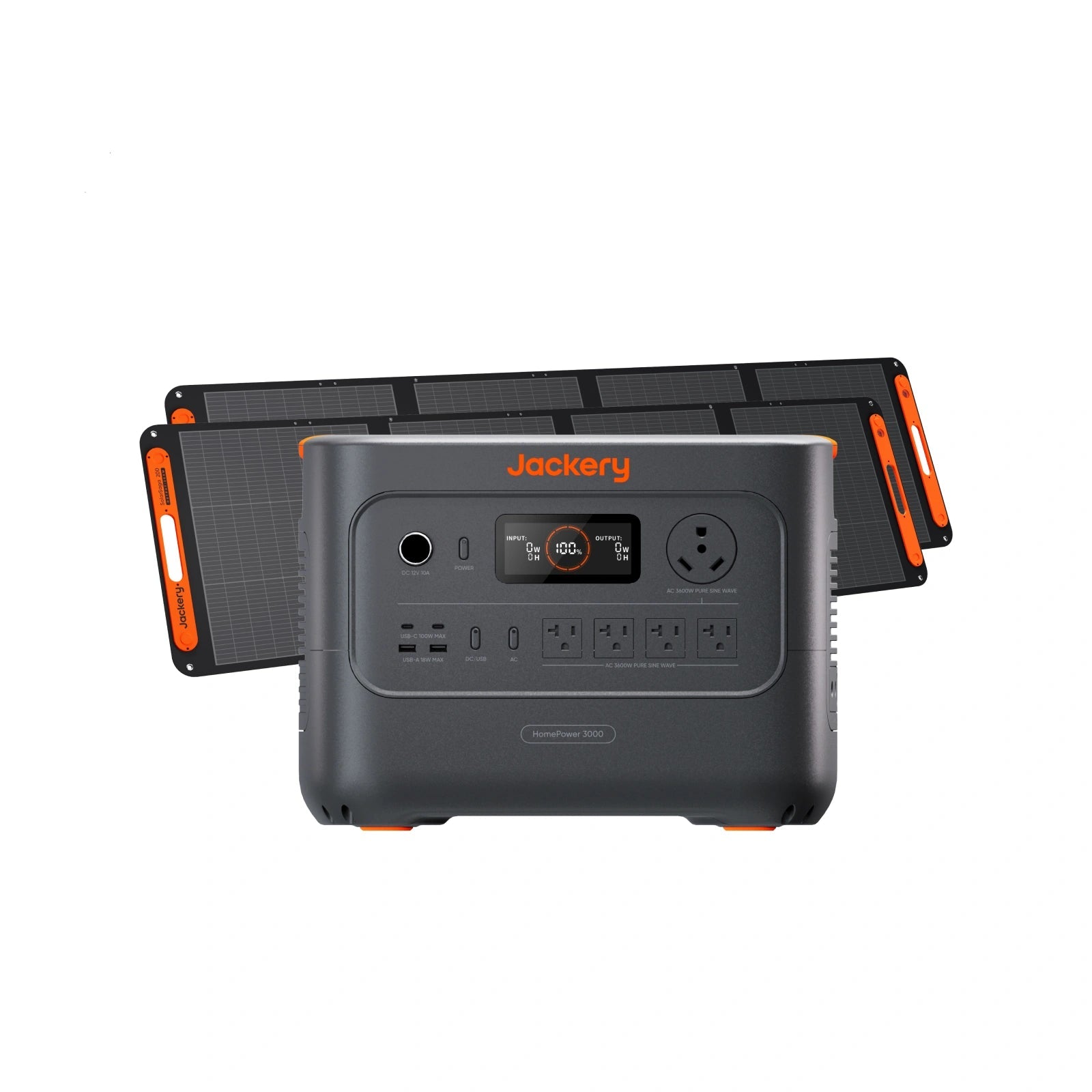
Explore this need in the finder →The HomePower 3000 + SolarSaga 200W × 2 option is the HomePower station with two folding SolarSaga 200 panels, two multifunctional solar charging cables and the AC charging cable. Its U.S. package SKU is 60-300020-US00080. The station itself is still a 3,072 Wh, 3,600 W, 120 V unit: the panels change what arrives for recharging, not the battery size, outlet voltage or AC output rating. This is the more complete solar-starting configuration of the two direct-page panel bundles if you prefer two 200 W panels to one 500 X panel.
Two panels, two input paths, no extra battery
Jackery rates each SolarSaga 200 at 200 W ±5% under its stated conditions, so the package’s combined panel nameplate is 400 W. The associated panel manual identifies the JS-200E version and lists 18 V ±5% maximum-power voltage and 11.5 A ±5% maximum-power current. Jackery’s HomePower 3000 documentation lists two DC8020 solar inputs, each with a 16–60 V range and 12 A maximum, up to 500 W on one input and 1,000 W total. The station manual says each input can accept one 500 W or up to two 200 W panels; this selected box instead includes two panels and two charging cables. The direct page does not show a separate model-specific panel SKU in the station bundle record, so this review describes the components by the name and ratings in the box list, while noting that the linked SolarSaga 200 manual covers JS-200E.
The cable matters: the SolarSaga 200 manual says its multifunctional charging cable is for the JS-200E panel, not a universal lead for other panels. The product page lists two such cables, so the package is more than two panels on a generic connector. Still, the panel manual’s 11.5 A ±5% current is close to the station’s 12 A per-port cap. The manufacturer sells the bundle and documents support for this panel class, but the published tolerance leaves little strict headroom at the maximum-current end. Do not assume that 400 W of nameplate panels will continuously become 400 W of station input, or that the two panels can be freely mixed with a different make or revision.
What stays fixed
The battery remains 3,072 Wh LFP, and the station has no compatible expansion-battery path. The five AC outlets are 120 V: four ordinary receptacles share a 2,400 W rating, while the TT-30 receptacle is rated 120 V/30 A; all AC output is capped at 3,600 W total with a listed 7,200 W surge. This is not split-phase 240 V. Jackery says the TT-30 can be used for an RV only with the required grounding adapter, so verify the specific vehicle and connector setup. The 3,072 Wh number is nameplate storage, not usable AC capacity or guaranteed runtime; a refrigerator’s compressor, inverter losses and cold conditions change the result.
The panel package may suit a home outage plan where two panels can be positioned outdoors while the station stays dry, ventilated and accessible. It is less attractive if the user needs the highest possible solar nameplate in a small panel count, an expansion battery for longer outages, or panels light enough to leave deployed in every weather condition. Jackery does not publish a water/dust rating for the station, and neither a solar bundle nor a marketing picture removes the need to follow both manuals for placement, cables and panel handling.
Do not treat a power station as home wiring or a zero-time UPS
The HomePower 3000’s UPS transfer is documented at up to 20 ms, not 0 ms; Jackery specifically warns against using it for sensitive servers or workstations that require a truly uninterrupted changeover. Its bypass-mode output while wall charging is limited to 1,440 W. The manual transfer switch is not in this box; a home circuit connection requires separately chosen equipment and a qualified electrician. A portable station should not be backfed through a wall outlet.
At about 59.5 lb, the station is heavy before adding the panels and cables; package mass is not listed as one number. Its charging range is 0–45°C and discharge is −15–45°C. Below −10°C, output is limited to 2,000 W. Direct purchases from Jackery are advertised with a three-year warranty plus a two-year extension, but verify the terms for the actual seller and registration. The product photograph is a composite manufacturer rendering showing the station and two panels, not a real tested kit.
Pick the two-panel SKU if the contents match your charging plan and you want the listed cables supplied. Pick the 500 X bundle for one larger panel, or the station-only version if you already own a compatible array. A buyer who needs higher storage, panel-array expansion or 240 V should compare a different station rather than infer a capability from the “3000” name.
Sources: Jackery HomePower 3000 product page and box contents; HomePower 3000 user manual; SolarSaga 200 user manual; Jackery Solar Generator Connection Guide.
Key details at a glance
| Nameplate battery capacity | 3072 Wh |
|---|---|
| Rated AC output | 3600 W |
| Manufacturer surge rating | 7200 W |
| Maximum solar input | 1000 W |
| Included panels, combined nameplate | 400 W |
| Maximum USB-C output per port | 100 W |
| Listed weight | 59.52 lb |
| Compatible extra-battery expansion | No |
| 12 V DC output | 120 W |
| Manufacturer UPS transfer figure | 20 ms |
| Base warranty term | 3 years |
| AC outlet output | Yes |
| USB-C ports | 2 |
| USB-A ports | 2 |
| Solar input ports | 2 |
| 12 V car-style output | 120 W |
| Battery chemistry | LiFePO4 |
| Expansion battery in this package | No |
| Home Power Panel in this package | No |
| Separate station units in offer | 1 |
| Smart Transfer Switch in this package | No |
| Expansion packs in exact offer | 0 |
| Solar panels in exact offer | 2 |
Use the exact model’s instructions for operating limits, supplied equipment and version differences.
Sources for this assessment
- Jackery U.S. portable power station collection snapshot
- Jackery U.S. HomePower 3000 product page
- Jackery U.S. product option JSON
- Jackery HomePower 3000 user manual (U.S. English section)
- Jackery HomePower 3000 Basic Information
- Jackery Solar Generator Connection Guide
- Jackery SolarSaga 200 user manual
- Exact selected-option Jackery product image
- U.S. CPSC HomePower 3000 product-name recall API query

A useful match starts with the loads that matter.
Use the finder for hard electrical requirements, then check appliance starting behavior, actual run time and the exact package in the full assessment.