
Your needs, this model
Does it fit your priorities?
Do you need a fixed-capacity 3 kWh, 120 V station rather than a 240 V or expandable system?
This station-only SKU supplies 3,072 Wh and 120 V AC, and Jackery says the HomePower 3000 does not support extra batteries.
Explore this need in the finder →Will a 120 V/30 A RV-style outlet fit your RV plan?
This exact HomePower 3000 has a TT-30 outlet rated at 120 V/30 A, but an RV grounding adapter is required and total output remains limited to 3,600 W.
Explore this need in the finder →Must the solar panels be in this exact box?
The station-only SKU contains no panel; its 1,000 W solar-input capability is not included hardware.
Explore this need in the finder →Would any required appliance fail without a 0 ms UPS?
Jackery describes switching within 20 ms and explicitly says this is not a zero-time UPS.
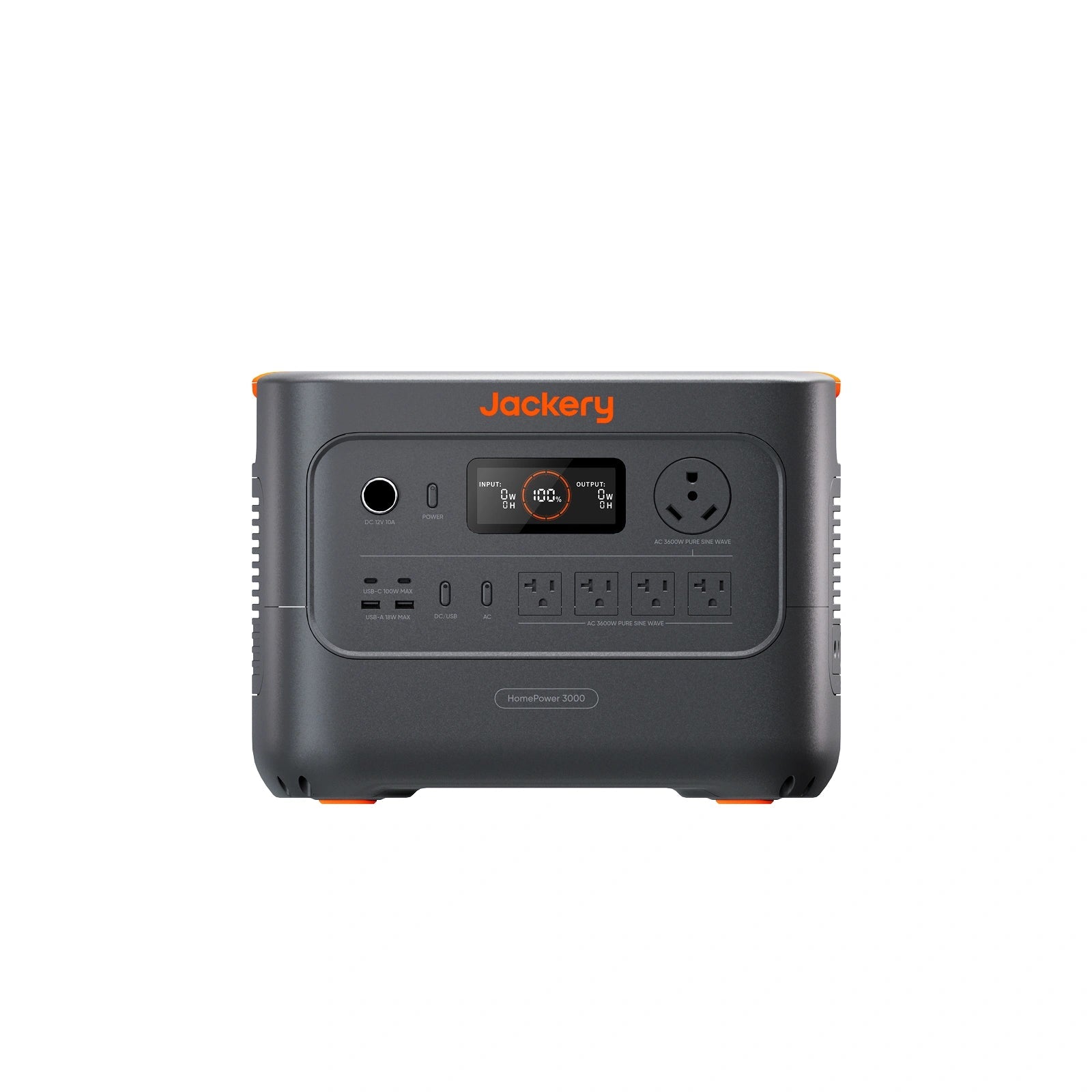
Explore this need in the finder →The Jackery HomePower 3000 is a fixed-capacity 3,072 Wh station for a buyer who wants substantial 120 V backup from one box, including a dedicated RV-style TT-30 outlet, and does not require 240 V or a later expansion battery. Its selected U.S. station-only option is SKU 21-0001-000337; the box list names the station and an AC charging cable, not solar panels, an extra battery or a home transfer switch. One identity detail remains unresolved: the product manual cover says JHP-3000C, while Jackery’s newer HomePower 3000 support table says JE-3000B. The direct product page identifies the retail item by its HomePower 3000 name and SKU but does not reconcile those codes, so this review keeps the exact retail identity and does not silently choose one model code.
One strong 120 V plan, with outlet-specific limits
Jackery lists a 3,072 Wh LiFePO₄ battery, 3,600 W total continuous AC output and a 7,200 W surge figure. The front panel combines four 120 V/20 A receptacles whose combined rating is 2,400 W with one 120 V/30 A TT-30 receptacle rated up to 3,600 W. Those ratings are not additive: all five AC outlets share the 3,600 W station ceiling. A TT-30 connector can be useful for a compatible RV inlet, but it does not make this a 240 V source. Jackery’s FAQ says RV use requires a grounding adapter; confirm the exact RV inlet and grounding arrangement in the current manual rather than treating a plug shape as proof of compatibility.
The 3,072 Wh capacity is battery nameplate energy, not guaranteed AC energy delivered to a refrigerator, pump or heater. Inverter losses, the device’s cycling pattern, ambient temperature and the load’s starting surge all matter. The published 7,200 W surge number is not a promise that every compressor or motor will start. Make a list of the actual running watts and startup behavior, and leave margin. This station can be attractive for selected essentials and a 120 V RV plan; it is not a substitute for checking each appliance or for a 240 V well pump or range.
Solar capability is not solar in the station-only box
The unit has two DC8020 solar inputs, with a published 16–60 V range and 12 A per port; Jackery lists up to 500 W on a single input and 1,000 W across both. The station manual describes one 500 W panel or up to two 200 W panels per input, with a separate solar-panel connector needed when combining panels on one input. The base SKU includes no panel. The two package reviews below cover the actual direct-page choices: one SolarSaga 500 X, or two SolarSaga 200 panels and two multifunctional solar charging cables. Either bundle leaves the station’s battery capacity and AC ceiling unchanged. Jackery says not to mix panel models or mismatch panel counts across the two inputs when connecting arrays through a panel connector.
Current limits deserve more attention than a single “500 W” label. The SolarSaga 500 X manual lists 12.0 A ±5% at its maximum-power point; the SolarSaga 200 manual lists 11.5 A ±5%. Those are close to the station’s 12 A per-port ceiling. Jackery sells the named combinations and its manual explicitly lists these panel classes, but the published tolerance ranges do not prove every panel will deliver its full nameplate rating under every condition at the input limit. If full panel output is an essential engineering requirement, ask Jackery about the exact panel revision and input behavior instead of inferring it from a bundle image.
Heavy, fixed-capacity, and not a zero-interruption UPS
At about 59.5 lb and 16.4 × 12.8 × 12 inches, the station is a substantial object to move even though it is smaller than many home-backup units. Treat it as a placed appliance, not a day-hike battery. The published charging range is 0–45°C and the discharging range is −15–45°C; at the coldest −15 to −10°C band Jackery limits output to 2,000 W. The manual’s safety instructions require grounded use and call for dry, ventilated placement. A product-page rendering is not evidence of water or dust protection, and the manufacturer does not list an IP rating for this station.
Jackery documents UPS transfer within 20 ms and explicitly says this is not a 0 ms system; it warns against equipment such as data servers or workstations that require uninterrupted switching. The manual also notes that bypass output while connected to wall power is limited to 1,440 W. A transfer switch is separate equipment and household-circuit connection needs a compatible installation and a qualified electrician. Do not backfeed a home through an ordinary receptacle.
For a new direct-from-Jackery purchase the manufacturer advertises three years plus a two-year extension; check channel-specific warranty terms before buying elsewhere. Compare the station-only option if you already own compatible solar equipment or prefer to choose panels later. Choose the 500 X or two-200 W package if those exact panels are important; consider refurbished only if its shorter warranty and unknown unit history are acceptable. Skip this fixed 120 V design if you need 240 V, expansion, a guaranteed 0 ms UPS, or a lightweight unit to carry often.
Sources: Jackery HomePower 3000 U.S. product page; Jackery HomePower 3000 Basic Information; HomePower 3000 user manual.
Key details at a glance
| Nameplate battery capacity | 3072 Wh |
|---|---|
| Rated AC output | 3600 W |
| Manufacturer surge rating | 7200 W |
| Maximum solar input | 1000 W |
| Included panels, combined nameplate | 0 W |
| Maximum USB-C output per port | 100 W |
| Listed weight | 59.52 lb |
| Compatible extra-battery expansion | No |
| 12 V DC output | 120 W |
| Manufacturer UPS transfer figure | 20 ms |
| Base warranty term | 3 years |
| AC outlet output | Yes |
| USB-C ports | 2 |
| USB-A ports | 2 |
| Solar input ports | 2 |
| 12 V car-style output | 120 W |
| Battery chemistry | LiFePO4 |
| Expansion battery in this package | No |
| Home Power Panel in this package | No |
| Separate station units in offer | 1 |
| Smart Transfer Switch in this package | No |
| Expansion packs in exact offer | 0 |
| Solar panels in exact offer | 0 |
Use the exact model’s instructions for operating limits, supplied equipment and version differences.
Sources for this assessment
- Jackery U.S. portable power station collection snapshot
- Jackery U.S. HomePower 3000 product page
- Jackery U.S. product option JSON
- Jackery HomePower 3000 user manual (U.S. English section)
- Jackery HomePower 3000 Basic Information
- Jackery Solar Generator Connection Guide
- Exact selected-option Jackery product image
- U.S. CPSC HomePower 3000 product-name recall API query

A useful match starts with the loads that matter.
Use the finder for hard electrical requirements, then check appliance starting behavior, actual run time and the exact package in the full assessment.