
Your needs, this model
Does it fit your priorities?
Do you need both 7.168 kWh of nameplate storage and an included panel?
This option lists one station, one Battery Pack 3600 and one SolarSaga 500 X; AC stays at 120 V/3,600 W.
Explore this need in the finder →Can the solar panel operate at every rating and tolerance inside the 12 A input limit?
The package is manufacturer-listed, but JS-500A current specs meet or exceed the per-port limit; a strict full-rating match is not asserted.
Explore this need in the finder →Is 240 V a nonnegotiable requirement?
This is one station plus battery and panel, not the two-unit Double Kit.
Explore this need in the finder →The “7.2 kWh + SolarSaga 500 X” option is a three-piece power plan: one JHP-3600A station, one JBP-3600A Battery Pack 3600 and one 500 W SolarSaga 500 X, sold under U.S. SKU 60-363650-US00124. The exact package is materially different from both the station-only offer and the 500 X-only bundle. Its value is the combination of added stored energy and a named panel—not higher AC output or 240 V operation.
Energy grows; the inverter does not
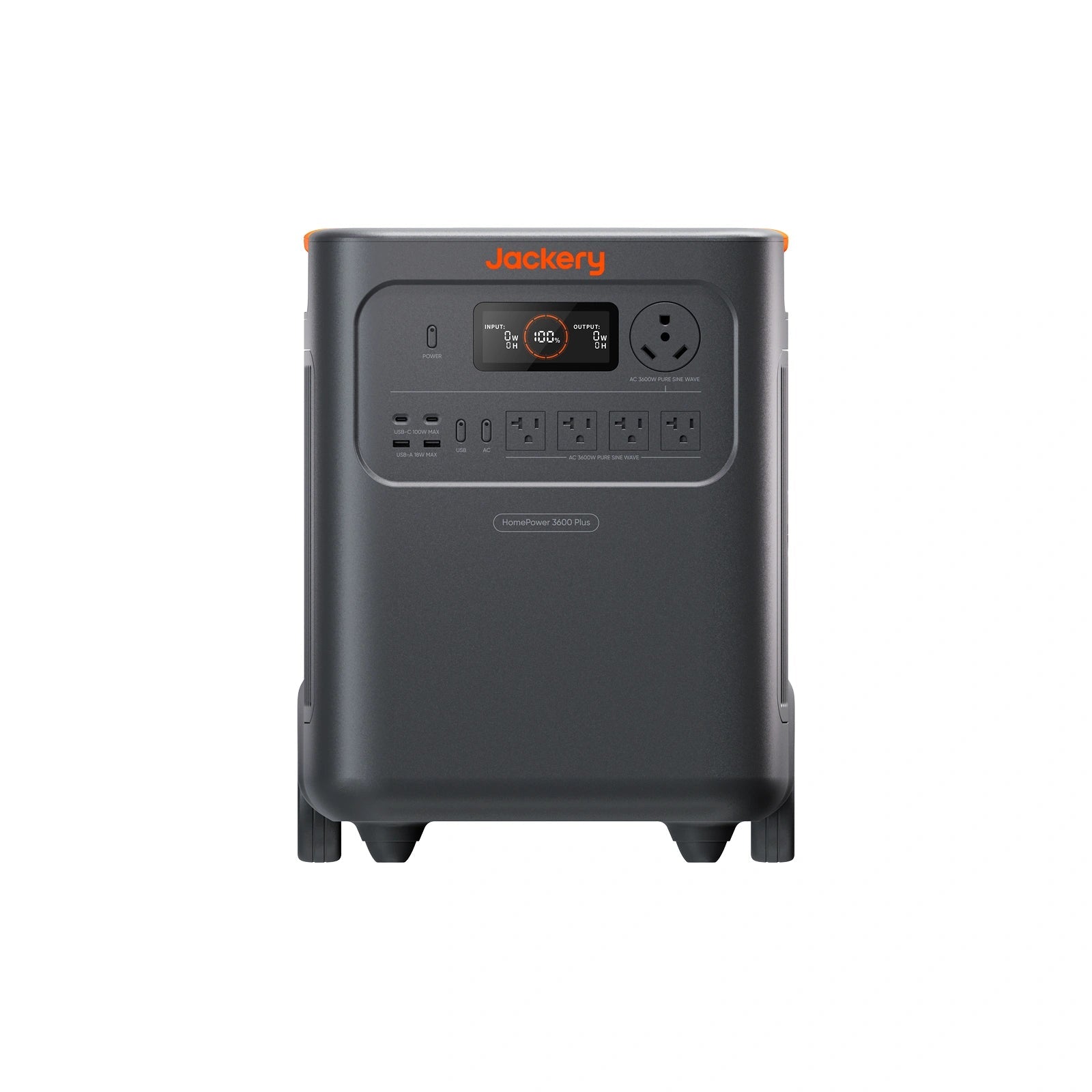
The station and expansion pack are each rated at 3,584 Wh, giving 7,168 Wh nameplate storage. The AC side remains one 120 V, 3,600 W station with a 7,200 W instantaneous surge ceiling. Four standard receptacles share 2,400 W, and one TT-30 outlet is rated 120 V/30 A; all are constrained by the same 3,600 W total output. A second battery may help a suitable 120 V load run longer, but it does not add an independent outlet bank or let the station exceed its rated AC load.
The primary components are heavy. The station is about 35 kg/77.2 lb, the pack about 25 kg/55.1 lb, and the SolarSaga 500 X about 10.5 kg/23.1 lb. Those named pieces together are roughly 155 lb before cables and any packaging. They are not one-person carry-on gear. Wheels and a handle help move the station on a clear path; the battery and large folding panel remain separate handling tasks. Keep the station and pack indoors or protected from wet and dusty exposure—Jackery does not claim water/dust resistance for the station.
One panel is not a 500 W recharge guarantee
The panel’s model-specific U.S. manual section identifies the SolarSaga 500 X as JS-500A. It rates 500 W ±5% at STC, 41.7 V and 12.0 A at maximum power (with a ±5% tolerance); the manual’s short-circuit current is 13.02 A ±5%. The station accepts 16–60 V and 12 A per DC8020 port, up to 1,000 W combined. The panel’s nameplate wattage is below the combined station limit, but its current rating sits at the one-port ceiling. Although this is an official product option, the selected configuration cannot be treated as a guaranteed full-nameplate harvest. A strict all-panels-at-published-ratings requirement should remain unsatisfied unless the manufacturer provides a more specific operating allowance.
The station ports are parallel rather than independent trackers. Jackery’s instructions support one, two or four panels; when both inputs are used, panel model and quantity must match between ports, while three panels and mixing 100 W with 200 W across the inputs are not supported. Vehicle and solar charging cannot run together, while AC plus solar is supported. The battery pack is installed using its expansion cable with both components powered off and side ventilation kept clear; the solar hardware is a separate charging path, not a substitute for that battery link.
What the package solves—and what it leaves open
This option comes closer to a self-contained energy-and-solar setup than buying a station alone, and the named panel makes it easier to identify what you are getting. Its image is a selected-option manufacturer composite, but it depicts the station and panel without clearly showing the battery pack. The pack is confirmed by the exact option’s box list and identity, not by that rendering. Verify the solar cable included with the selected package before relying on charging straight from the carton; the station-only SKU and other package lists do not supply that fact automatically.
For a home or RV buyer whose critical devices fit a 120 V/3,600 W shared ceiling, this configuration combines a longer energy reserve with one panel for replenishment. It will not run a 240 V load, make a 3,600 W appliance run longer than the energy allows, or provide a universal outage runtime. Nameplate watt-hours are not delivered AC energy; estimate runtime from actual load and conversion losses. If 240 V is the requirement, the Double Kit is a separate two-station connection system. If you only need extra capacity and already own compatible solar, the battery-only option avoids paying for a panel you will not use.
Finally, Jackery’s support page describes up to 20 ms transfer and explicitly excludes true zero-time UPS use. The manual’s shorter figure does not remove the warning. Bypass mode is limited to 1,440 W, and sensitive equipment should be checked and tested under its own requirements. Choose the package for energy and solar as separate capabilities, not as a promise that every household load or high-current panel will operate at its theoretical maximum.
Key details at a glance
| Nameplate battery capacity | 7168 Wh |
|---|---|
| Rated AC output | 3600 W |
| Manufacturer surge rating | 7200 W |
| Maximum solar input | 1000 W |
| Included panels, combined nameplate | 500 W |
| Maximum USB-C output per port | 100 W |
| Listed weight | 77.16 lb |
| Compatible extra-battery expansion | Yes |
| 12 V DC output | 120 W |
| Maximum AC recharge input | 1720 W |
| Manufacturer UPS transfer figure | 20 ms |
| Base warranty term | 3 years |
| AC outlet output | Yes |
| USB-C ports | 2 |
| USB-A ports | 2 |
| Solar input ports | 2 |
| 12 V car-style output | 120 W |
| Battery chemistry | LiFePO4 |
| Expansion battery in this package | Yes |
| Home Power Panel in this package | No |
| Separate station units in offer | 1 |
| Expansion packs in exact offer | 1 |
| Solar panels in exact offer | 1 |
Use the exact model’s instructions for operating limits, supplied equipment and version differences.
Sources for this assessment
- Jackery U.S. portable-power-station collection
- Jackery U.S. HomePower 3600 Plus product page
- Jackery HomePower 3600 Plus option JSON
- Jackery HomePower 3600 Plus alternate-route option JSON
- Jackery HomePower 3600 Plus User Manual, JHP-3600A
- Jackery HomePower 3600 Plus Basic Information
- U.S. CPSC recall index/name-model query
- Jackery Battery Pack 3600 User Manual, JBP-3600A
- Jackery SolarSaga 500 X User Manual, U.S. JS-500A section
- Jackery Solar Generator Connection Guide
- Exact HomePower 3600 Plus selected-option manufacturer image

A useful match starts with the loads that matter.
Use the finder for hard electrical requirements, then check appliance starting behavior, actual run time and the exact package in the full assessment.