
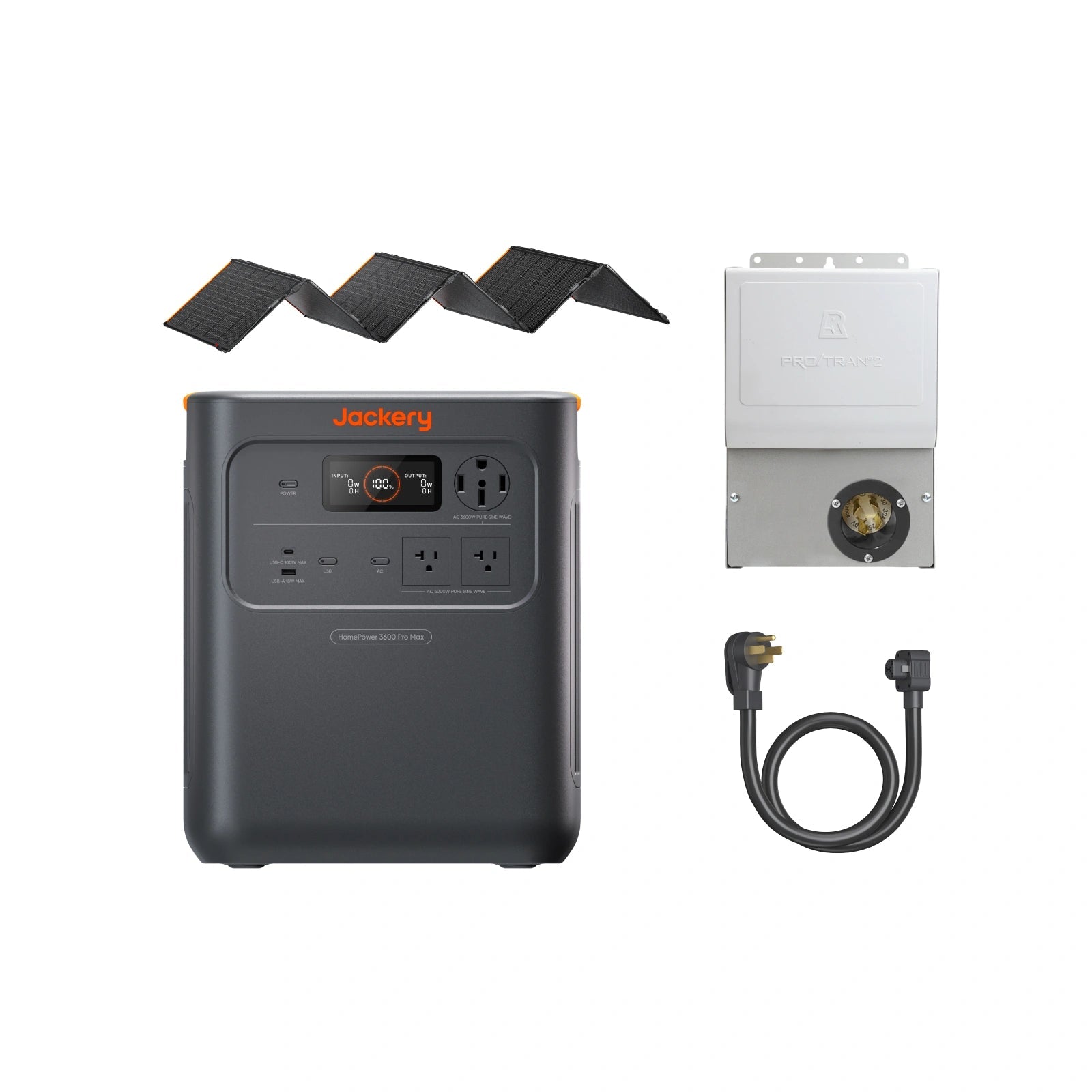
Your needs, this model
Does it fit your priorities?
Are the panel and MTS both included?
SKU 60-360050-US00476 selects one SolarSaga 500 X plus MTS and 40A charging cable; the MTS model/circuit count is not stated.
Explore this need in the finder →Does this package include the expansion battery?
No. One JHP-3600C remains at 3,584 Wh; the one-pack package is a distinct SKU.
Explore this need in the finder →Does MTS installation require trade qualification?
Yes. The MTS instructions say qualified-electrician installation; no switch circuit count is inferred from the offer.
Explore this need in the finder →SKU 60-360050-US00476 combines one JHP-3600C station, one SolarSaga 500 X, a Manual Transfer Switch, a 40A charging cable and an AC cable. This is the Pro Max package for someone who wants both a solar panel in the box and the transfer switch hardware for selected home circuits. It still contains only one 3.584 kWh station and one panel; it does not include a Battery Pack HomePower 3600 or a second station. It is a distinct setup, not a promise of whole-home autonomy out of the carton.
The operating plan remains bounded
The station supplies 120 V and 240 V from one inverter. The manual rates the two 120 V NEMA 5-20R ports up to 2,000 W each, 4,000 W combined, and the NEMA 14-50R up to 4,000 W at 240 V; 8,000 W is the surge peak. Loads on selected circuits must fit the station and transfer equipment limits, with room for appliance startup. The 14-50 connector does not mean a 50 A inverter. Battery nameplate watt-hours are not the same as usable AC energy, so size the system from your appliance schedule rather than treating a panel package as an all-day runtime claim.
For a house connection, the MTS routes only the circuits for which it is professionally installed. The attached instruction manual warns that installation must be done by a qualified electrician and describes branch-circuit, breaker and multi-wire circuit requirements. The selected product option does not name an exact MTS model or circuit count, so have the installer verify that the delivered switch matches the planned circuits. Neither the MTS nor 40A cable raises the station's battery output; this is not a substitute for an electrical design.
Panel value and an important current edge
The box includes one JS-500A SolarSaga 500 X. The station's two DC8020 inputs accept 16–60 V, 12 A each, 24 A combined and up to 1,200 W overall. The panel's own manual lists 500 W ±5%, 41.7 V ±5% at maximum power and 12.0 A ±5%. The panel's nominal current is already at the station's input limit. This exact package is sold by Jackery, but its printed tolerances are not evidence that a user will receive an uninterrupted 500 W or that a 5% upper tolerance becomes an accepted 12.6 A input. Expect output to vary with sunlight and the station's limit; the exact cable arrangement also matters. The product's box list names the panel but not an extra DC charging lead, so its inclusion is not marked confirmed here.
The station supports matching panels across its parallel channels; the manual says to use the same panel model and quantity on both inputs, and does not support solar and car charging at the same time. This package's one panel is not itself proof of the system's full 1,200 W possible solar ceiling. If a user's essential plan requires two or four panels, those additional panels and the compatible connection arrangement are separate decisions.
When to choose this over adjacent options
The panel-plus-MTS package is relevant when both the 500 W-labelled panel and transfer switch must be bundled, and the home will be prepared professionally. It should match a solar-panel-included requirement and a manual-transfer-switch-included requirement together. It should not match a battery-included requirement or a 7,000 Wh minimum. If a single panel is unnecessary, the MTS-only variant avoids redundant solar hardware. If longer outage duration is the priority, the battery+500W+MTS option adds a compatible expansion pack; if more simultaneous inverter power is the requirement, the two-station kit is materially different. The station's UPS mode is stated as under 10 ms, not zero, and the manual advises testing device compatibility. For zero-millisecond loads or a do-it-yourself electrical connection, this is the wrong package.
Sources: Jackery product page; HomePower 3600 Pro Max manual; SolarSaga 500 X manual; Manual Transfer Switch manual.
Key details at a glance
| Nameplate battery capacity | 3584 Wh |
|---|---|
| Rated AC output | 4000 W |
| Manufacturer surge rating | 8000 W |
| Maximum solar input | 1200 W |
| Included panels, combined nameplate | 500 W |
| Maximum USB-C output per port | 100 W |
| Listed weight | 73.85 lb |
| Compatible extra-battery expansion | Yes |
| 12 V DC output | 120 W |
| Manufacturer UPS transfer figure | 10 ms |
| Base warranty term | 3 years |
| AC outlet output | Yes |
| USB-C ports | 1 |
| USB-A ports | 1 |
| Solar input ports | 2 |
| 12 V car-style output | 120 W |
| Battery chemistry | LiFePO4 |
| Expansion battery in this package | No |
| Home Power Panel in this package | No |
| Separate station units in offer | 1 |
| Smart Transfer Switch in this package | No |
| Expansion packs in exact offer | 0 |
| Solar panels in exact offer | 1 |
Use the exact model’s instructions for operating limits, supplied equipment and version differences.
Sources for this assessment
- Jackery U.S. HomePower 3600 Pro Max product page
- Jackery U.S. HomePower 3600 Pro Max product-option JSON
- Jackery HomePower 3600 Pro Max user manual (JHP-3600C)
- Jackery HomePower 3600 Pro Max Basic Information
- Jackery Battery Pack 3600 user manual (JBP-3600A)
- Jackery Battery Pack 3600 Plus support and compatibility
- Jackery SolarSaga 500 X user manual (JS-500A)
- Jackery Solar Generator Connection Guide
- Jackery Manual Transfer Switch installation/user manual
A useful match starts with the loads that matter.
Use the finder for hard electrical requirements, then check appliance starting behavior, actual run time and the exact package in the full assessment.