
Your needs, this model
Does it fit your priorities?
Do you need battery, solar and MTS together in the selected SKU?
SKU 60-363650-US00477 is the only current observed package that lists one pack, one 500 X panel, MTS and 40A cable.
Explore this need in the finder →Is 7,200 Wh a true capacity floor?
No: one 3,584 Wh station plus one 3,584 Wh pack is 7,168 Wh nameplate, below 7,200 Wh.
Explore this need in the finder →Can a single Pro Max guarantee full 500 W panel input?
No such performance is established: JS-500A current tolerance touches/exceeds the 12 A port ceiling at the upper end.
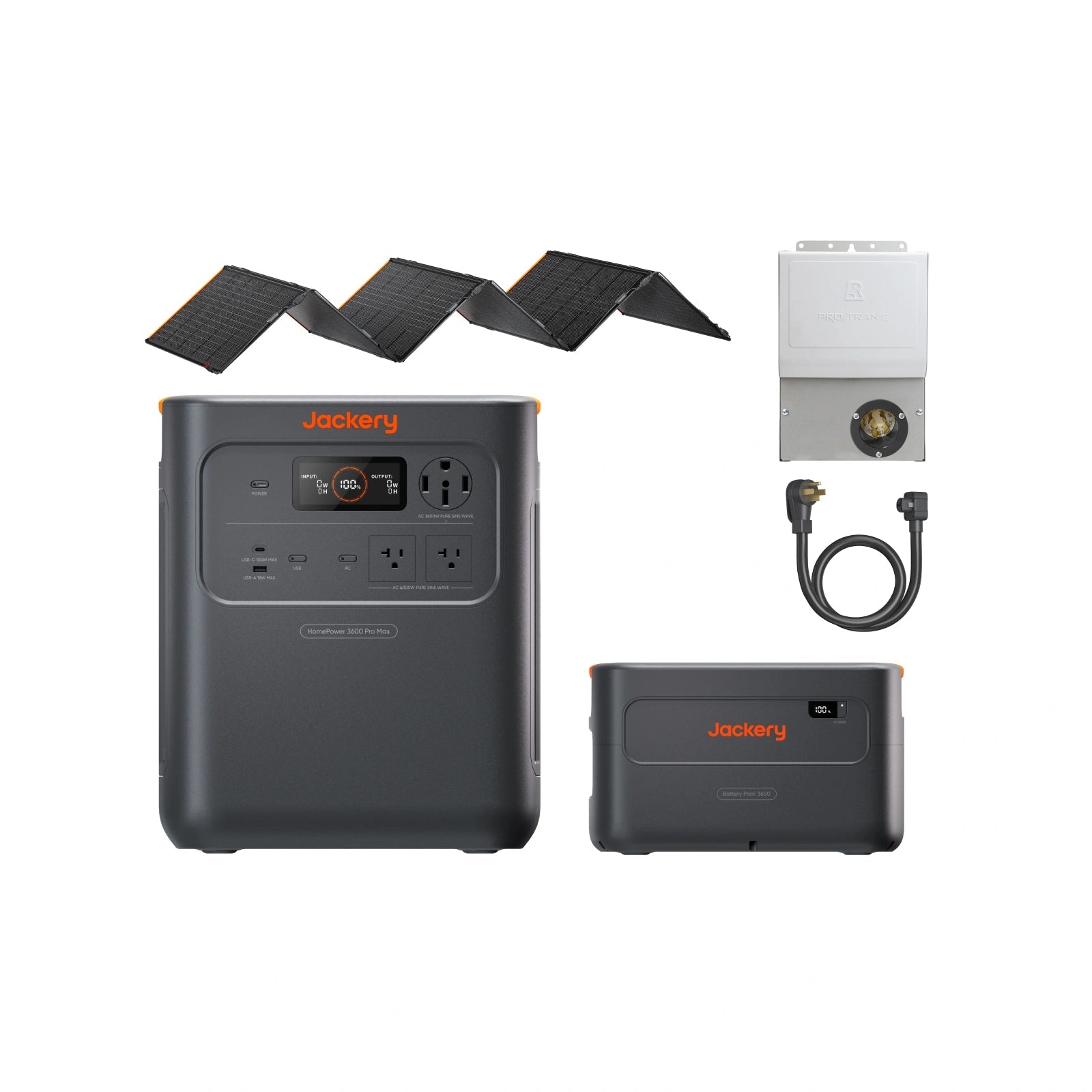
Explore this need in the finder →The exact bundle 60-363650-US00477 includes a HomePower 3600 Pro Max station, one Battery Pack HomePower 3600, one SolarSaga 500 X, a Manual Transfer Switch, a 40A charging cable and an AC cable. This is the broadest single-station package in the current product-option family: it arrives with extra nameplate storage, one panel and transfer hardware. It is not two power stations, does not add a second inverter and should not be treated as a ready-to-use home connection until a qualified electrician has installed and checked the included switch.
What the added pack changes—and what it does not
The station and compatible JBP-3600A pack are each rated 3,584 Wh, so the connected package represents 7,168 Wh nameplate storage. The station manual allows up to five expansion packs on one main unit. The battery pack improves potential duration but does not raise the station's 4,000 W rated AC output, 8,000 W surge peak or 1,200 W solar-input ceiling. The actual AC energy a household receives depends on inverter conversion, load, temperature, idle draw and operating settings; the capacity label is not a runtime estimate.
The station weighs about 73.85 lb and the pack about 55.1 lb, for about 129 lb across the two main battery modules before other kit contents. Put them on a stable, dry surface and leave the manual's ventilation space; both devices must be powered down before the expansion connection. This is a stationary backup kit with separate heavy components, not a lightweight carry-out camping setup. The dedicated Battery Pack support page names both the HomePower 3600 Plus and Pro Max as compatible, even though the older pack manual is titled for the Plus; that exact compatibility statement is why this bundle is treated as a valid Pro Max expansion configuration.
Solar is useful, but not a daily-energy promise
The bundled JS-500A panel has a 500 W ±5% STC nameplate. The station's parallel DC8020 inputs are rated 16–60 V and 12 A per port; the combined solar ceiling is 1,200 W. The panel's 12.0 A ±5% Imp meets the station's per-port limit at nominal current, so the station will be the limiting side at the tolerance edge. Actual harvest varies with sun, orientation, shading and temperature. The package's one panel will not fill a 7,168 Wh battery in every outage or on every day. A charging lead is not listed among this package's box contents, so do not count it as confirmed without checking the selected shipment; and the manual requires the same panel model and count across both channels if both are used.
The MTS and 40A cable add a route for selected branch circuits and the station's 240 V charge arrangement, respectively. The MTS manual warns that the transfer switch is for installation by a qualified electrician under local electrical requirements. Confirm breaker sizes, circuit count and compatibility with the actual switch model before depending on it. The selected offer does not provide an exact MTS circuit count. The station's 10 ms backup-transfer statement is manufacturer-published and 0 ms devices are explicitly unsupported; test all critical electronics. Under 120 V wall input, bypass output is only 1,440 W, so high loads can draw down the battery even while plugged in.
Fit by need, not by bundle size
Choose this configuration when an included extra battery, one SolarSaga 500 X and MTS hardware are all essential and you have a professional installation plan. A capacity floor between 3,584 and 7,168 Wh distinguishes it from the base single station; a 7,200 Wh requirement should fail. Requiring an included panel alone is not enough to identify this variant—other single-panel packages have less gear. If you need only longer runtime, the battery-only option omits the panel and MTS. If the key requirement is higher output for parallel 240 V backup, compare the two-unit package; this one still uses a single station inverter.
Sources: Jackery product page; HomePower 3600 Pro Max manual; Battery Pack 3600 Plus compatibility support; SolarSaga 500 X manual; Manual Transfer Switch manual.
Key details at a glance
| Nameplate battery capacity | 7168 Wh |
|---|---|
| Rated AC output | 4000 W |
| Manufacturer surge rating | 8000 W |
| Maximum solar input | 1200 W |
| Included panels, combined nameplate | 500 W |
| Maximum USB-C output per port | 100 W |
| Listed weight | 73.85 lb |
| Compatible extra-battery expansion | Yes |
| 12 V DC output | 120 W |
| Manufacturer UPS transfer figure | 10 ms |
| Base warranty term | 3 years |
| AC outlet output | Yes |
| USB-C ports | 1 |
| USB-A ports | 1 |
| Solar input ports | 2 |
| 12 V car-style output | 120 W |
| Battery chemistry | LiFePO4 |
| Expansion battery in this package | Yes |
| Home Power Panel in this package | No |
| Separate station units in offer | 1 |
| Smart Transfer Switch in this package | No |
| Expansion packs in exact offer | 1 |
| Solar panels in exact offer | 1 |
Use the exact model’s instructions for operating limits, supplied equipment and version differences.
Sources for this assessment
- Jackery U.S. HomePower 3600 Pro Max product page
- Jackery U.S. HomePower 3600 Pro Max product-option JSON
- Jackery HomePower 3600 Pro Max user manual (JHP-3600C)
- Jackery HomePower 3600 Pro Max Basic Information
- Jackery Battery Pack 3600 user manual (JBP-3600A)
- Jackery Battery Pack 3600 Plus support and compatibility
- Jackery SolarSaga 500 X user manual (JS-500A)
- Jackery Solar Generator Connection Guide
- Jackery Manual Transfer Switch installation/user manual
A useful match starts with the loads that matter.
Use the finder for hard electrical requirements, then check appliance starting behavior, actual run time and the exact package in the full assessment.