
Your needs, this model
Does it fit your priorities?
Is the compatible extra battery included and is 7,168 Wh sufficient?
Yes. The exact SKU includes one JBP-3600A pack; two 3,584 Wh nameplates total 7,168 Wh without raising one station’s 4,000 W output.
Explore this need in the finder →Must at least 7,200 Wh be available?
One station and one pack give 7,168 Wh nameplate, not 7,200 Wh.
Explore this need in the finder →Does the pack supply solar or a house switch in this option?
The exact SKU includes the station, pack and AC cable; no panel or MTS is listed.
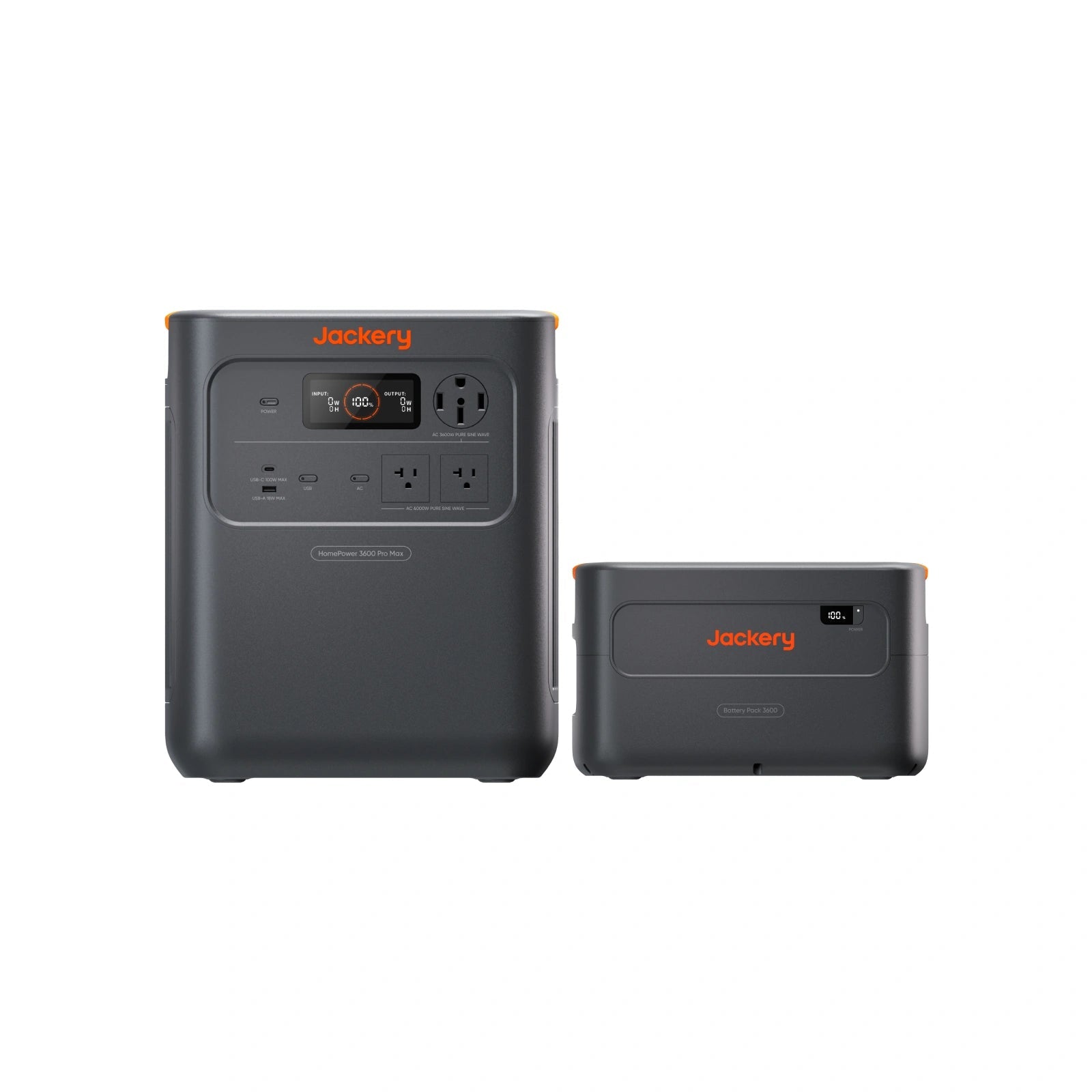
Explore this need in the finder →This package pairs one Jackery HomePower 3600 Pro Max (JHP-3600C) with one Battery Pack HomePower 3600 (JBP-3600A) and an AC charging cable. The exact U.S. package SKU is 60-363600-US00473. It is the capacity-first single-station choice in the Pro Max family: it supplies more nameplate stored energy than the base offer, but it does not include solar panels, a manual transfer switch or the 40A cable for the separate 240 V charging arrangement.
More storage, not a larger inverter
The main station and one expansion pack each list 3,584 Wh, making 7,168 Wh nameplate for this package when connected as directed. The station remains rated at 4,000 W continuous AC and 8,000 W surge peak; the extra battery adds stored energy, not another inverter or an 8,000 W single-box output. At 120 V, the manual rates each of the two NEMA 5-20R ports for 2,000 W with 4,000 W total; at 240 V, the NEMA 14-50R is rated 4,000 W. Decide what must run together and for how long, then leave margin for conversion losses, device starting behavior and the station's own draw.
Moving the pair also changes the practical footprint. The station weighs about 73.85 lb and the pack about 55.1 lb; together the listed component weights total roughly 129 lb before cables. They are separate boxes, which makes placement more flexible than one heavier combined appliance, but each still needs a safe lifting plan and ventilation clearance. The station manual says to power both pieces off before connecting and to leave at least 200 mm around the vents. Pack compatibility and connection order matter; do not hot-connect it or treat any 3.6 kWh battery with a similar connector as interchangeable.
Charging and backup equipment stay separate
The station supports two DC8020 solar inputs with 16–60 V operating range, 12 A per input and 1,200 W combined. This SKU does not supply a panel, so it only meets a solar-panel-in-box requirement if the shopper changes to a bundle. SolarSaga 500 X has a 500 W label, but the maker's manual lists 12.0 A ±5% and the station input is limited to 12 A per port; real solar output varies and the nameplate does not guarantee harvest. The charger manual requires matching models and panel counts on the two parallel inputs, and solar cannot be used with car charging at the same time.
The exact box contents also omit the MTS, 40A charge cable and panel. If the goal is outage backup through selected house circuits, choose a package that includes transfer equipment or plan to obtain it separately, and have a qualified electrician design and install it. The MTS manual warns against unqualified installation. A battery pack cannot by itself connect the station to a home panel. Similarly, more battery capacity does not change the 1,440 W bypass limit when using a 120 V wall input; high loads may continue drawing down the battery in pass-through operation.
Who benefits from this configuration?
Choose it when you want a longer-duration single-station plan and can handle a station plus a 55 lb expansion module. The finder should include it for an included compatible expansion battery and for a capacity floor above the standalone 3,584 Wh but no higher than this package's 7,168 Wh nameplate plan. It should fail a 7,200 Wh minimum, a required included panel or an included-transfer-switch requirement. If the hard requirement is more simultaneous power rather than longer runtime, compare the two-station kit; if a house-circuit connection must be in the box, compare an MTS package. For a lighter system or a simpler 120 V load plan, the base JHP-3600C is the less encumbered choice.
Sources: Jackery product page; HomePower 3600 Pro Max manual; Battery Pack 3600 manual; Jackery Battery Pack 3600 Plus compatibility support.
Key details at a glance
| Nameplate battery capacity | 7168 Wh |
|---|---|
| Rated AC output | 4000 W |
| Manufacturer surge rating | 8000 W |
| Maximum solar input | 1200 W |
| Included panels, combined nameplate | 0 W |
| Maximum USB-C output per port | 100 W |
| Listed weight | 73.85 lb |
| Compatible extra-battery expansion | Yes |
| 12 V DC output | 120 W |
| Manufacturer UPS transfer figure | 10 ms |
| Base warranty term | 3 years |
| AC outlet output | Yes |
| USB-C ports | 1 |
| USB-A ports | 1 |
| Solar input ports | 2 |
| 12 V car-style output | 120 W |
| Battery chemistry | LiFePO4 |
| Expansion battery in this package | Yes |
| Home Power Panel in this package | No |
| Separate station units in offer | 1 |
| Smart Transfer Switch in this package | No |
| Expansion packs in exact offer | 1 |
| Solar panels in exact offer | 0 |
Use the exact model’s instructions for operating limits, supplied equipment and version differences.
Sources for this assessment
- Jackery U.S. HomePower 3600 Pro Max product page
- Jackery U.S. HomePower 3600 Pro Max product-option JSON
- Jackery HomePower 3600 Pro Max user manual (JHP-3600C)
- Jackery HomePower 3600 Pro Max Basic Information
- Jackery Battery Pack 3600 user manual (JBP-3600A)
- Jackery Battery Pack 3600 Plus support and compatibility
- Jackery SolarSaga 500 X user manual (JS-500A)
- Jackery Solar Generator Connection Guide
- Jackery Manual Transfer Switch installation/user manual
A useful match starts with the loads that matter.
Use the finder for hard electrical requirements, then check appliance starting behavior, actual run time and the exact package in the full assessment.