
Your needs, this model
Does it fit your priorities?
Do you need the documented two-station 240 V plan?
The selected two-unit SKU includes the communication and 40A cables; manual documents 8,000 W through the second station’s NEMA 14-50R after specified setup.
Explore this need in the finder →Does the paired package include solar panels?
No panel is listed in SKU 60-360000-US00478; the package includes two stations and transfer/parallel charging hardware.
Explore this need in the finder →Can you rely on an 8,000 W surge figure for the pair?
No combined surge rating was established in the reviewed manual; do not extrapolate one.
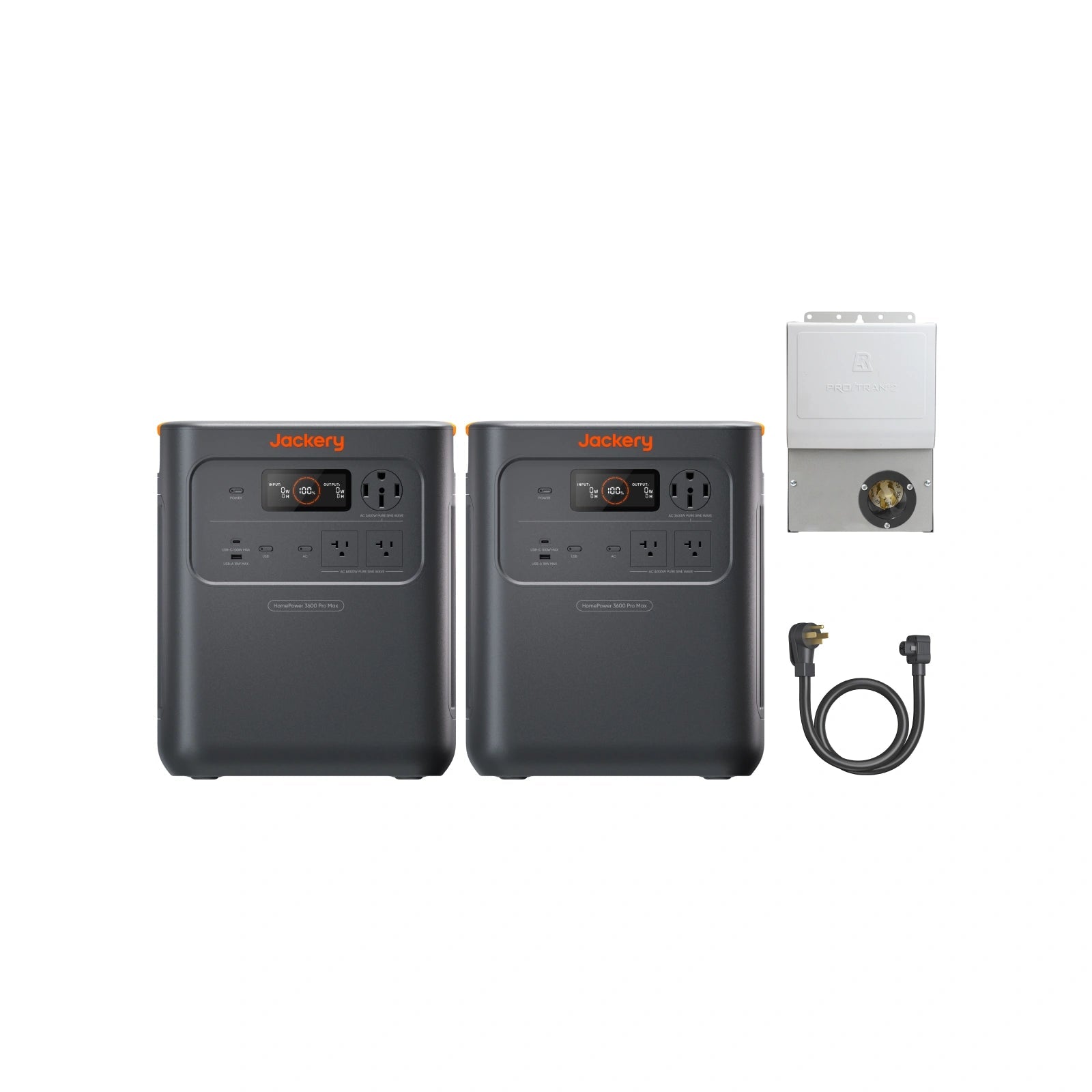
Explore this need in the finder →U.S. SKU 60-360000-US00478 is a two-station HomePower 3600 Pro Max package, not one oversized station. Its selected option lists two JHP-3600C units, a Manual Transfer Switch, a 40A charging cable and a parallel communication cable. Jackery labels the arrangement 7.2 kWh; the two individual 3,584 Wh nameplates sum to 7,168 Wh. The system is intended to be connected in cascade-parallel mode, so it is a different operating plan from buying two unrelated stations and plugging them into different loads.
Parallel output requires the full connection sequence
The manual says to power down and disconnect both units, join their parallel communication ports, then connect the first unit's NEMA 14-50R output to the second unit's AC expansion port using the 40A cable. It warns that omitting the communication step can prevent synchronization and may damage the equipment. In this supported two-unit arrangement, the manual rates output through the second unit's NEMA 14-50R for up to 8,000 W total. The package's MTS is part of the separate backup route. Do not apply 8,000 W to a single Pro Max, skip the cables or improvise a split-phase connection from two standalone outlets. If the communication or charging cable is missing, this combined plan is not established.
Two station bodies weigh about 147.7 lb together before the switch and cables. Each unit is separately portable only in the broad sense; neither is a hand-carry device for many users. The manual requires open space at their vents and safe placement. A station count does not turn the system into a compact travel kit. A two-unit setup is most useful for a fixed backup layout where its extra output and storage justify the wiring and floor space.
Transfer switch is not plug-and-play house wiring
The included manual transfer switch is used to feed selected household circuits through a professionally installed system. Its manual requires a qualified electrician and compliance with applicable electrical rules. The exact selected product page does not state the MTS model or number of circuits, so establish those details with the installer and shipment documentation rather than inferring them from the package name. The two stations do not power every home circuit automatically; your intended branch loads must fit the connected output, and their startup draw still needs separate checking. The MTS/cable package solves equipment inclusion, not load design.
The pair's two capacity labels add up to 7,168 Wh nameplate before conversion. That still does not promise 7.168 kWh at appliance outlets. Runtime depends on load shape, inverter losses and reserve settings. The units can each support compatible expansion packs according to the manufacturer, but none is included in this exact two-station offer. If future expansion is part of the plan, confirm a two-station-plus-pack wiring configuration with Jackery rather than assuming the single-unit accessory count applies unchanged to a cascade.
Who should choose two units?
This exact package fits someone who needs a documented 240 V backed-up circuit plan, wants the two station units and MTS/cables in the same order, and has an electrician for installation. It should match a 240 V need, a minimum of two station units or a 7,000 Wh capacity floor; it should fail a three-unit minimum and any demand for a panel in this package. A single JHP-3600C costs less in floor space and connection complexity when 4,000 W is enough. The one-battery configuration gives a single station more duration without the second inverter. This double kit is justified only when the actual load plan needs the cascade output, not because its product title advertises a higher aggregate watt-hour figure.
Sources: Jackery product page; HomePower 3600 Pro Max manual; Manual Transfer Switch manual.
Key details at a glance
| Nameplate battery capacity | 7168 Wh |
|---|---|
| Rated AC output | 8000 W |
| Maximum solar input | 1200 W |
| Included panels, combined nameplate | 0 W |
| Maximum USB-C output per port | 100 W |
| Listed weight | 73.85 lb |
| Compatible extra-battery expansion | Yes |
| 12 V DC output | 120 W |
| Manufacturer UPS transfer figure | 10 ms |
| Base warranty term | 3 years |
| AC outlet output | Yes |
| USB-C ports | 1 |
| USB-A ports | 1 |
| Solar input ports | 2 |
| 12 V car-style output | 120 W |
| Battery chemistry | LiFePO4 |
| Expansion battery in this package | No |
| Home Power Panel in this package | No |
| Separate station units in offer | 2 |
| Smart Transfer Switch in this package | No |
| Expansion packs in exact offer | 0 |
| Solar panels in exact offer | 0 |
Use the exact model’s instructions for operating limits, supplied equipment and version differences.
Sources for this assessment
- Jackery U.S. HomePower 3600 Pro Max product page
- Jackery U.S. HomePower 3600 Pro Max product-option JSON
- Jackery HomePower 3600 Pro Max user manual (JHP-3600C)
- Jackery HomePower 3600 Pro Max Basic Information
- Jackery Battery Pack 3600 user manual (JBP-3600A)
- Jackery Battery Pack 3600 Plus support and compatibility
- Jackery SolarSaga 500 X user manual (JS-500A)
- Jackery Solar Generator Connection Guide
- Jackery Manual Transfer Switch installation/user manual
A useful match starts with the loads that matter.
Use the finder for hard electrical requirements, then check appliance starting behavior, actual run time and the exact package in the full assessment.