
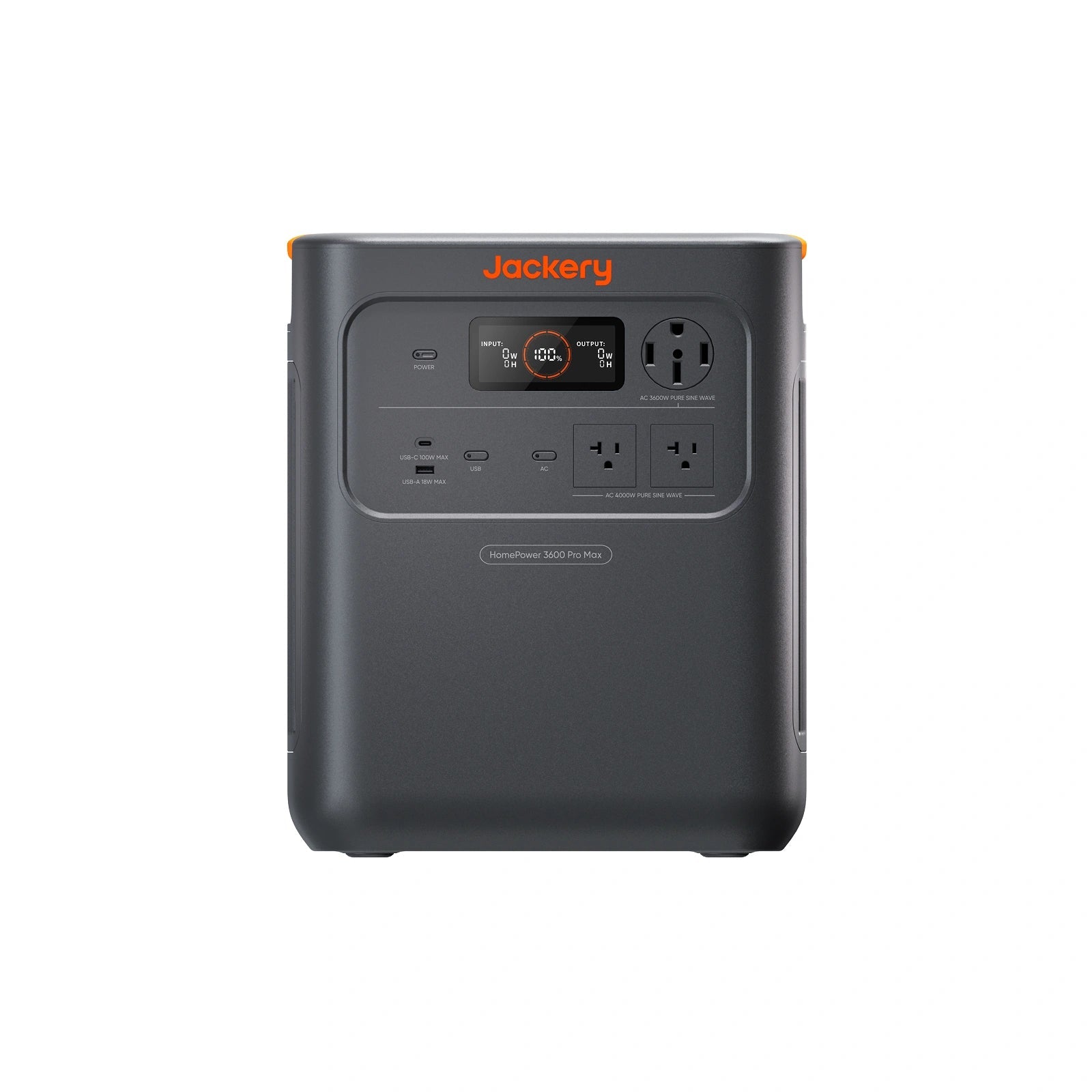
Your needs, this model
Does it fit your priorities?
Does one JHP-3600C meet a 240 V / 4,000 W rated load plan?
Yes: the manual gives the single NEMA 14-50R 4,000 W rated/8,000 W surge specification. It is still one 3,584 Wh station.
Explore this need in the finder →Must a solar panel arrive in this SKU?
No. SKU 21-0001-000430 is the station-only offer; solar support is not an included panel.
Explore this need in the finder →Do you need a transfer switch in the order?
The standalone option does not include MTS; the product supports an output connection, not a ready home-panel installation.
Explore this need in the finder →The HomePower 3600 Pro Max is a large, single-box power station for a load plan that may include both 120- and 240-volt equipment. The exact U.S. standalone option is model JHP-3600C, retail SKU 21-0001-000430. Its box lists one station and an AC charging cable; it does not include the expansion battery, SolarSaga panel, manual transfer switch or the 40A fast-charge cable. Similar-looking bundle choices add different gear, so the standalone profile is not a shortcut for the contents of another option.
Two voltages, a fixed inverter ceiling
The manual identifies a 3,584 Wh LiFePO₄ battery, 4,000 W rated AC output and 8,000 W surge peak. Its NEMA 14-50R supports 240 V at up to 4,000 W; the two NEMA 5-20R outlets each support up to 2,000 W at 120 V, with a 4,000 W total across the 120 V outlets. Those figures describe the station's limits, not a promise that a pump, compressor or other motor will start. Add the continuous draw of simultaneous loads and check each appliance's starting requirement separately. The NEMA 14-50 socket is a connector, not a 50-amp, 12-kW battery inverter.
Stored capacity is not delivered AC energy. Conversion loss, temperature, idle draw, reserve settings and the load pattern change actual runtime; Jackery does not publish a single AC runtime that applies to every home. Use appliance labels and a conservative reserve rather than multiplying the nameplate watt-hours into a guaranteed number of hours. At about 73.85 lb, the station itself is a two-person or careful lift for many households. It is a poor choice for frequent stair carrying; the visible feet in manufacturer renderings are not wheels.
Charging paths have different limits
For solar, the station has two DC8020 inputs, each rated 16–60 V and 12 A, with 24 A and 1,200 W combined. The manual says to use the same model and panel count on both parallel inputs; it documents one, two or four matched panels, not three. It also says not to use solar and the car-charging input simultaneously. SolarSaga 500 X is an optional exact package, not included with this standalone SKU. Its manual lists model JS-500A and a 500 W nameplate under standard test conditions, while its stated current tolerance meets the station's 12 A input limit at the edge. Actual harvest depends on sun and setup; neither the panel label nor the station's ceiling is a daily-energy guarantee.
The AC input accepts 100–120 V at up to 15 A. The manual describes a separate 240 V charge route using Jackery's 40A cable, sold separately in the standalone offer. A standard 120 V wall connection is not the same fast-charge arrangement as that 240 V cable. Vehicle charging is supported through a DC8020 car input, but the car cable is separately listed in the manual. The package does not include solar or vehicle charging leads simply because the station supports those routes.
Backup connection is a separate installation decision
One station can supply 120/240 V through its outlets, but it is not wired into household branch circuits by itself. Jackery's supported home-backup setup uses transfer equipment; the MTS is sold as a separate package or accessory. The supplied MTS manual warns that installation must be performed by a qualified electrician under applicable electrical requirements. A transfer switch routes selected circuits; it does not raise the station's 4,000 W continuous output or make every household circuit available at once. A whole-home promise is not an operating plan—list the circuits and loads with an electrician first.
The manual describes UPS switching within 10 ms and explicitly says zero-millisecond switching is unsupported. Treat that as a maker-stated figure, not an independent timing test. It warns against devices that require 0 ms and asks users to test device compatibility. AC bypass while charging is another limit: a 120 V input has a 1,440 W bypass ceiling. Above that, the station draws from its battery; if the battery empties, output may shut down and interrupt connected loads. Do not confuse the 4,000 W battery-mode rating with 4,000 W continuous pass-through from an ordinary wall outlet.
Who should shortlist the standalone?
This exact option suits someone who has a defined 120/240 V load plan, wants 3.584 kWh of LFP storage and will source solar, transfer gear or expansion separately only if needed. It is not a match when a panel or MTS must arrive in the same box, when 7.2 kWh is essential, when a 0 ms UPS is required, or when the household cannot safely move a heavy unit. Choosing 240 V in the finder will retain this one-unit plan; adding an included-battery, included-panel or transfer-switch requirement will instead favor the corresponding reviewed package. For extra runtime without a second inverter, compare the one-battery offer. For more output and stored energy, inspect the separately reviewed two-station configuration rather than assuming one station's connector changes its rating.
Sources: Jackery HomePower 3600 Pro Max product page; HomePower 3600 Pro Max user manual; Jackery support basic information.
Key details at a glance
| Nameplate battery capacity | 3584 Wh |
|---|---|
| Rated AC output | 4000 W |
| Manufacturer surge rating | 8000 W |
| Maximum solar input | 1200 W |
| Included panels, combined nameplate | 0 W |
| Maximum USB-C output per port | 100 W |
| Listed weight | 73.85 lb |
| Compatible extra-battery expansion | Yes |
| 12 V DC output | 120 W |
| Manufacturer UPS transfer figure | 10 ms |
| Base warranty term | 3 years |
| AC outlet output | Yes |
| USB-C ports | 1 |
| USB-A ports | 1 |
| Solar input ports | 2 |
| 12 V car-style output | 120 W |
| Battery chemistry | LiFePO4 |
| Expansion battery in this package | No |
| Home Power Panel in this package | No |
| Separate station units in offer | 1 |
| Smart Transfer Switch in this package | No |
| Expansion packs in exact offer | 0 |
| Solar panels in exact offer | 0 |
Use the exact model’s instructions for operating limits, supplied equipment and version differences.
Sources for this assessment
- Jackery U.S. HomePower 3600 Pro Max product page
- Jackery U.S. HomePower 3600 Pro Max product-option JSON
- Jackery HomePower 3600 Pro Max user manual (JHP-3600C)
- Jackery HomePower 3600 Pro Max Basic Information
- Jackery Battery Pack 3600 user manual (JBP-3600A)
- Jackery Battery Pack 3600 Plus support and compatibility
- Jackery SolarSaga 500 X user manual (JS-500A)
- Jackery Solar Generator Connection Guide
- Jackery Manual Transfer Switch installation/user manual
A useful match starts with the loads that matter.
Use the finder for hard electrical requirements, then check appliance starting behavior, actual run time and the exact package in the full assessment.